

Alas, Poor Caesar, I Knew Him Well……
Wait, wrong play! But, (hopefully) you get my playful pun 😉 But, in all seriousness, if you’re looking for the best way to introduce Shakespeare’s Julius Caesar to your students, this is the post for you!
Last week I started the play Julius Caesar with my face-to-face students. However, if I know anything about my students, it’s that they don’t know their history. Maybe it’s a sad commentary on public education or maybe you just never truly get history until you’re older.
Either way, I knew I’d have to build that background knowledge before they could jump into the play. Otherwise, how else will they know why the senators are conspiring against him or why the people loved Caesar so much or why Brutus‘s betrayal was the most heartbreaking?
I was only slightly saddened when one student finally raised his hand and said, “You said this is important to remember with what happens to Cesar later, but what happens to Cesar?” I didn’t think I was going to have to remind anyone about that bit… So SPOILERS for anyone who is not familiar with the entire history of Cesar- he does die.
Teaching the Rise of Caesar
Since Shakespeare’s play begins at the height of Caesar’s power and shortly before his death, I need my students to fully understand WHY so many loved Caesar and why so many Senators feared him.
To make sure I gave my students enough context on the historical circumstances to Caesar’s assassination, I poured over the history and even pulled in my history major husband to make the most detailed history lesson imaginable about Cesar. I made it even more complete with clips from HBO’s show, Rome.
We covered details of Caesars earlier life, his military campaigns, his pardoning of all the conspirators who later killed him, and much more.

Was Cesar a Tyrant or a Victim?
By the end of this history lesson, students are pretty pro-Caesar. They love what he’s done for the soldiers of Rome, the mercy he’s shown to his enemies, the way he lifted the common folks to the Senate, and his moxy.
It is easy then to pose the question, “With unlimited power, do you think he would have remained a good leader?”
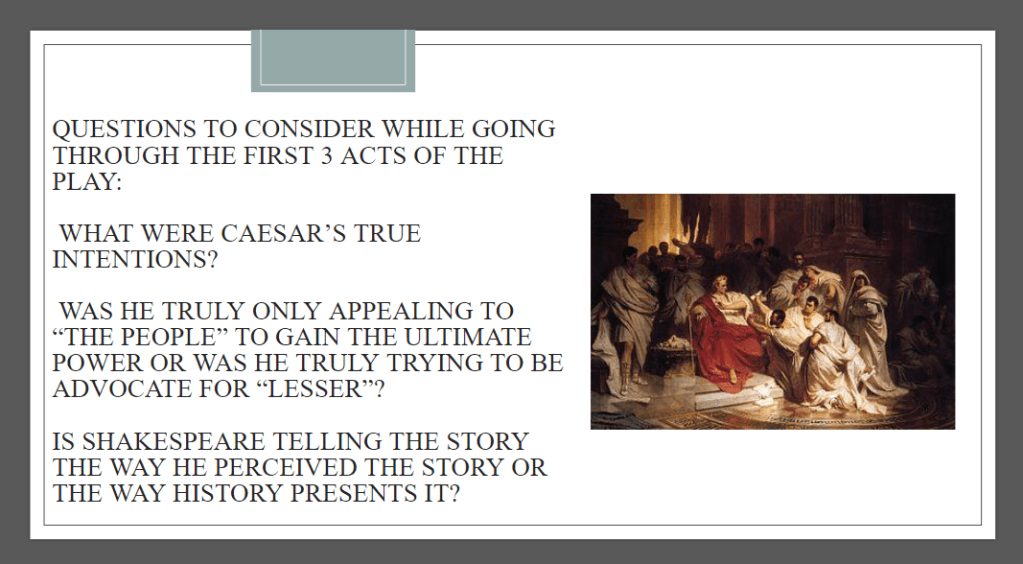
We’re left wondering a few things as we start Shakespeare’s Julius Caesar.
By anchoring my students in these questions before we begin the play, they are poised to analyze the motives and persuasive techniques the various characters use. In fact, we zero in on Act II when Brutus has a soliloquy. In this he goes back and forth with his feelings of loving Caesar but being afraid that he is becoming too powerful and that ultimate power would corrupt him.
However, we also see that Cassius is more self-serving. It appears his motivations are jealousy and looking power. So, to wrap up our analysis of Acts I-III, we conclude with a debate on whether or not assassinating Caesar was the correct thing. Where the assassin’s truly worried about Rome or were they more concerned with their own power?
All this to say, that making sure my students had a strong understanding of Julius Caesar the man before we covered Shakespeare’s portrayal made all the difference in my students understanding and enjoying this play!
Now, lets take a quick peek at some other tips you can use when teaching Shakespeare’s Julius Caesar.
Treating Shakespeare’s Caesar As A Film Study
A few years ago I started treating all of Shakespeare as a film study and it has been one of the best changes in my classroom! My students are far more engaged and actually get the material far better.
I started out the actual play by having them watch act one of the 1950s movie starring Marlon Brando. We then zeroed in and analyzed dialogue between Cassius and Brutus. I have my students breakdown Cassius’s persuasive techniques when speaking with Brutus in Act I Scene ii.

First they fill out the rhetorical triangle outline with details of the scene and then build an argumentative paragraph that is visually broken down for them. This method has been fantastic for my lower level learners as well as those who benefit from a more visual look (especially ESOL students).
I then continue this cycle of watching an act before we dive into the language of a selected scene. This way, students are not overwhelmed by sifting through the language and are still getting the themes we are trying to focus on.
These close reads are designed to help students consider the word choices Shakespeare made as well as the careful allusions he incorporated. By giving our students close reads, we are also boosting their overall literacy and inferencing skills.
They also become far more skilled in finding evidence within a text by having these guiding questions that they have to stop and ponder. Having students complete these close reads as we cover the play prepares them for the final project.

In my classroom that is a debate on whether or not the senators were just in their fears or if Caesar would have been a good “king”. For you, it may be a paper or a video essay! No matter what, these close reads, help students to critically think on the text and prepare.
Final Thoughts
No matter how you choose to teach Caesar, I highly recommend a heavy dose of history class before covering this Shakespearean play! If you’re not up making your own presentation, here is a link to the one I created and used! If you are need of any other Julius Caesar materials, I highly recommend MyShakespeare.com and my annotation bundle or my Acts I-III bundle that includes everything described here today and more!

Join my weekly newsletter!
Would you love to get weekly tips and resources for teaching secondary English delivered right to your inbox? Click here to join!
 Around the World With Mrs. C