

I don’t know about you, but the high school students at my school are dealing with some major gaps. One of the biggest gaps we have identified is vocabulary. We also know that vocabulary is one of the biggest hurdles to understanding a text.
In this post, I will be discussing 3 FREE AND FUN strategies that can be used to help teach vocabulary to your high school and middle school students. These activities also work well for all abilities (yay for strategies that fit our already jammed-pack schedules)!
Semantic Mapping
Semantic mapping is a powerful strategy that can greatly enhance vocabulary skills in students. By visually organizing related words and concepts, semantic mapping helps students understand the relationships between words and expand their knowledge of vocabulary. When students engage in semantic mapping activities, they actively explore connections between words, such as synonyms, antonyms, categories, and associations.
This process promotes deeper understanding and retention of vocabulary by allowing students to see the bigger picture and make meaningful connections. Semantic mapping encourages critical thinking, fosters word exploration, and expands students’ ability to express themselves more precisely and effectively. By incorporating semantic mapping into instruction, educators can empower students to develop a rich and interconnected web of vocabulary, enhancing their language skills across various subject areas.
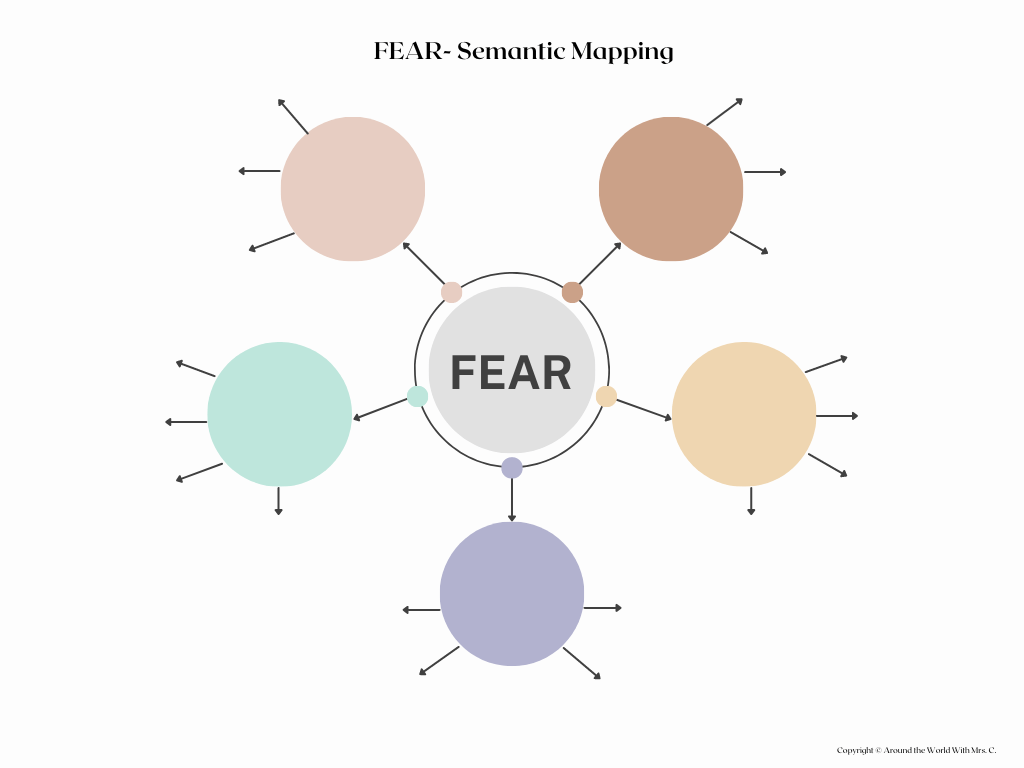
For example, in my Suspense unit, I have students begin with semantic mapping activity with the word FEAR. With these they are also engaging in the driving question of the unit: Why are humans drawn to stories that evoke suspense and fear? And taking this further by asking students to share their favorite ways to be “scared” (such as movies, haunted houses, etc.)
So, this one strategy is now working as both a vocabulary strengthening strategy as well metacognition!
Here’s a breakdown of how of how I approach Semantic Mapping in my Suspense Unit:

1. Begin by giving students my mapping handout with the word ‘fear’ in the center. You can have them work independently or in small groups/pairs first and then come together as a class after a few minutes.
2. Give them 90 seconds to generate any words that first come to mind when they think of the word fear. After the time is up, begin discussing and I also record their ideas on the whiteboard.
3. To my students generate more ideas, I ask them to think about different contexts in which they may experience fear––at home, school, work, in public, etc.

4. After the students have listed all of their associations, I have them group them in a way that makes sense (e.g., physical fears, emotional fears, fear of the unknown, etc.).
5. Continue to discuss the different kinds of fear and ask the students to provide examples or personal experiences.
6. Finally, I ask the students to think about why fear can be so pervasive and discuss the role it plays in fiction writing, movies, or haunted attractions.
Finding Better Words to Resurrect
Coincidentally, one of my BIGGEST pet peeves as a an English teacher is when I look at my high schoolers’ papers and it is littered with ‘very’.
One way I combat this is by adding a criteria to my two-point rubrics that stated they refrained from using filler words like ‘very’ and ‘so’. If you haven’t heard me talk about how life-changing 2-point rubrics can be before, here’s a blog post you can check out!

With this activity, I took it up a WHOLE other level by killing them off and resurrecting the better words in its place.
To demonstrate to students the need for learning more impactful words, two mentor sentences were shared to show the effect of choosing one powerful word in place of two weaker ones. The example mentor sentences were “I was very scared and ran away” and “I was terrified and ran away”. After pointing out that they both effectively say the same thing, but then posed the question as to which one had more emotion and truly demonstrated fear.
OBVIOUSLY, it’s the second one!
Students were then given tombstones with the ‘very’ words to kill off. Such as ‘very sad’, ‘very bad’, ‘very happy’, etc. Then they had to put at least three words they would resurrect and use instead next time.
With all of these tombstones, they then created graveyard Word Wall!
Now, anytime they are stuck with figuring out a better word, they can go right to the graveyard and resurrect better words in its place.
Would you like to get your hands on 50 of these tombstones for FREE so your students to use today? Click here!
Vocabulary Games!
One of my favorite ways to make grammar and vocabulary highly engaging so that students actually want to do them and learn are through games. I recently found this fun, FREE, and no-prep vocabulary resource I have started using in my classroom- Merriam- Webster’s games and quizzes.

I find which game or quiz I want to use, copy the URL for it, head over to classroomscreen.com, past it into my QR code generator, add a timer, and directions along with the day’s agenda.
If you want to see a tutorial video, you can check out this Tik Tok video I made!
This has been lots of fun as I make it a competition style warmup in which they have to get a certain number correct and then they get Dojo points that I use for PBIS purposes and a piece of candy (win win on getting rid of this MASSIVE pile of Halloween candy).
These are random vocabulary and spelling activities and students can keep playing until they reach the desired level of accuracy. What I extra love about these is that is exposing them to lots of different vocabulary and they are fun. The spelling challenge was extra great for my ESOL students who often know the words when they hear them, but may now know how to spell them yet.
One more FANTASTIC way to access lots of great vocabulary games is at vocabularygames.com! I personally love Outspell as it is similar to Scrabble which challenges them with both vocabulary and spelling.
Vocabulary Jams

With vocabulary.com you can create or use pre-made vocabulary lists that students can learn and practice vocabulary with flashcards. But, the really FUN practice comes with the Vocabulary Jams!
With these, you have students join a competition that you can set the controls on as far as difficulty, speed, and number of questions. Students are broken up into teams and work quickly to gain as many points as possible. This simple act of making it a competition takes it to a whole other level with my students and I usually see fantastic results!
Creative Vocabulary Assessments
Mad Libs with only assigned vocabulary can be a fun and engaging way to assess students with their vocabulary. I like to use this idea after a few rounds of assigned vocabulary to assess their cumulative knowledge of the words.
Another creative assessment that could be added to the post is a Vocabulary Collage. In this activity, students are given a set of vocabulary words or a theme and asked to create a collage that represents and connects the words visually. They can use images, drawings, and even text to showcase their understanding of the vocabulary.
You could also use Bloom Balls or hexagonal thinking pieces along with this idea to make all the connections.

This assessment allows students to demonstrate their comprehension of the words in a creative and visual manner, encouraging them to think critically about the meanings and relationships of the vocabulary. It also provides an opportunity for students to showcase their artistic and design skills while reinforcing their vocabulary acquisition.
Final Thoughts
I know there are MANY wonderful ways to teach, practice, and assess vocabulary. It is a critical skill for text comprehension for all levels of students. So, I hope this post gave you a few ideas to help bridge this gap and I would love to hear of anything you are doing that wasn’t mentioned!
Join my weekly newsletter!
Would you love to get weekly tips and resources for teaching secondary English delivered right to your inbox? Click here to join!
 Around the World With Mrs. C
One thought on “Bridging the Vocabulary Gap in Middle and High School Students with Creative Vocabulary Strategies”