

A Midsummer Night’s Dream is hands down one of my all-time favorite plays. The love stories, the shenanigans of Puck, all of the jokes at Bottom’s expense….
It’s just perfection!
I also LOVE mythology and this play is stuffed with it and it really adds to the magic of the story!
Shakespeare had far less formal education as many of his contemporaries.
Therefore, while many other playwrights would put actual Latin, Greek, mythology, and astrology in their plays to be more sophisticated for their high brow audiences. Shakespeare read mythology and used it to enhance his characters and make them more appealing to the general masses.
Before teaching A Midsummer Night’s Dream, I find it best to teach my student about the mythology seen within the play so that they can more deeply analyze it.
Tips on Teaching Shakespeare
Before I go into all the wonderful mythology allusions in A Midsummer Night’s Dream, I want to share my two cents on teaching Shakespeare!
Personally, I fall into the camp of plays were meant to be seen. They are NOT novels! Nor are our students professional actors.
Therefore, I like to teach Shakespeare as a film study.
We watch portions of the play (usually in movie format) and then zoom in on a few close reads and activities.
For this play, I prefer to show the movie from 1999. It is beautifully done and watching the actors make the plot so easier to follow and adds to the hilarity of this comedy.
I have several items to help you teach A Midsummer Night’s Dream this way that you can find HERE!

Pyramus and Thisbe
Pyramus and Thisbe was a famous Greek tragedy that takes place in Babylonia about two young lovers from rival families that end up dying for their love.
Despite parental opposition, they fell in love, and spoke (although they could not see each other) through a hole in the common wall between their two houses. They agreed to meet in the woods next to the mulberry tree, which bore white fruit.

Thisbe gets to the woods first, but a lioness who’d just finished eating frightens her away.
In her hurry, Thisbe drops her veil, which the lioness absentmindedly picks up in her mouth and bloodies it with the traces of blood from her recent meal.
Pyramus then arrives, finds Thisbe’s bloody veil, and draws the worst conclusion with no investigation.
On the spot, he stabs himself under the mulberry tree, and his blood turns the mulberries red.
When Thisbe comes back to keep their appointment, she discovers the dying Pyramus, and stabs herself with his knife.
Shakespeare most likely also used this as inspiration for Romeo and Juliette.

There are a group of characters that are putting together a play within this play as part of the wedding celebration of Theseus and Hippolyta.
It adds to the hilarity of the play because they are so awful (they literally have a character they call Wall and he acts as the wall) plus they are putting on a sad, bloody tragedy at a wedding celebration.
Pan as Puck
Puck could be compared to two mythic figures, and sometimes is, depending on the director’s choices for costuming. On the one hand, Puck bears some resemblance to Pan, the Greek god of nature. Pan was a satyr, who was also the son of Hermes, making him just as cunning and playful.
Pan was known to enjoy scaring travelers in the woods with loud noises, and it is from him that we get the word ‘panic.’

Puck has this impish and tricky nature as well, and gets joy out of causing chaos, if only for a little while.
On the other hand, Puck is sometimes compared to Eros, or Cupid as his Roman name would be. Eros was the god of love and the son of Aphrodite. He too had a little bit of a trickster reputation and would sometimes play around with the hearts of mortals.
Puck’s tricks do cause some problems in the love lives of the mortals of the play, but eventually work out for the better.
Theseus
Theseus is a famous hero in Greek mythology known for his strength and bravery. He is best known for defeating the Minotaur, a monster with the body of a man and the head of a bull, in the labyrinth of Crete. Besides his heroic deeds, Theseus also became the king of Athens and brought many important changes to the city.
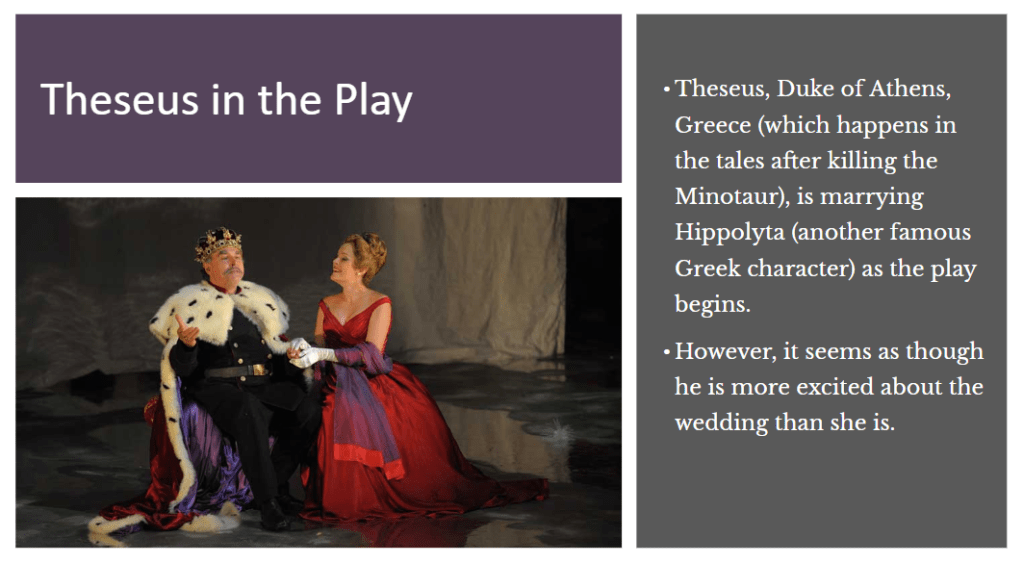
In the play, Theseus is now the Duke of Athens, Greece (which happens in the tales after killing the Minotaur), and is marrying Hippolyta (the Amazonian queen from Greek mythology).
However, it seems as though he is more excited about the wedding than she is.
In the mythology, Theseus and Hippolyta do marry, but it is never because she wants to. In fact, she refuses his proposal, and he kidnaps her from the island of the Amazons. This tension between them is picked up on at the start of the play.
Hippolyta
Hippolyta was the Amazonian queen who possessed a magical girdle that was given to her by her father, Ares, the god of war. The girdle was a waist belt that signified her authority as queen of the Amazons.
In both mythology and in the play, she marries Theseus and then becomes Queen of Athens.
Their marriage symbolizes the coming together of different worlds, with Hippolyta representing the fierce power of the Amazons and Theseus symbolizing the organized society of Athens.

Shakespeare shows Hippolyta as strong and noble, indicating a relationship of mutual respect and power. Her mythological background makes her character more interesting and adds depth to her interactions and the story.
Zeus and Hera reflected in Titania and Oberon
Titania and Oberon are the king and queen of all fairy folk. Their emotions also have a direct impact on the natural order of Earth.
While they are not direct allusions in name, they are indirect allusions to Zues and Hera. Zues and Hera’s conflicts in several stories includes consequences to mortals as well as affecting the balance of nature just as Titania and Oberon.
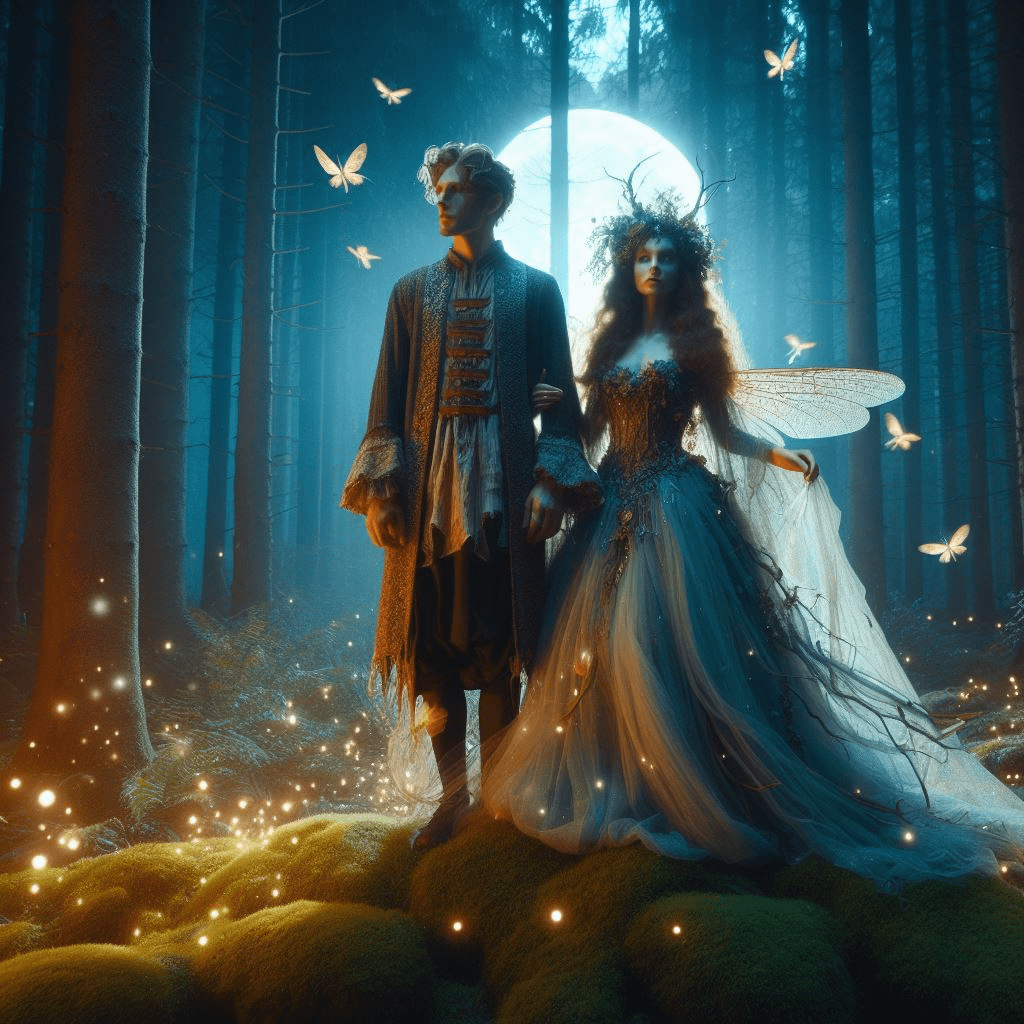
Hera was the goddess of marriage and childbirth with many shrines to come worship. Titania also has shrines to worship her and she inherits a child of a faithful servant who dies during childbirth.
Hera and Titania are both powerful women who have to endure infidelity from their husbands. Since they cannot actually harm their mates, they often take their anger out on others.
In the play, Titania tells Oberon that she refuses to sleep with him or give him the child that she has inherited. It is also noted that because of their fight, there are disruptions the seasons and extreme weather changes. These are causing chaos in the environment, affecting the lives of humans and animals alike. This mirrors Hera’s tendency to direct her wrath towards mortals and other deities, showcasing the far-reaching impact of their marital strife.
Oberon’s jealousy of the child and Titania’s anger about his infidelity sparks a lot of the conflict in the play. Such as Oberon’s love potion that effects the lovers and his punishment to Titania that turns Bottom into a donkey-man creature for the night.
May Day
While, not entirely mythological, the play ends on May Day and this ancient festival does have ties to the Celtic beliefs systems and this festival was still observed during Shakespeare’s time.

“No doubt they rose up early to observe
The rite of May, and hearing our intent,”
The play’s focus on marriage and generations fits well with May Day fertility rituals. May Day marks the change from spring to summer and celebrates the fertility of the land and people. Villagers danced around the maypole, and went into the woods to gather branches and choose partners, sometimes engaging in premarital sex.
These rituals are the roots of comedy, as seen in A Midsummer Night’s Dream. The four lovers leave the city, experience a magical night in the woods, and return as mature adults ready for marriage and parenthood, reflecting a journey influenced by old fertility traditions.
As soon as the lovers are discovered in the woods, they all assume that they have been out “observing the rites of May”. It also makes sense that Theseus and Hippolyta would be getting married on May Day since this ancient festival is steeped in love, mating, and fertility.
Final Thoughts
There are so many Greek mythology allusions in this play and I highly suggest covering these with your students before you begin A Midsummer Night’s Dream. You can easily do this by using this product!

You can also find EVERYTHING you need to teach the play in this discounted bundle!
Join my weekly newsletter!
Would you love to get weekly tips and resources for teaching secondary English delivered right to your inbox? Click here to join!
 Around the World With Mrs. C
2 thoughts on “Teaching A Midsummer Night’s Dream with Mythology Allusions”