

I know that I and every other high school English teacher I know has been lamenting the past couple of years on the major crisis that is VOCABULARY! We also know from a whole body of research that vocabulary and background knowledge are the two biggest components to text comprehension.
In a previous post, I discussed 3 of my favorite (and FREE) ways to work on building vocabulary with my high school students. You can also check out those ideas here!
In this post, I am sharing about the power of close reads to improve vocabulary acquisition and displays of understanding that vocabulary!
How Close Reads Improve Vocabulary

Research tells us that teaching vocabulary in context through close readings in secondary education has wonderful results. Close readings prompt students to analyze, evaluate, and reflect on language, enhancing their understanding of vocabulary and its nuances.
For example, a study done by Winton, Kaitlyn saw significant gains in all her students despite different academic needs. These gains were not only in vocabulary, but also in text comprehension and reading stamina!
While I did not solely rely on close readings, this strategy has always worked well for my students. Here are some of my top tips for close reading activities.
Tips For Teaching with Close Readings

Before beginning any new text, I provide a quick overview of anything that may be of important for context. For example, before diving into Edgar Allen Poe’s “The Fall of the House of Usher”, my students are given an overview of Dark Romanticism and we discuss all the different meanings of the word “fall”.
Fall- the season
Fall- move downward, typically rapidly and freely without control, from a higher to a lower level.
However, we also have the lesser used meaning of the ending of something.
After we have had a chance to think about the meaning of the title of the short story and I have gone over a short presentation on Dark Romanticism and its love of examining characters that are in psychological and/or physical torment, my students are primed to dig into the text.

I then pick a particularly juicy portion of the text you want students to zero in on. This could be for a variety of reasons such as:
- conflict
- vocabulary
- figurative language
- connotative language
- strong imagery
To be highly effective, I keep this portion short- usually no more than 200-250 words.
I identify any words that I think will be challenging, archaic, have double meanings, or are particularly important to the context of the the piece. I underline and bold those words and the first they do is annotate to the side what those words mean.
For example, this first description of the the Usher House,
“I scanned more narrowly the real aspect of the building. Its principal feature seemed to be that of an excessive antiquity. The discoloration of ages had been great. Minute fungi overspread the whole exterior, hanging in a fine tangled web-work from the eaves. Yet all this was apart from any extraordinary dilapidation. No portion of the masonry had fallen; and there appeared to be a wild inconsistency between its still perfect adaptation of parts, and the crumbling condition of the individual stones. In this there was much that reminded me of the specious totality of old wood-work which has rotted for long years in some neglected vault, with no disturbance from the breath of the external air. Beyond this indication of extensive decay, however, the fabric gave little token of instability. Perhaps the eye of a scrutinizing observer might have discovered a barely perceptible fissure, which, extending from the roof of the building in front, made its way down the wall in a zigzag direction, until it became lost in the sullen waters of the tarn.”
― Edgar Allan Poe

After defining these targeted words, we then read the passage together. After this, my students read the passage again and annotate with guiding questions and further directions.
Why Pre-Identifying Problematic Words is Crucial
By identifying the words first, my students realize that I am admitting up front that there is challenging vocabulary and I want them to slow down and truly understand what they are reading.
This also provides scaffolding to my students but also putting some of the responsibility on them.
If I am unsure of a word’s meaning, I definitely underline it and let my students know. In this case, I didn’t know what the word “tarn” meant. By sharing that even I had to look this up, shows my students that vocabulary is an ever-evolving skill that we are all practicing all the time.

Visualizing the Vocabulary
Research has also shown that integrating vocabulary in multimodal ways also has fantastic gains for our students. In my experience, this is has an even greater effect with my ELL and SPED students when they make these connections.
For example, after completing the close read of the passage from “The Fall of the House of Usher,” that I mentioned above, I then have my students create an illustration of what they have read and use the text to support the details they include.

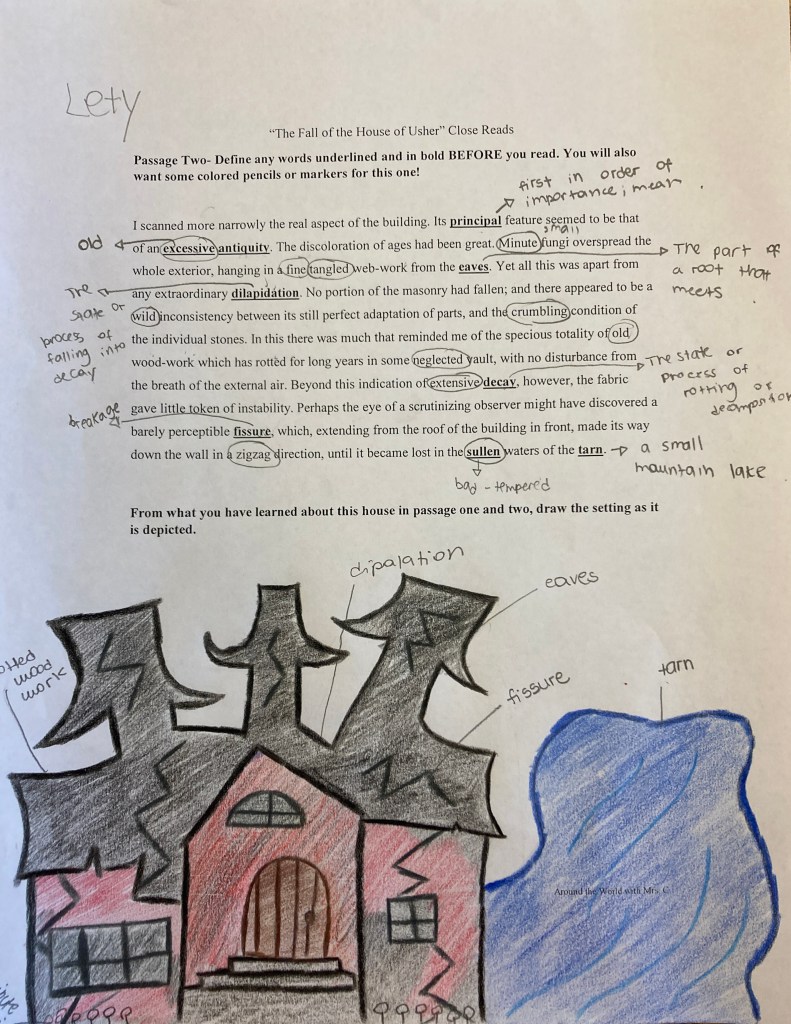

This is entirely vocabulary driven as I also have them annotate to the side the textual evidence that led to details within their illustration. This also gives my students an alternative way to show there understanding of these tier 2 words they are learning.
Incorporating visual or multimedia elements, such as illustrations, videos, or audio recordings related to the text, can enhance students’ comprehension and engagement. These multimodal resources can provide additional context and support for vocabulary acquisition, particularly for diverse learners or those with varying learning preferences.
Close Reads Can Help Clear Up Confusing Vocabulary
Completing a close read can also help students to critically think on confusing word choices for a clearer understanding on a topic.
For example, the song “Baby It’s Cold Outside” has had some controversary over the year based on its lyrics. Some of this is due to the slang of the time in which it was written in.
For example, one student said she questioned the age of the woman in the song due to her living at home with her family still. This lead to us discussing the original date of the song (1949) and the fact that women largely did not move out of their family home unless it was to marry.
We have to watch the video clip of the movie the song was written for and performed in to see that she is a grown woman in her late 20’s early 30’s.

Some understandably question the phrase, “what’s in this drink?” Through some research of the time it was written in, we learn that this was a popular saying/joke in the 30’s and 40’s when people were making an excuses for doing things they knew they shouldn’t be.
Understanding the nuances of the vocabulary in this song then leads to discussing, “Was this something that she actually wanted to be doing and was concerned about what everyone else would say over her own desires?”
By taking the time to closely read and discuss the language in the song leads to a stronger connection of the denotative and connotative usage of vocabulary. It also strengthens students to be a more critical thinker and consumer.
Final Thoughts on Building Vocabulary in Secondary Education
As you can see, close reads are a fantastic way to work on closing the vocabulary gap with our secondary students. By picking juicy pieces of text to have them slow down, define tier 2 words, and deeply analyze the meanings of these words our students can grow in their vocabulary skills.

Using multimodal ways to work in the newfound vocabulary can also further instill these words and their meanings.
Close reads are a fantastic strategy to add to the variety of ways to build your students’ vocabulary. I have several that are READY TO GO right here!
More Ideas and Resources for Teaching Vocabulary
Would you love even more ideas on building vocabulary in your middle and high school students? Check out these
Don’t forget that you can also check out 3 more FREE and FUN vocabulary building strategies in a previous blog post here!
You can also check out what another English teacher has to say here: Beyond Greek and Latin Roots Worksheets: Activities for HS ELA by McLaughlin Teaches English
 Around the World With Mrs. C