

Shakespeare’s play Julius Caesar is a fantastic option for teaching students rhetoric and persuasive techniques. It is rich with masterful speeches, compelling arguments, and dynamic power struggles that illustrate how language can be used to manipulate, inspire, and influence others.
In fact, I am going to share something that will sound a little odd… I have only EVER taught the first three acts of this play!
The reason I do this is because of the beautiful use of rhetoric and persuasion going on during those three. I also do this by having students watch an Act and then we spend some time zeroing in to key scenes to annotate and dissect.

Read on to see some of my top tips for teaching this play and having students LOVE it! After that, be sure to check out my entire bundle for teaching the heck out of Acts I-III of Shakespeare’s Julius Caesar!
Introducing the Real Julius Caesar Before Shakespeare’s Julius Caesar
First, I found that students were often severely lacking on contextual knowledge of Julius Caesar the man. Sadly, I know this because when I tried doing Cesar for the first time, my students were a little lost on these details and they didn’t understand why the conspirators wanted to kill Cesar.
Since Shakespeare’s play begins at the height of Caesar’s power and shortly before his death, I need my students to fully understand WHY so many loved Caesar and why so many Senators feared him.

To make sure I gave my students enough context on the historical circumstances to Caesar’s assassination, I poured over the history and even pulled in my history major husband to make the most detailed history lesson imaginable about Cesar.
By the end, many students truly see why many of the citizens of Rome loved Caesar. And why many of the senators saw him as a threat.
Teach Plays Like Film Studies
One of the hills I’m willing to die on, is that Shakespeare wrote plays not novels!
You are meant to watch and be entertained by what he wrote, not read every single word as an untrained teen actor. The way his works our best experienced in the classroom is by watching first and then zeroing in on key parts.
By watching it first, students get a feel for the language, tone, setting, etc. BEFORE they think critically on the words.
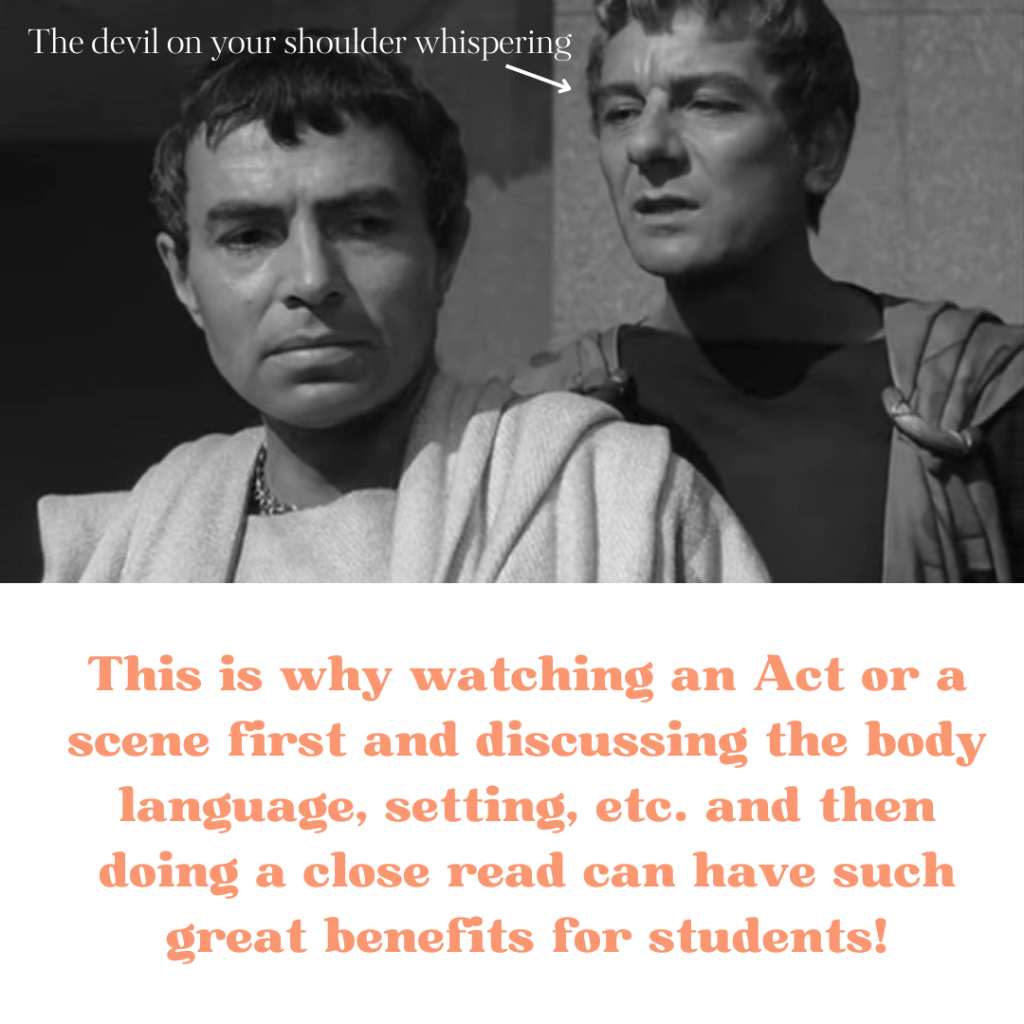
I personally love to use the Marlon Brando version of Julius Caesar. As my students have said, the actor who plays Cassius has a punchball face!
In order to do this, we watch an Act first and then zero in on key lines. The following are a few of the areas of Acts I-III that we focus in on. 
Act I Scene II Lines 135-175
Cassius’ speech in Act I of Julius Caesar is a masterclass in persuasion and manipulation.
In this scene, Cassius is trying to convince Brutus to turn on Caesar. To add to the drama, Brutus and Caesar have been close for many years. While Brutus loves Caesar on a personal level, he is concerned about the power he is accumulating.

By using vivid imagery, metaphors, and historical allusion, Cassius manipulates Brutus’ perception of Caesar and his own sense of self-worth.
The comparison of Caesar to a “Colossus” towering over “petty men” paints an image of unchecked power, while the assertion that “the fault…is not in our stars, but in ourselves” appeals to Brutus’ agency and personal ambition.
Oh, you and I have heard our fathers say,
There was a Brutus once that would have brooked
Th’ eternal devil to keep his state in Rome
As easily as a king.
Cassius further diminishes Caesar’s greatness by questioning what makes him superior, reducing his name to mere sounds and syllables no greater than Brutus’. The reference to Brutus’ noble ancestor serves to stir a sense of destiny and patriotic duty.
Implying that Brutus has a legacy to uphold.

Through these rhetorical strategies, Cassius subtly plants the idea that Caesar’s dominance is unnatural. He suggests that true Romans must resist tyranny.
Cassius’ words have clearly planted a seed of doubt in Brutus’ mind, making him question Caesar’s growing power and his own place in Rome. Though Brutus does not immediately commit to Cassius’ cause, his response shows that he is deeply unsettled.
By stating that he is “nothing jealous” of Cassius’ affection, Brutus affirms his trust in him, which makes Cassius’ manipulation even more effective.
His admission that he has already been thinking about “these times” suggests that Cassius has merely confirmed fears Brutus already had. While he resists being further persuaded, his promise to “find a time” to discuss the matter reveals that he is open to being swayed.
Brutus had rather be a villager
Than to repute himself a son of Rome
Under these hard conditions as this time
Is like to lay upon us.
His final statement indicates his preference and personal values. He would rather be a mere villager than live under an oppressive rule. This signals that the idea of resisting Caesar is already taking root in his mind.
Act II- Brutus Persuades Himself
One of the most compelling moments in Julius Caesar occurs in Act II, Scene I, when Brutus wrestles with the decision of whether to join the conspiracy against Caesar. In this soliloquy, Brutus isn’t being persuaded by another character.
He is persuading himself.

He carefully weighs the pros and cons of assassinating Caesar, using extended metaphors, logical reasoning, and rhetorical questions to work through his internal conflict.
He acknowledges that Caesar has not yet abused his power, but he fears that once crowned, Caesar might become a tyrant.
It must be by his death; and, for my part,
I know no personal cause to spurn at him,
But for the general. He would be crowned —
How that might change his nature, there’s the question.
Brutus compares ambition to a ladder. And suggests that leaders often appear humble while rising it to power. Once they’ve reached the top, they turn their backs on the people.
This self-persuasion makes the speech a perfect close reading opportunity because it allows students to analyze how language impacts thoughts and how it can be used even on oneself.
Shakespeare also uses vivid imagery and comparisons to reveal Brutus’ mindset. He describes Caesar as a serpent’s egg—harmless now but dangerous once hatched. Implying that it is safer to eliminate him before he can grow into a threat, “It is the bright day that brings forth the adder, / And that craves wary walking”.

This metaphor forces students to think critically about whether Brutus’ argument is based on logic or fear.
By slowing down and closely examining this passage, students can see how Brutus builds his own justification for murder.
This scene is especially effective at showing how people construct arguments, rationalize difficult decisions, and wrestle with moral dilemmas.
Act III- Brutus and Antony Try to Persuade the Angry Mob
As Act III gets underway, Caesar has been killed and news has spread to the citizens of Rome. The citizens are angry and demand answers!
Brutus thinks that he will be able to turn the crowd into understanding. He even agrees to allow Antony to speak, but only after he has been able to speak first and establish the “reasons”.

Brutus begins by calling them friends and then assuring the crowd that he loved Caesar as dearly, even more, than they did. He then shows himself as the true patriot as he was willing to put his personal feelings aside for the good of Rome.
–Not that I loved Caesar less, but that I loved
Rome more.
Brutus goes on to share Caesar’s unquenchable “ambition” and the danger it posed to Rome. He paints a picture where Caesar would have become a tyrant and turned them all into slaves.
By the time Brutus finishes, the angry crowd has now turned against Caesar. Some even call out for Brutus to now be made Caesar.
All
Live, Brutus! live, live!
First Citizen
Bring him with triumph home unto his house.
Second Citizen
Give him a statue with his ancestors.
Third Citizen
Let him be Caesar

Antony then takes his turn to speak to the crowd, carrying Caesar’s mutilated body. He has listened to what Brutus has to say and hears how the crowd has turned.
So, he wastes no time trying to openly persuade them otherwise. In fact, he tells the crowd that he NOT there to praise Caesar.
I come to bury Caesar, not to praise him.
The evil that men do lives after them;
The good is oft interred with their bones;
So let it be with Caesar
This grabs the attention of the calmed mob. This crowd is also unaware that Antony promised the conspirators that he would not speak against them. Instead, he leans into what an “honorable” man Brutus is. He also says that he is not a great speaker like Brutus. These are things he continues to repeat.
He then goes into Caesar’s “ambition” from his viewpoint. He reminds the crowd that his ambition filled their coffers.
His ambition helped the poor. His ambition created public parks and gardens for citizens to enjoy.
He also reminds them that when he offered him the laurel crown on Luprical, “Which he did thrice refuse”. Followed by the rhetorical question, “Was this ambition?”
Antony’s speech continues on as is one of the most brilliant examples of rhetoric and persuasion. He even pauses when he is overcome by emotion and weeps over Caesar’s body. A reminder that it isn’t our words alone that are persuasive!
By the end, the crowd is no longer calmed, but they have returned to their enraged mob state.
First Citizen
Never, never. Come, away, away!
We’ll burn his body in the holy place,
And with the brands fire the traitors’ houses.
Take up the body.
Second Citizen
Go fetch fire.
Third Citizen
Pluck down benches.
Fourth Citizen
Pluck down forms, windows, any thing.
As I remind my students, we do not have an exact transcript of what Brutus and Antony said on that historical day. However, we do know that once Antony was done speaking, the mob went nuts!
They began tearing apart and burning parts of Rome and shortly after a new civil war begun.
Final Thoughts

Julius Caesar is an incredible play for teaching rhetoric, persuasion, and the power of language. Through masterfully crafted speeches, Shakespeare explores how words can shape perceptions, fuel ambition, and even spark revolutions.
By focusing on Acts I-III, students can engage deeply with some of the most compelling moments in the play—where persuasion is at its peak and the characters’ choices have profound consequences.
By analyzing Cassius’ manipulation of Brutus, Brutus’ internal struggle, and the competing rhetoric of Brutus and Antony, students develop critical reading and analytical skills that extend far beyond the classroom. They begin to see how persuasion operates in politics, media, and everyday life.
If you’re looking to dive even deeper into these pivotal moments, be sure to check out my Julius Caesar bundle, packed with over 40 PDFs of close reading and annotation activities. With the right approach, your students won’t just read the play—they’ll experience its power firsthand.
⭐⭐⭐⭐- Sara-Jane G.
I loved this packet! It was a wonderful way to break up this speech into smaller sections for them to understand. I really appreciate that they did this in such as way that the students could understand the material – yet didn’t talk down to them. I really loved using this in class. Thanks!
Join my weekly newsletter!
Would you love to get weekly tips and resources for teaching secondary English delivered right to your inbox? Click here to join!
 Around the World With Mrs. C