

Have you ever taught a short story that sparked an honest classroom conversation about belief, pressure, growing up, and disillusionment?
Langston Hughes’ “Salvation” is one of those rare memoirs that hits students right where they are. It’s raw, relatable, and rich in narrative techniques that high schoolers need to master—especially when prepping for writing and reading assessments. But let’s be honest: without the right guidance, students can miss the deeper message and simply summarize the story instead of analyzing it.
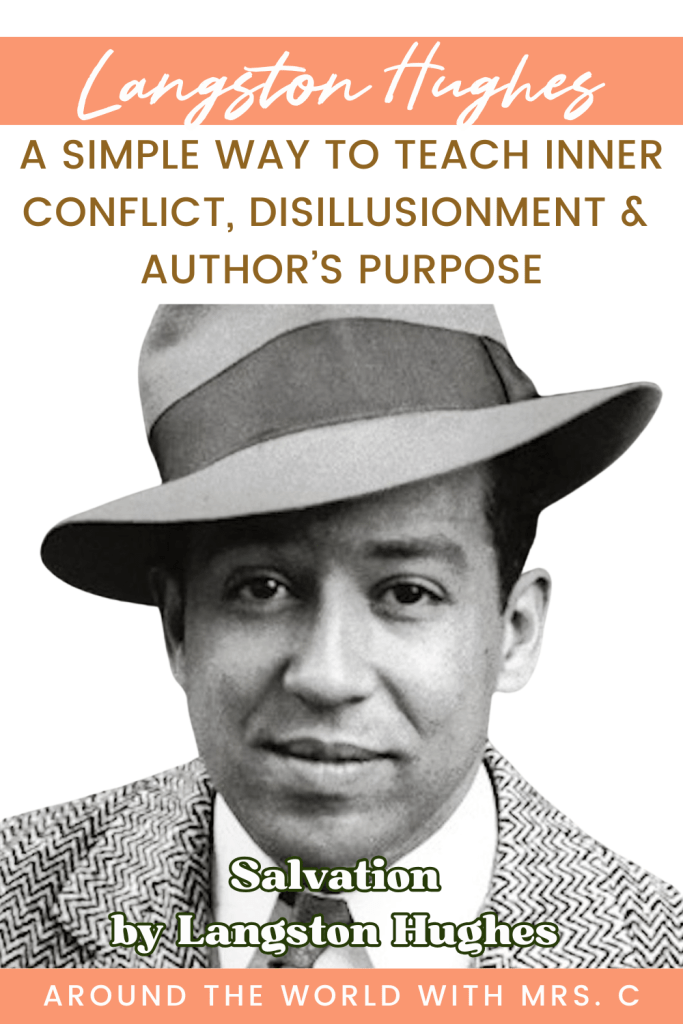
What can be a bit deceptive about this story is that it is SO brief. Students can see that it’s barely two pages long and assume that it has little depth. However, after we are done reading and analyzing it, they find it to be one of the most powerful pieces we read.
If you’re looking for a lesson that helps students get what makes this story powerful—without hours of prep—this post will give you practical teaching ideas and a done-for-you resource to make it easy.
Why “Salvation” Can Be Tricky to Teach
When students first read “Salvation,” many expect it to be a story about religious faith or a church experience. But it’s really about something more complex: the pressure to believe, the desire to please others, and the disappointment of unmet expectations.
“Salvation” is actually NOT a short story.
I was saved from sin when I was going on thirteen. But not really saved. It happened like this.
It’s the third chapter of Langston Hughes’s memoir The Big Sea. While it is technically non-fiction, Hughes uses his famous fictional writing skills to immerse you into this critical moment in his life and the lasting impact that it had on him. As your students read, they should consider how he inserts the reader into this vivid memory so they experience it as he did.
Teachers often tell me their students summarize instead of analyze texts like these. And it’s no wonder—narrative nonfiction can be tough to crack. Students need support identifying tone, inner conflict, and theme without getting overwhelmed.
So how do you help students dive deeper without needing to create everything from scratch?
Make the Struggle Clear: 3 Ways to Teach “Salvation” for High-Impact Learning
1. Start with Inner Conflict
The first line—“I was saved from sin when I was going on thirteen. But not really saved.”—sets up Langston’s internal struggle. Ask students to unpack what he expected to feel versus what he actually experienced. Use this as a bridge into the concept of disillusionment and the pressure young people feel to conform.
Mini prompt: How does this first sentence introduce Langston’s conflict?

2. Focus on Diction and Tone
Have students examine how Hughes’ word choices reflect his changing emotions—from hopeful to guilty to disillusioned. Phrases like “I cried” and “I was really crying because I couldn’t bear to tell her that I had lied” reveal both tone and inner conflict. These are gold for helping students analyze author’s purpose and literary technique.
3. Ask Big Questions About Belief
End with a class or small group discussion around this key line:
“That night, for the first time, I cried in bed alone, and I couldn’t stop… I didn’t believe there was a Jesus anymore, since he didn’t come to help me.”
Prompt students to explore: How does this line connect to the theme of disillusionment? What does it say about the pressure to perform belief instead of truly feeling it?
My students often find that they can connect with this coming-of-age moment in different ways. Not necessarily about loss of faith, but a loss of something. Something in which they officially became disillusioned and it shifted so much for them.
Resource Spotlight: All the Work Is Done for You
If you want a ready-to-go activity that walks students through all of this step by step, I created a Salvation by Langston Hughes Close Reading & Analysis Activity. It includes:
- ✅The 2-page text
- ✅A 2-page printable PDF handout with thoughtful short answer questions
- ✅ An answer key with modeled responses
- ✅ A PowerPoint presentation to guide students through analysis
- ✅ Perfect for test prep, sub plans, tutoring, or small group instruction

This activity has worked beautifully in my own classroom and can be used as:
- A small group test prep tool
- Practice or make-up assessment
- A sub-friendly activity that actually builds skills
Final Thoughts: Use “Salvation” to Build Real Insight
When we teach stories like “Salvation,” we’re not just covering standards—we’re helping students recognize how narratives reflect the very real struggles people face. Hughes’ memoir invites students to think critically about belief, honesty, and identity, all while giving you a perfect anchor for assessing key literary skills.
👉 Ready to try it out in your classroom? Check out the full resource here!
Or leave a comment below: What’s your favorite short story to teach when exploring internal conflict?
Could you use an entire bundle of of resources to use for meaningful ELA skills sharpeners and test prep? This bundle ALSO includes this Langston Hughes product!
Join my weekly newsletter!
Would you love to get weekly tips and resources for teaching secondary English delivered right to your inbox? Click here to join!
 Around the World With Mrs. C