

What do feminist theory, Disney movies, and student-led creativity have in common? If you’re teaching literary analysis this semester, everything.
Teaching fairy tales can be more than just a nostalgic trip down memory lane. With the right approach, these familiar stories become rich texts for critical thinking, discussion, and engaging project-based learning. In this post, you’ll learn how to elevate fairy tale analysis using critical lens theory—and see how a fresh take on Disney can inspire meaningful student collaboration and creativity.

Why Fairy Tales Still Matter (and Why Students Deserve More Than Just a Retelling)
By the time students reach high school, they’ve seen a dozen versions of Cinderella and can hum half the lyrics from Frozen. But ask them why these stories persist—and how they shape our ideas about gender, power, and culture—and you’ll likely get silence.
That’s because they haven’t been taught to look beyond the magic.
Many students coast through fairy tale units without ever examining the deeper messages hidden beneath the sparkles and ballgowns. Teachers are often left balancing literary standards with the need for cultural relevance and engagement.
So… how can we help students read beyond the “happily ever after”?
The Power of Critical Lenses: Turning Familiar Stories into Critical Conversations

In my Fairy Tales & Disney Movies Unit, students explore five classic fairy tales through multiple critical perspectives. Over six to eight weeks, students read, watch, write, and discuss—not just the stories, but the messages within them. Whether you’re diving into feminist theory or exploring archetypes, these activities create deeper, more meaningful engagement.
Here’s how I break it down:
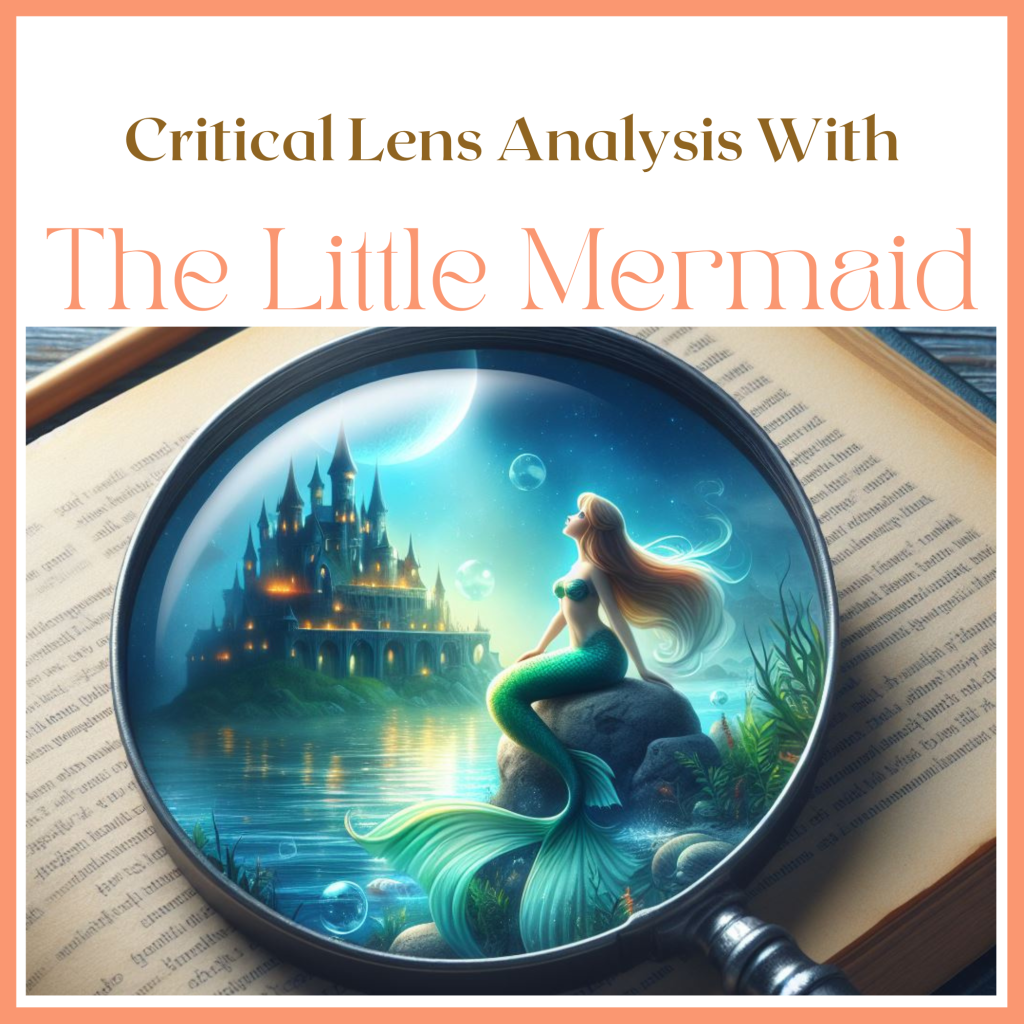
🧜♀️ Week 1: Archetypes and Gender in The Little Mermaid
BY the time I get to this unit, my students are already well-versed in archetypes. But, if you have not yet done this, begin by teaching character and symbolic archetypes using The Little Mermaid. Students compare Hans Christian Andersen’s story with Disney’s adaptation, then write from either a feminist or archetypal lens. This sets the tone for critical analysis while using a story they already know and love.

Using The Little Mermaid, we do a guided archetypal analysis of both the written story and the film. Students look for familiar archetypes like the hero, the mentor, the shapeshifter, and the threshold guardian. We also explore symbolic archetypes like water, transformation, the color red, and sacrifice. This builds a strong foundation for deeper analysis in later weeks, and students start seeing that these “myths” are more than just old stories—they’re frameworks we still use today.
During a class discussion on Andersen’s biography and his emotional inspiration for writing The Little Mermaid, one of my students exclaimed, “I get it! He’s the little mermaid.”
Andersen, devastated when the man he loved was marrying a woman, poured his heartbreak into this fairy tale. The little mermaid’s painful transformation, her silencing, and her ultimate dissolution into sea foam mirror the silent suffering of someone who cannot openly express their love or find a place where they truly belong.
“In many ways, the little mermaid is society’s ideal woman as being silent, beautiful, obedient, and devoted.”
While Andersen was a man, he identified with what many women felt at the time. This leads naturally into discussion on gender stereotypes from society and what happens to those who do not fit those roles.
👠 Week 2: Step into the Stepmother’s Shoes
Ah, Cinderella. What’s great about this story is that there are LITERALLY over one hundred of them! Almost every culture over time have had some version of this story. However, I focus on two versions- Perrault’s “The Little Glass Slipper” and Grimms’ “Cinderella”. I like to use this because most of my students are familiar with the Disney version (inspired by Perrault) and the Grimm version is just so fun!
Plus, there is so much to consider with our analysis. The cleaning woman who became a princess through her generous spirit, good deeds, and her ability to never give up in the face of poor hatred. Humans are fascinated with rags to riches stories, so it’s not surprising that there are over 100 Cinderella stories from cultures all around the world.

Cinderella also becomes the focal point for analyzing the “evil stepmother” archetype and feminist themes.
Perrault’s version ends so sweetly with Cinderella being full of forgiveness to those that had treated her so cruelly her entire life. It didn’t stop there! She even gave her wicked stepsisters homes and matched them with upper class husbands! Perrault was even kind enough to give us his morals to be taken away from the story at the end.
Moral: Beauty in a woman is a rare treasure that will always be admired. Graciousness, however, is priceless and of even greater value. This is what Cinderella’s godmother gave to her when she taught her to behave like a queen. Young women, in the winning of a heart, graciousness is more important than a beautiful hairdo. It is a true gift of the fairies. Without it nothing is possible; with it, one can do anything.
Another moral: Without doubt it is a great advantage to have intelligence, courage, good breeding, and common sense. These, and similar talents come only from heaven, and it is good to have them. However, even these may fail to bring you success, without the blessing of a godfather or a godmother.

No doubt this reinforced to many children for decades to come of how kind, forgiving, and generous a young lady should be in order to live a truly “good life”.

However, the Grimms’ version has a slightly different take. The wicked stepsisters that tormented Cinderella end the story being horribly deformed and mutilated by the helpful animals that had assisted Cinderella on her journey from the ashes. While we are never given a moral, I think it is safe to say that the key takeaway is to be a good Christian girl and live happily ever after or don’t and…..
The Grimms’ version is also filled with archetypal goodness to examine. Such as being visited by the spirit of her dead mother three times. Once students understand that the number three is an archetype of a holy number, they can make the connection that Cinderella’s mother was a good woman and is sending divine intervention for her pure daughter. Contrasting this with the evil step-mother who torments her, gives us the 3 most common female archetypes in literature: angel, damsel-in-distress, and wicked.
💰 Week 3: Class, Power, and Tangled Dreams
This week highlights Marxist criticism. First, I like to start out with introducing the Marxist lens. I tell students that we call it the Marxist lens, but I am not implying that we should all run out and become Communists. We are merely looking at the theory that all cultures have a social class system of some kind and often the class we were born into/live in directly impacts our lives in many ways.

With this lens we look at some questions such as:
Who has power and who doesn’t?
How do those in power use their power?
How are the powerless portrayed?
Is anyone seeking a better life?
If they are seeking a better life, what is standing in their way?
After we get all of that out of the way, my students read Rapunzel, watch Tangled, and study characters like the “ruffians” through the lens of social class and economic power. Bonus: there’s a TED Talk analysis and song study built into this lesson!
If you would like an even more detailed look at how this looks, check out this blog post!
🍎 Week 4: Gender and Symbolism in Snow White
This week brings together gender and archetypal analysis with Little Snow White. The discussion turns deeper as students examine symbolic colors, mother figures, and societal ideals of beauty and obedience. Through archetypes, we explore Snow White as the innocent, nurturing maiden, contrasted with the Evil Queen as the dark mother or crone.

Students analyze how the film reinforces ideals of femininity—highlighting purity, passivity, and beauty as virtues rewarded with love and safety. The gender bias grid invites students to sort characters like the Evil Queen, Prince Charming, and the dwarves based not on gender but on their actions, challenging assumptions about what behaviors are “male” or “female.” Students often identify that the Queen is portrayed as villainous because she is powerful and autonomous—traits often coded as masculine.
Many students have insightful conversations about how the Queen’s portrayal suggests that ambition and power in a woman are dangerous or corrupting. Since she is the active ruler and decision-maker, her downfall can be read as a cautionary tale—implying that young girls should not seek power or leadership, lest they become “evil.” This reinforces the idea that girls should aspire to be like Snow White instead: obedient, quiet, and beautiful.
The archetypal and symbolic reading of Snow White ultimately opens up rich dialogue about gender norms, the cost of challenging them, and the messages these stories send to young audiences.
Click HERE to download a free resource to use with analyzing Snow White!
🌍 Week 5: Cultural Criticism with The Princess and the Frog
Students analyze how culture, race, religion, and socio-economic status shape storytelling in The Princess and the Frog. This lens invites essential conversations around representation and societal context—perfect for deeper student inquiry and connection.
You can have students examine several aspects or narrow the focus if you wish. I personally like to have them start out more broadly and then narrow down their focus for seminar discussion.

The Princess and the Frog is a rich text for classroom discussion, especially when compared to the original French tale. Students tend to latch onto the racial, class, and religious dynamics portrayed in the movie—particularly how these themes intersect with the glossy way Disney paints 1920s America. Framing the discussion around Disney’s intentions helps, especially since this film was meant to be a landmark moment with the introduction of the first African American princess.
But the question remains—did Disney achieve the representation it set out to, or did it fall short?
A key moment to examine is the train ride home from Lottie’s house. Visually, we move from lavish mansions to rundown homes, a shift that prompts students to question whether it reflects class divisions, racial segregation, or both. Tiana’s belief that food brings people together is another layer to explore. In the opening gumbo scene, we can ask: are all walks of life really represented?

And when Tiana is denied her dream property by two condescending real estate brothers, we dig into the subtext—is the rejection rooted in race, gender, or class bias? The line “a little woman of your background” opens up a discussion on intersectionality and how these layered biases operated in the 1920s—and still echo today.
There is honestly so much more I have to say on analyzing these works! If you would love even more detail, check out this blog post!
🎬 Project Spotlight: The Disney Movie Pitch Challenge
If you want to take engagement to the next level, you have to check out the optional PBL project in this unit: the Disney Movie Pitch Challenge.

Students work in groups to research, reimagine, and pitch a brand new Disney movie—one that reflects more authentic values, diverse characters, and modern storytelling.
They present their movie pitch at the end of the unit, backed by what they’ve learned from their critical lens studies. It’s collaborative, creative, and incredibly insightful. (Plus, students love it!)
🎤 Absolutely amazing and fun end of the year unit. The student loved creating their own movie sales pitch! – Actual feedback from an ELA teacher using the unit.
📚 Ready-to-Use Resources with Built-In Flexibility
This 6–8 week unit is packed with everything you need:
✅ 5 full fairytale + film studies (each self-contained—you can pick and choose!)
✅ Critical lens PowerPoints and student-friendly explanations
✅ Worksheets, handouts, discussion prompts, and writing tasks
✅ A flexible PBL project with built-in checkpoints and presentation guidance
✅ A variety of essay prompts with scaffolded supports
Even better? You don’t have to do everything. Each lens study is self-contained so you can customize based on time, standards, or class needs.
🧾 Want to dive into a free sneak peek of Week 4? Grab it HERE!
Final Thoughts: Why This Unit Works
This fairy tale unit isn’t just about analyzing princesses or retelling old stories—it’s about empowering students to think critically, ask questions, and create something meaningful.
If you’re looking for a fresh, flexible way to teach literary analysis and engage students in collaborative work, this unit delivers. Whether you use it for six weeks or just a few, it’s designed to make critical theory accessible—and even fun.

Ready to bring critical lenses and modern storytelling into your classroom?
You can check out the full resource HERE!
Or drop a comment below and tell me your favorite fairy tale to teach—I’d love to hear how you bring it to life.
Join my weekly newsletter!
Would you love to get weekly tips and resources for teaching secondary English delivered right to your inbox? Click here to join!
 Around the World With Mrs. C