

What If Snow White Isn’t Just a Princess in a Glass Coffin?
Fairy tales are everywhere. They show up in Pixar films, Broadway musicals, Halloween costumes, and wedding hashtags. They’re so familiar, so stitched into our cultural memory, that we often forget to ask: What are these stories really saying?
In high school English classrooms, we teach students to question the world around them—its texts, its trends, its traditions. So why not help them question the fairy tales they grew up with? These aren’t just bedtime stories; they’re blueprints. They shape how students think about love, power, beauty, and even their own identities.
Re-examining fairy tales through a critical lens gives students the tools to spot the deeper messages hiding behind poisoned apples and enchanted kisses. It transforms “Once upon a time” into something much more powerful: an opportunity for literary analysis, cultural critique, and meaningful conversation.
Let’s start with one of the most iconic tales of all…
Why Fairy Tales Still Matter
By the time students reach high school, they’ve seen a dozen versions of Cinderella and can hum half the lyrics from Frozen. But ask them why these stories persist—and how they shape our ideas about gender, power, and culture—and you’ll likely get silence.
That’s because they haven’t been taught to look beyond the magic of the beautiful illustrations and the entertaining tunes.
However, they can be the PERFECT medium for teaching literary analysis! This is because they already “know” the stories so well that you don’t have to worry about basic comprehension. They can already tell you every detail… in detail. Now, you can focus on looking beyond that surface level.
So… how can we help students read beyond the “happily ever after”?
The Power of Critical Lenses: Turning Familiar Stories into Critical Conversations

In my Fairy Tales & Disney Movies Unit, students explore five classic fairy tales through multiple critical perspectives. Over six to eight weeks, students read, watch, write, and discuss—not just the stories, but the messages within them. Whether you’re diving into feminist theory or exploring archetypes, these activities create deeper, more meaningful engagement.
In today’s post, I am just covering what your students can discover when deeply analyzing Snow White. Before we get started, you can click here to download a FREE resource to help with analyzing Disney’s movie in your classroom.
🍎 Gender and Symbolism in the Brother’s Grimm “Snow White and the Seven Dwarfs”
By brining gender and archetypal analysis to the Brother’s Grimm “Snow-White and the Seven Dwarfs” and Disney’s movie adaptation, our students can uncover a lot. The discussion turns deeper as students examine symbolic colors, mother figures, and societal ideals of beauty and obedience.
Beginning with analyzing the archetypes in “Little Snow White”, they can see the innocent, nurturing maiden, contrasted with the Evil Queen as the dark mother or crone. Essentially two sides of womanhood. One positive and reinforcing typical gender norms and the other negative.
When Snow White is chased into the woods on the first attempt of her life, she comes to a house and seeks shelter. When the seven dwarfs find her and hear her ordeal, they strike a bargain,
Then the dwarfs said, “If you will keep our house for us, and cook, and wash, and make the beds, and sew and knit, and keep everything tidy and clean, you may stay with us, and you shall lack nothing.”
“With all my heart,” said Snow-white; and so she stayed, and kept the house in good order.
It did not matter that she was royalty and most likely did not know how to do these things. She was a young woman, so she was immediately relegated to womanly work in exchange for protection.
The Evil Queen is obsessed with youth and beauty and uses items symbolic to this to try and kill Snow White. The first being the laces in a corset and the second being a decorative hair comb. Both times, Snow White actually does succumb. The Dwarves find her and removed the cursed items and save her each time. Each time they also remind her to not speak to anyone that may come to the house.
Reinforcing the idea of Snow Whit being the young naive damsel in distress who needs men around her to be safe. However, you could say that it goes even further. Despite her repeated experiences and being told not to speak to strangers, she continues to do so. Further emphasizing that she is completely helpless without a man around her constantly telling her what she needs to do. Snow White maintains typical female expectations, while the Queen’s obsession with her beauty and jealousy reinforce typical patriarchal power structures.
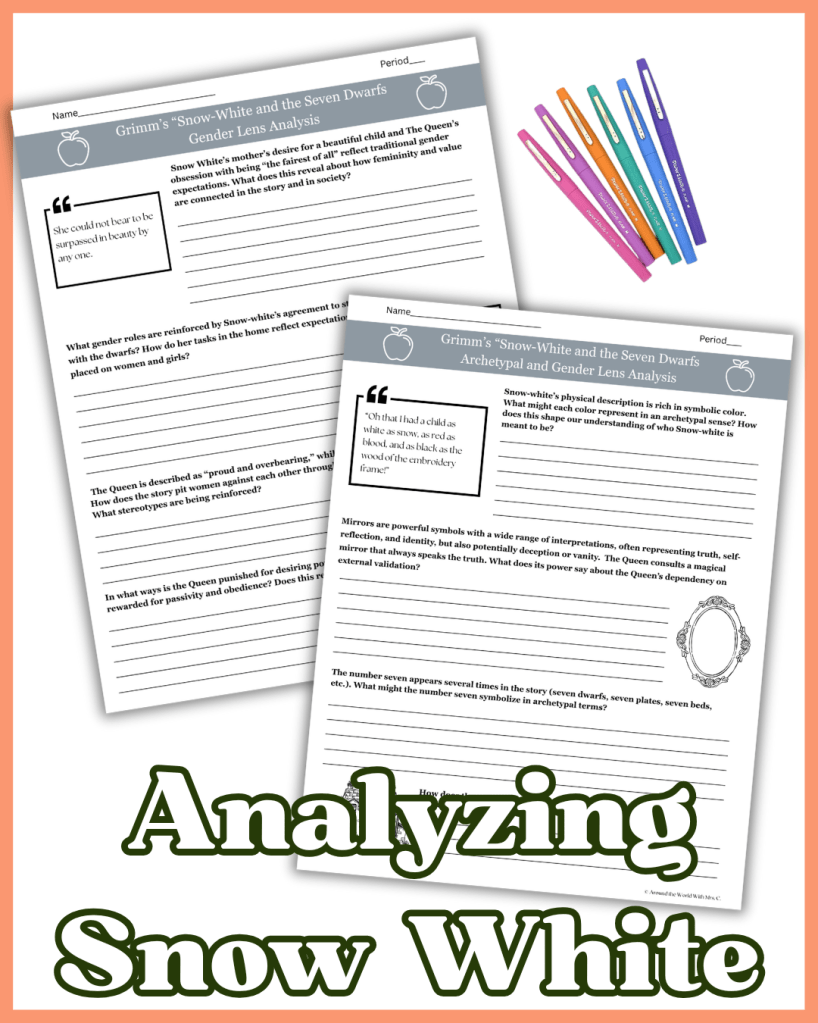
Here are a few questions you can ask students while analyzing this text through these lenses:
🔍 Archetypal Lens Questions
- Snow-white’s physical description—“a child as white as snow, as red as blood, and as black as the wood of the embroidery frame”—is rich in symbolic color. What might each color represent in an archetypal sense? How does this shape our understanding of who Snow-white is meant to be?
- The number seven appears several times in the story (seven dwarfs, seven plates, seven beds, etc.). What might the number seven symbolize in archetypal terms?
- What role does death and rebirth play in this story’s arc? How is Snow White’s resurrection symbolic in an archetypal sense?
♀️ Gender Lens Questions
- The Queen uses traditionally feminine objects (lace, comb, apple) to harm Snow White. What might this say about how femininity is portrayed or weaponized in the story?
- In what ways is the Queen punished or vilified for her ambition and desire for power? Would a male character acting the same way be treated differently in the narrative?
- The Queen is described as “proud and overbearing,” while Snow-white is “innocent” and “lovely.” How does the story pit women against each other through these contrasting characterizations? What stereotypes are being reinforced?
🍎 Gender and Symbolism in Disney’s Snow White and the Seven Dwarfs
Students analyze how the film reinforces ideals of femininity—highlighting purity, passivity, and beauty as virtues rewarded with love and safety. The gender bias grid I created has students sort characters like the Evil Queen, Prince Charming, and the dwarfs based not on gender but on their actions, challenging assumptions about what behaviors are “male” or “female.”
Students often identify that the Queen is portrayed as villainous because she is powerful and autonomous—traits often coded as masculine.

Many of my students have insightful conversations about how the Queen’s portrayal suggests that ambition and power in a woman are dangerous. Even hinting that it corrupts her into something sinister and evil. Since she is the active ruler and decision-maker, her downfall can be read as a cautionary tale—implying that young girls should not seek power or leadership, lest they become “evil.”
This reinforces the idea that girls should aspire to be like Snow White instead: obedient, quiet, and beautiful. Wait for a man to make everything alright.
At the same time, you can’t help but look more closely at the 7 men in her life. My students often begin to contrast Grumpy and Bashful. Grumpy reflects his name. He’s gruff and hard around the edges. His main emotion on display is hardness, but Snow White slowly begins to soften him (just a little). He represents what many would consider a typical male role. Works hard and doesn’t want to be bothered, but can show a softer side in private towards a select few.
Bashful on the other hand wears his emotions on his sleeve. He blushes and bats his long feminine lashes at the slightest hint of praise from Snow White. He delights in making her happy and jumps at every command. Though he is male, he takes on a more typical female role in his actions.
Here are a few questions you can ask students while analyzing the Disney movie through these lenses:
🔍 Archetypal Lens Questions
- What is the significance of the “poisoned apple” as a symbol or archetype? How does it represent temptation, knowledge, or danger in a mythic sense?
- How do the Seven Dwarfs function as archetypal figures in Snow White’s development or protection? Are they mentors, guardian angels, comic relief, or all of the above?
♀️ Gender Lens Questions
- What does Snow White’s role as a homemaker for the dwarfs suggest about traditional gender roles? How might this reflect the societal expectations of women in the 1930s?
- How do some characters reinforce typical gender roles while others challenge them? Are there any who seem gender neutral?
- How does the film portray the relationship between female characters? Is there a rivalry? Solidarity? What might this suggest from a gendered perspective?
👑 Ready to Help Your Students Read Beyond the Fairy Tale?
Fairy tales may start with “Once upon a time,” but in your classroom, they can become something much more—a chance to spark critical thinking, uncover hidden messages, and explore cultural norms with fresh eyes.
By looking at stories like Snow White through gender and archetypal lenses, students begin to see how even the most familiar tales are filled with layered meanings and complex commentary on society. And the best part? They already know these stories—so now, they get to rethink them.
If you’re ready to dive in but not sure where to start, I’ve got you covered. You can download a free resource to get started today with Snow White: What If Snow White Isn’t Just a Princess in a Glass Coffin? This ready-to-use activity will help you introduce critical lenses and get your students talking right away.
👉 Click here to grab your free download and bring deeper conversations to your classroom—no magic wand required.
Let’s reimagine fairy tales, one critical conversation at a time.
📚 Ready-to-Use Resources with Built-In Flexibility
Would you LOVE an entire unit that covers 5 fairytales and Disney adaptations? This 6–8 week unit is packed with everything you need:
✅ 5 full fairytale + film studies (each self-contained—you can pick and choose!)
✅ Critical lens PowerPoints and student-friendly explanations
✅ Worksheets, handouts, discussion prompts, and writing tasks
✅ A flexible PBL project with built-in checkpoints and presentation guidance
✅ A variety of essay prompts with scaffolded supports
Even better? You don’t have to do everything. Each lens study is self-contained so you can customize based on time, standards, or class needs.

Join my weekly newsletter!
Would you love to get weekly tips and resources for teaching secondary English delivered right to your inbox? Click here to join!
 Around the World With Mrs. C