

A Midsummer Night’s Dream is hands down one of my all-time favorite plays. The love stories, the shenanigans of Puck, all of the jokes at Bottom’s expense, the hilariously terrible play within the play…. All of it is just perfection.
Because I love it so much, it’s no wonder that I also love to bring it into my classroom! What’s great about using this play in World Literature is that I can also tie in lots of mythology because it is STUFFED with it. The themes also lead to deep connections that span centuries and cultures so I can easily pair other texts with it.
What I extra love about this play is how it shows just how complex love is. Before beginning the play, consider asking your students this essential question: How love can be both joyful and painful, magical and misleading?
Or in other words, why is love so dang complicated?!
Let me sprinkle some fairy dust and paint a picture of how you can easily teacher Shakespeare’s masterpiece, A Midsummer Night’s Dream!

Teaching Strategies for A Midsummer Night’s Dream
In my opinion (and experience), one of the most effective ways to teach Shakespeare is to approach it as a film study. Plays are meant to be seen and experienced, not just read. Particularly when the language is already difficult, your students will pick up much more of the context seeing it first and then zeroing in on key parts.
By watching the skilled actors first deliver the lines, students are able to get so much more of the context. My stance has always been that Shakespeare wrote plays to be WATCHED not novels to be READ! Watching Calista Flockheart deliver these lines has far more impact than just reading them.
I will go tell him of fair Hermia’s flight.
Then to the wood will he tomorrow night
Pursue her. And, for this intelligence
If I have thanks, it is a dear expense.
But herein mean I to enrich my pain,
To have his sight thither and back again

I recommend showing the 1999 film adaptation, which beautifully brings the play to life. After viewing each act, have your students examine key scenes. Your students will actually be able to dig into the language more deeply after watching.
This is also a great time to layer in other texts to delve more deeply into the universal themes that we still grapple with today. This helps students better understand the humor and complexities of Shakespeare’s text while keeping them engaged.
Additionally, before diving into the play, it is beneficial to introduce students to the mythological allusions within the text. Of which there are SO MANY! Shakespeare weaved mythology into his work to create deeper meaning, and understanding these references enhances students’ appreciation of the story.
So, lets talk about these mythical allusions more!
Mythological Allusions in A Midsummer Night’s Dream
I wrote a more detailed blog post JUST on the mythology within A Midsummer Night’s Dream. I am summarizing it below, but if you want a more detailed look then check out the post HERE! I also have an entire lesson you can share with your students on the mythology within the play HERE.
Pyramus and Thisbe
The tragic love story of Pyramus and Thisbe, from Greek mythology, is comically reenacted by a group of amateur actors within the play. This myth serves as a humorous contrast to the romantic entanglements of the main characters and is also thought to have inspired Romeo and Juliet.
The play-within-a-play format adds another layer of depth, making it an excellent discussion point in class. For example:
What might Shakespeare be suggesting about love and tragedy by including this comedic version of a myth?
In what ways is the performance of Pyramus and Thisbe both a failure and a success?

Pan as Puck
Puck, the mischievous fairy, has characteristics reminiscent of both Pan (or Faunus from Roman mythology), the Greek god of nature, and Eros (Cupid), the god of love. Pan was known for playing tricks on travelers, much like Puck’s meddling in the play.
The word “panic” even comes from the the god Pan because of his ability to cause sudden, irrational fear in people and animals. Much like the confusion and fear Puck creates with his mischief. In fact, when we first meet Puck, another fairy asks,
Those that Hobgoblin call you and sweet Puck, You do their work, and they shall have good luck: Are you not he?
As most tricksters, Puck is known for being both a hobgoblin and sweet. Puck’s role in manipulating the love potion aligns with Eros’ influence over romance. Though, both Pan and Faunus were also fertility gods. Both were also said to show people their futures in their dreams. Much like when the four lovers are awakened in the forest and share the “strange dream” they had the night before.
Demetrius shares that upon waking:
But, my good lord, I wot not by what power —
But by some power it is — my love to Hermia
Melted as the snow,
While we don’t know what he looked like in Shakespeare’s productions; in the 1999 movie adaptation, he looks like a faun/satyr. This is most likely because of his mirroring of these god.
Theseus and Hippolyta

Theseus, a legendary hero known for slaying the Minotaur and then becoming the ruler of Athens. Hippolyta was the Queen of the Amazons (though many know her today as Wonder Woman’s mother). Both are major figures from Greek mythology that Shakespeare incorporates into his play. Their dynamic in the play hints at the tension in their mythological origins, where Theseus kidnaps Hippolyta rather than wooing her romantically.
Titania and Oberon as Zeus and Hera
The fairy king and queen reflect the tumultuous marriage of Zeus and Hera. Their conflicts cause disruptions in the natural world, just as the quarrels of Zeus and Hera impacted mortals in Greek myths.
Hera was the goddess of marriage, family, childbirth, and women. She was considered the protector of women, particularly during childbirth. The fact that Titania is entrusted with the care of the changeling child when her mother dies in childbirth reflects this same connection.
Oberon’s jealousy and trickery reflect Zeus’ manipulative tendencies. The conflict they are in at the start of the play is over Oberon’s infatuation with Hippolyta. Titania accuses him of having an affair with Amazonian queen. In mythology, Zeus did have an affair with her (and so many others). In Greek mythology, most of the myths involving Hera involved her getting back at Zeus for his affairs.
In the play, Oberon and Titania’s quarrel impact the natural world and humans of Greece just as Hera and Zeus would.
The Moon and Moonlight in A Midsummer Night’s Dream
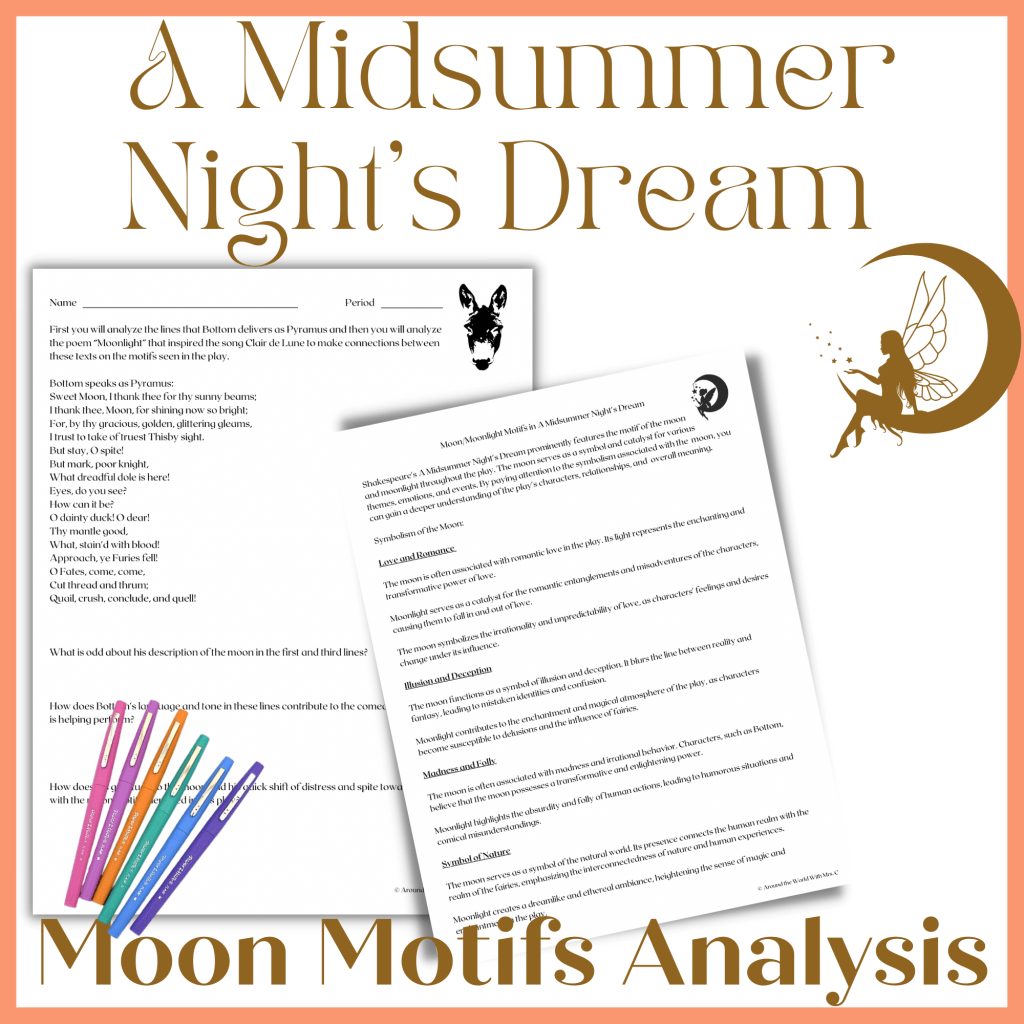
One of the most important motifs in A Midsummer Night’s Dream is the moon and moonlight. Shakespeare uses the moon to represent love, magic, and change. In many scenes, moonlight creates a dreamlike and mysterious atmosphere where characters fall in and out of love, make silly mistakes, and get caught up in illusions.

The moon also connects the natural world with the magical world of the fairies, showing how nature can influence people’s emotions and actions. Just like the moon is always changing, the characters in the play go through changes too.
Before reading the play, it’s helpful to talk with students about how the moon shows up in stories, music—especially when it comes to love, confusion, or transformation. It is frequently referenced throughout the play, from Theseus’ comments about the moon’s slow pace to Titania’s poetic descriptions of the night.
Here are some simplified interpretations of the moon motif that can be used to guide student analysis:
Love and Romance
The moon is often connected to love and romance in the play. Its light seems magical and mysterious, causing characters to fall in and out of love. It also shows how love can be unpredictable and confusing.
Illusion and Deception
The moon adds to the dreamlike feel of the play. It creates a sense of illusion, making it hard to tell what’s real and what’s not. Characters are easily tricked or confused under its light.
Madness and Folly
The moon is linked to silliness and strange behavior. Characters act foolishly and experience humorous misunderstandings, adding to the play’s comedy.
Symbol of Nature
The moon connects the human world with the fairy world. Its glow helps create the magical setting and reminds us how nature and human experiences are linked.
Transformation
The moon constantly changes shape, symbolizing transformation. Just like the moon, characters go through big changes during the play, especially under its light.
Poetry Pairings with A Midsummer Night’s Dream
To further enrich students’ understanding, consider pairing A Midsummer Night’s Dream with poetry that explores similar themes.
“If You Forget Me” by Pablo Neruda can be used to explore the themes of love, loyalty, and emotional connection. In Act III of A Midsummer Night’s Dream, characters struggle with shifting affections under the influence of magic. Neruda’s poem speaks of a deep and enduring love that changes depending on how the other person acts—much like how love in the play is conditional and manipulated. Students can discuss how love can be powerful, but also dependent on choice and circumstance.
You can also compare Bottom’s lines as Pyramus to the famous French poem “Moonlight” by Paul Verlaine.

Sweet Moon, I thank thee for thy sunny beams;
I thank thee, Moon, for shining now so bright;
For, by thy gracious, golden, glittering gleams,
I trust to take of truest Thisby sight.
But stay, O spite!
But mark, poor knight,
What dreadful dole is here!
Eyes, do you see?
How can it be?
O dainty duck! O dear!
Thy mantle good,
What, stain’d with blood!
Approach, ye Furies fell!
O Fates, come, come,
Cut thread and thrum;
Quail, crush, conclude, and quell!
Verlaine’s poem paints a dreamy, melancholy image of moonlight and emotion. It connects well with the exaggerated, poetic speech of Bottom as Pyramus in the play-within-a-play. Bottom’s lines—“Sweet Moon, I thank thee for thy sunny beams…”—mimic the romantic and over-the-top style of classic poetry, while also parodying it. Both the poem and Bottom’s speech show how moonlight can stir deep feelings, but also how those feelings can sometimes be dramatic or even ridiculous.
Claude Debussy’s famous piano piece “Clair de Lune” (which translates to “Moonlight”) was inspired by the poem. You could even consider playing the song and discussing how it reflects the poem!
Final Thoughts
Teaching A Midsummer Night’s Dream offers countless opportunities for creativity and deeper literary analysis. By incorporating film study, mythology, moon motifs, and poetry pairings, you can make Shakespeare’s work more accessible and engaging for students.
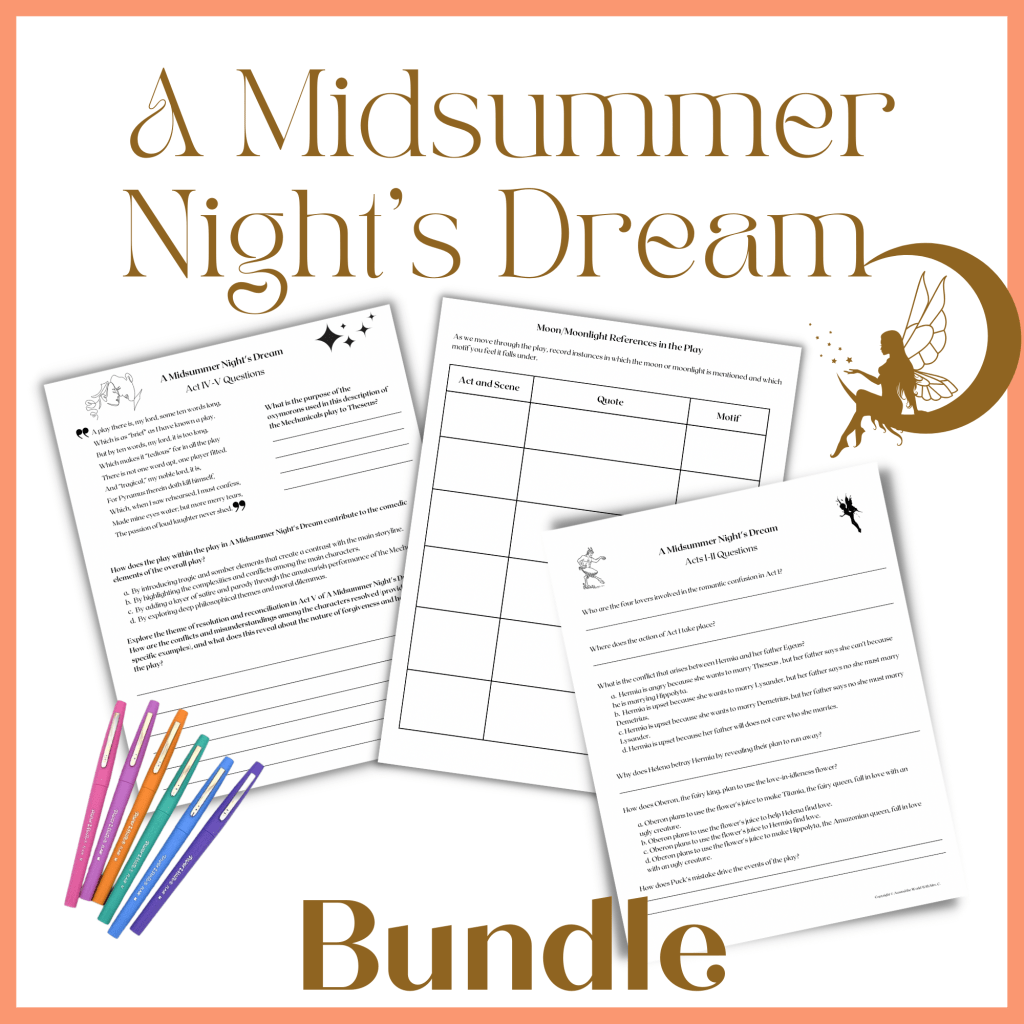
If you are ready to have your students fall in love with this play and its timeless magic, check out this bundle! It has everything you need.
Join my weekly newsletter!
Would you love to get weekly tips and resources for teaching secondary English delivered right to your inbox? Click here to join!
 Around the World With Mrs. C
One thought on “Unlocking the Magic of Love and Moonlight: Creative Ways to Teach A Midsummer Night’s Dream”