

Have you ever introduced a classic text to your students, only to be met with blank stares and low energy? You’re not alone. One of the biggest challenges in high school English is helping students connect personally with what they’re reading and think critically about it.
That’s why I love inquiry-based learning.
Inquiry isn’t just a buzzword. It’s a powerful approach that transforms your classroom from a place where answers are memorized… into a space where students ask the questions. And more importantly, they care about finding the answers.
In this post, I’ll walk you through how to build your own inquiry-based unit in English class step by step. And if you’d rather skip the planning? I’ll show you how to use ready-made resources that do the heavy lifting for you.
Make the case for inquiry: boosts engagement, critical thinking, real-world connections.
What Is Inquiry-Based Learning (IBL) in the English classroom?
Inquiry- based learning is often thought of in the world of STEM or for elementary level students. However, it has such wonderful benefits for our high school ELA students as well!
Inquiry-based learning requires our students to consumer multiple sources of texts and synthesize a nuanced answer to an open-ended question. Because of this, studies have shown that it increases critical thinking, enhances engagement, and leads to much deeper understanding in our students.
There are a couple of ways you can do this. One is where you generate the question for your students. With this, you would also provide some (of not all) the texts that they will use to answer this question.
In the other hand, you can have students generate their own question and you act more like a guide as they delve into their own research looking for texts to answer the question.
In this blog post, I will be focusing on the teacher-lead option. However, I have two great resources to help you with student-lead inquiry HERE and HERE!
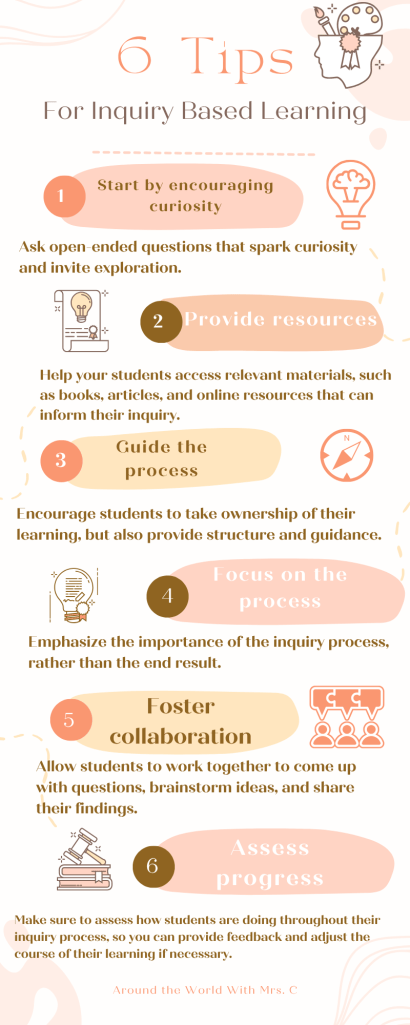
Step 1: Start with a Big, Open-Ended Question
The heart of any inquiry unit is a strong essential question. A good one isn’t easy to answer—it invites debate, reflection, and exploration.
Here are a few examples from my own units:
- How do our fears and anxieties influence the way we perceive reality?
Fear & Reality Inquiry Unit – featuring “The Fall of the House of Usher”, “The Legend of Sleepy Hollow” and more to explore the ideals of Dark Romanticism. - What do our heroes say about the values of our culture?
Mythical Hero Project-Based Learning Unit – where students learn about mythical heroes from around the world and then create a modern mythical hero for younger audiences - Why do humans like to be scared?
Suspense Unit – This unit has students Exploring how fear captivates the human imagination through techniques like pacing, unreliable narration, and atmosphere. It engages them in analyzing stories such as Limetown and “The Fall of the House of Usher”. Finally, they create their own suspenseful piece. - How do fear and desire interact in the vampire myth? In what ways do vampires reinforce or challenge moral boundaries? Vampire Unit – This unit invites students to explore how vampire stories reflect complex human emotions, cultural anxieties, and shifting moral codes. Through texts like Carmilla, “The Vampyre”, classic vampire lore, and modern interpretations, students analyze how the vampire figure blurs the line between attraction and danger.
Students don’t just read with these questions in mind. They engage, question, and argue! Every text becomes another part of the puzzle that is answering this question. And that changes everything.
💡 Need help writing strong essential questions?
You can do this one of two ways.
- Focus on a topic and what are some universal questions that can be applied to this topic? Then, search for a variety of texts that can be used to give insight into answering the question.
For example you could consider the topic individuality. But, then you create the question: What responsibilities do individuals have to their communities?
Sample Texts:
- To Kill a Mockingbird by Harper Lee
- Antigone by Sophocles
- The Absolutely True Diary of a Part-Time Indian by Sherman Alexie
- The Crucible by Arthur Miller
Why this works:
This question frames character actions and conflicts around duty, justice, and sacrifice. It’s particularly effective in exploring civic engagement, resistance, and ethical dilemmas. These are timely themes for students navigating their own roles in society.
2. You know the main text you want to use, so then you consider the topic and the universal question that best goes with it.
For example: Lord of the Flies by William Golding
Since so much of this book centers around fear and power structures, you can pose the question: In what ways do fear and power shape human behavior? You can then layer in supplemental texts throughout your unit that continue to add new aspects of this question.
➡️ FYI: I include ready-to-use inquiry questions in every one of my thematic World Literature units—see the full list in this resource.
Step 2: Choose Texts That Support Exploration
Once you have your big question, you’ll need texts that support it. I recommend using:
- A central anchor text (short story, novel, play or podcast)
- 2-3 supporting texts, which might include nonfiction, poetry, film, or podcasts
- A choice board that students can use to determine their final text
For example, in my Fear & Reality with Dark Romanticism Unit, I pose the question: How do our fears and anxieties influence the way we perceive reality?
We first learn about the Romantic movement from Europe and then zero in on how it splintered in America and the Dark Romantics. The Dark Romantics tended to believe that humanity was naturally drawn to darkness and sinister. They often depicted the natural world is dark, decaying, and mysterious; when it does reveal truth to man, its revelations are evil and hellish.

I then pair:
- “The Fall of the House of Usher” by Edgar Allan Poe
- “The Legend of Sleepy Hollow” by Washington Irving
- “Young Goodman Brown” by Nathaniel Hawthorne
- Informational text: How Does Your Physical Environment Affect You and Your Mental Health?
- Poems: “The Ocean” by Nathaniel Hawthorne and “Annabel Lee” by Edgar Allan Poe
Each piece adds a new layer to the question students are investigating in considering the inquiry question.
Step 3: Plan Scaffolded Activities That Lead to the Inquiry
This is where it comes to life!
Each activity in an inquiry-based unit should build toward helping students answer the big question. That doesn’t mean every lesson needs to be dramatic, but it does mean you’re constantly pushing for deeper thinking.
Try:
- Close reading questions that connect literary elements to the essential question
- Socratic Seminars or philosophical chairs that give students space to test ideas
- Creative journal prompts that ask students to take on a character’s voice or rewrite a scene
For example, students consider: How does Hawthorne use the setting of the forest in the following quote to create a sense of mystery and fear in the story?
“As they went, he plucked a branch of maple, to serve for a walking-stick, and began to strip it of the twigs and little boughs, which were wet with evening dew. The moment his fingers touched them, they became strangely withered and dried up, as with a week’s sunshine. Thus the pair proceeded, at a good free pace, until suddenly, in a gloomy hollow of the road, Goodman Brown sat himself down on the stump of a tree, and refused to go any farther”.
The forest is dark and unpredictable, symbolizing moral ambiguity. The withering branch creates an eerie, supernatural tone, while the “gloomy hollow” suggests a descent into moral corruption and fear of the unknown.

Or when they read “The Legend of Sleepy Hollow”, they consider: How does the deepening darkness during Ichabod Crane’s ride home heightens his fears and fuels his imagination, blurring the line between reality and superstition.
Though the night was dark and dismal, yet the form of the unknown might now in some degree be ascertained. He appeared to be a horseman of large dimensions, and mounted on a black horse of powerful frame. He made no offer of molestation or sociability, but kept aloof on one side of the road, jogging along on the blind side of old Gunpowder, who had now got over his fright and waywardness.- The Legend of Sleepy Hollow
The dark setting adds to his growing anxiety, making it hard for him to tell what’s real and what’s in his mind. This shows how a scary environment can shape how we see the world around us.
In every unit I create, I design the lessons so that students move from comprehension ➝ analysis ➝ synthesis, without feeling overwhelmed.
✨ Want a ready-to-go unit that blends Dark Romantic fiction, psychology, and inquiry? Check out my full Fear & Reality Unit.
Step 4: Focus on the Process and Collaboration
Inquiry calls for more than a test or quiz. The best assessments ask students to show their thinking, argue their ideas, and reflect on how their perspective has changed. You will want to have several checkpoints along the way that allows students to work independently as well as with others.
Here are a few that work especially well:
- Targeted close reads that have students work with a text with the inquiry question in mind
- A multi-modal project (like a podcast, a character social media profile, or a blog-style journal)
- Socratic Seminars that have students discuss and debate on the inquiry question, but also all the ones that connect to it!
- A collaborative creative project like the Mythical Hero Children’s Book Project, where students work with an actual elementary class to create a modern hero story for young readers
Not sure how to assess creative projects? I include detailed rubrics with every inquiry or PBL unit.
Step 5: Differentiate for Real Classrooms
Inquiry is flexible by nature, but it also needs thoughtful scaffolding for real classrooms.
Here’s how I differentiate within inquiry-based learning:
- Text Sets: Provide varied levels of text for choice and accessibility. This may mean a variety of novels, but you may also want to consider:
- Graphic novels
- Pairing podcasts with excerpts
- If it’s an open-source text, modify the language if needed
- Graphic Organizers: Support students who need help organizing complex thinking
- Group Projects with Assigned Roles: Like my Bloom Ball activity for The Fall of the House of Usher, where each student tackles a specific literary focus
- Sentence Starters & Question Stems: Help ESOL and SPED students participate in high-level discussion
These tools are built into my inquiry units to make sure every student has an entry point into deep thinking.
Step 6: Assessment- Applying what they have learned to give a well-rounded answer to the inquiry question
One of the biggest misconceptions about inquiry-based learning is that it lacks structure when it comes to assessment. In reality, a strong inquiry unit uses ongoing formative assessments to track student growth and ends with a larger summative task that asks students to demonstrate what they’ve learned in a meaningful, well-rounded way.
Here’s how assessment works in my “Fear and Reality” with Dark Romanticism inquiry unit:
Formative Checks Along the Way: As students explore texts like “The Legend of Sleepy Hollow”, “The Fall of the House of Usher”, and “Young Goodman Brown,” they’re continuously engaging with the essential question:
How do our fears and anxieties influence the way we perceive reality?
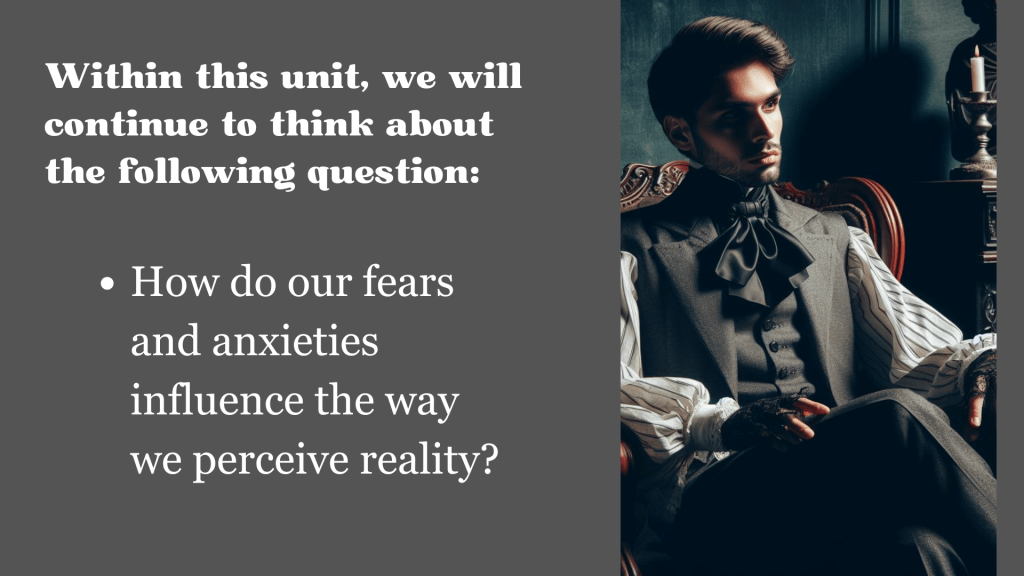
Rather than relying on quizzes or rote responses, the unit uses embedded formative assessments to check for understanding and build toward deeper thinking:
- Guided discussions and annotated close readings that focus on tone, word choice, and symbolism
- Group debates (e.g., Are Madeline and Roderick Usher actually vampires?) that ask students to use evidence to support a claim
- Visual representations and mind maps that illustrate how a character’s fears shape their reality
- Stations activities where students analyze how different settings and symbols across stories reflect mental and emotional states
Each of these moments gives students a chance to think critically and gives you a chance to monitor their progress. You’ll see them begin connecting ideas across texts, themes, and psychological concepts—all of which prepares them for the final tasks.
Final Discussion: Socratic Seminar
Before the final project, students also engage in a Socratic Seminar to revisit the inquiry question as a class. They bring in evidence from multiple texts, challenge each other’s interpretations, and openly discuss their ideas. This not only deepens their understanding but prepares them for their final written or creative product.
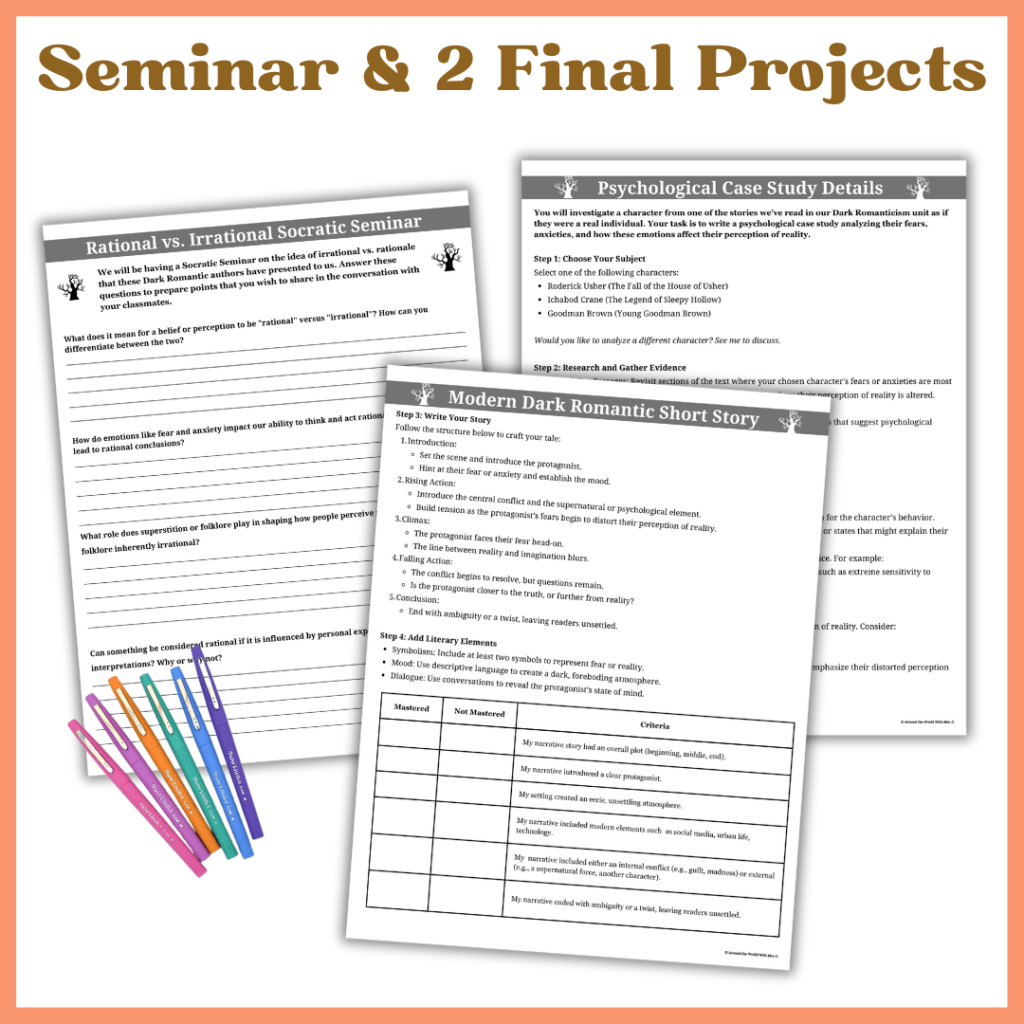
In this seminar, students engage in the following types of questions with each other using all the information they have considered through the unit:
- What does it mean for a belief or perception to be “rational” versus “irrational”? How can you differentiate between the two?
- How do emotions like fear and anxiety impact our ability to think and act rationally? Can they ever lead to rational conclusions?
- How do authors like Poe, Irving, and Hawthorne use irrationality to drive the plot and develop their themes? Are their characters justified in their irrational beliefs? Pull one specific reference from one of the texts we covered to support your answer.
Summative Assessment: Bringing It All Together
In the final week, students revisit the inquiry question and synthesize what they’ve learned in one of two culminating project options. Teachers can either choose the one they think is best suited for the class or you can give your students the choice they would prefer:
Psychological Case Study Project
Students select a character from one of the unit’s core texts (e.g., Roderick Usher, Ichabod Crane, Young Goodman Brown) and:
- Diagnose the character’s fears and anxieties
- Analyze how these psychological traits affect their perception of reality
- Present their findings as a written case study or mock therapy session
This task taps into literary analysis, character development, and psychological interpretation—all through the lens of inquiry.
Modern Dark Romantic Story
For a more creative option, students can write an original story that:
- Incorporates key elements of Dark Romanticism (Gothic setting, fear, supernatural, psychological depth)
- Connects with a modern fear or anxiety (e.g., social isolation, digital surveillance, failure)
- Explores how that fear distorts the character’s sense of reality
They begin with a planning “snapshot,” check-in for feedback, and then move into the writing process. Graphic organizers and writing outlines help all students. Meanwhile, advanced writers are encouraged to include symbolism or allegory.
Bonus Tips for Teachers New to Inquiry
Building an inquiry-focused classroom may not be easy at first. That is totally fine if it takes some time to tweak and feel comfortable with it. So, DO. NOT. WORRY!
Here are my top tips for when you are starting so that you don’t feel overwhelmed:
- Start small: Try a 1- or 2-week inquiry unit before planning a full quarter. For example, I have this 7-day inquiry mini study that focuses on how our memories impact our identity. This bite-sized look at inquiry can be the perfect place to start OR the perfect way to work one into existing curriculum demands.

- Model questioning: Think aloud while reading a passage. “Why is the narrator unreliable here?”
- Let go of control: You don’t have to know the answers. You’re a guide, not a gatekeeper. It is meant to be a journey for your students to come to their own complex answers and that doesn’t always mean that they will all align.
- Use writing as a tool to process: Reflection journals, one-pagers, or visual notes can help students connect the dots.
Wrap-Up: Inquiry Transforms English Class
Inquiry-based learning invites your students to wrestle with ideas that matter—not just in literature, but in life. And while it takes thoughtful planning, the payoff is worth it.
And if you’re short on time (who isn’t?), you don’t have to build inquiry units from scratch. I’ve created ready-to-use resources that walk you through the whole process—essential questions, scaffolded lessons, text pairings, assessments, differentiation, and more.
Want everything done for you? Here is a list of all of my units that are designed specifically for inquiry-based learning in the secondary ELA classroom.
Mythical Hero Project-Based Learning Unit
Memory, Identity, & Magical Realism: A Mini-Study of 1,000-Year-Old Ghosts
Full Year High School World Literature
Critical Lens Theory and Fairytales



Join my weekly newsletter!
Would you love to get weekly tips and resources for teaching secondary English delivered right to your inbox? Click here to join!
 Around the World With Mrs. C