

If you’ve ever wished you could teach Magical Realism without overwhelming your students, The Paper Menagerie by Ken Liu is the perfect solution. It’s emotionally powerful, culturally rich, accessible for a wide range of readers, and packed with literary devices that make it ideal for teaching theme, point of view, and author’s craft.
It’s also one of those “I can’t believe a short story just did that to me” texts. Your students will feel this one in their bones.
But it can also be tricky to teach without the right support. Magical Realism, memory vs. reality, cultural identity, mother–son relationships…there are so many layers to unpack.
That’s why I created this resource that guides students step-by-step through the story’s thematic development. Focusing on quote analysis, inferences, and author’s craft—while helping them understand the beauty and purpose behind Magical Realism.
Why The Paper Menagerie Works So Well in High School ELA
Teachers often tell me they’re searching for a text that:
- Introduces Magical Realism without the density of García Márquez
- Engages students immediately
- Helps students feel theme, not just identify it
- Connects to discussions about identity, family, culture, and language
- Works beautifully for quick checks, close reading, or building toward a literary analysis
This story checks all of those boxes!
You can find an open-source text version here and you can listen to LeVar Burton read it here (grab your tissues because his reading of this will make you cry!).
In case you are new to the story, here’s a brief summary:
The Paper Menagerie is the heartbreaking story of Jack, a biracial Chinese American boy who doesn’t realize the depth of his mother’s love until it is far too late.
As a young child, Jack is incredibly close to his mother, who speaks very little English. She entertains him with magical origami animals that come to life when she breathes into them. They are tiny, delicate creatures made of wrapping paper and love. His favorite becomes the tiger named Laohu, which is the Mandarin word for “tiger”.
But as Jack gets older and begins facing racism from classmates and neighbors, he starts to push his mother away. Embarrassed by her accent, her traditions, and her refusal to “be more American,” Jack slowly distances himself from the Chinese half of his identity—and from her.
After her death, Jack rediscovers his old paper menagerie along with a letter his mother wrote for him. Finally, he begins to understand the sacrifices she made and the fierce love she carried for him. It’s a story rooted in love, language, culture, and memory.

“You know what the Chinese think is the saddest feeling in the world? It’s for a child to finally grow the desire to take care of his parents, only to realize that they were long gone.”Ken Lui
One teacher who used this resource said:
“I had heard good things about this story, and wanted to give my students something that employed Magical Realism but wasn’t as dense as Garcia Marquez. This was a perfect fit. My students had a lot to say about Jack.”
— Amy P.
Another wrote:
“I had heard that this story was popular with students and wanted to give it a go. This resource was very helpful.”
— Wendy W.
When students reach the ending—especially when they realize why the “magic” returns on Qingming—they suddenly get it. It’s the moment when theme, cultural context, and emotional impact come together.
Inside our The Paper Menagerie Resource
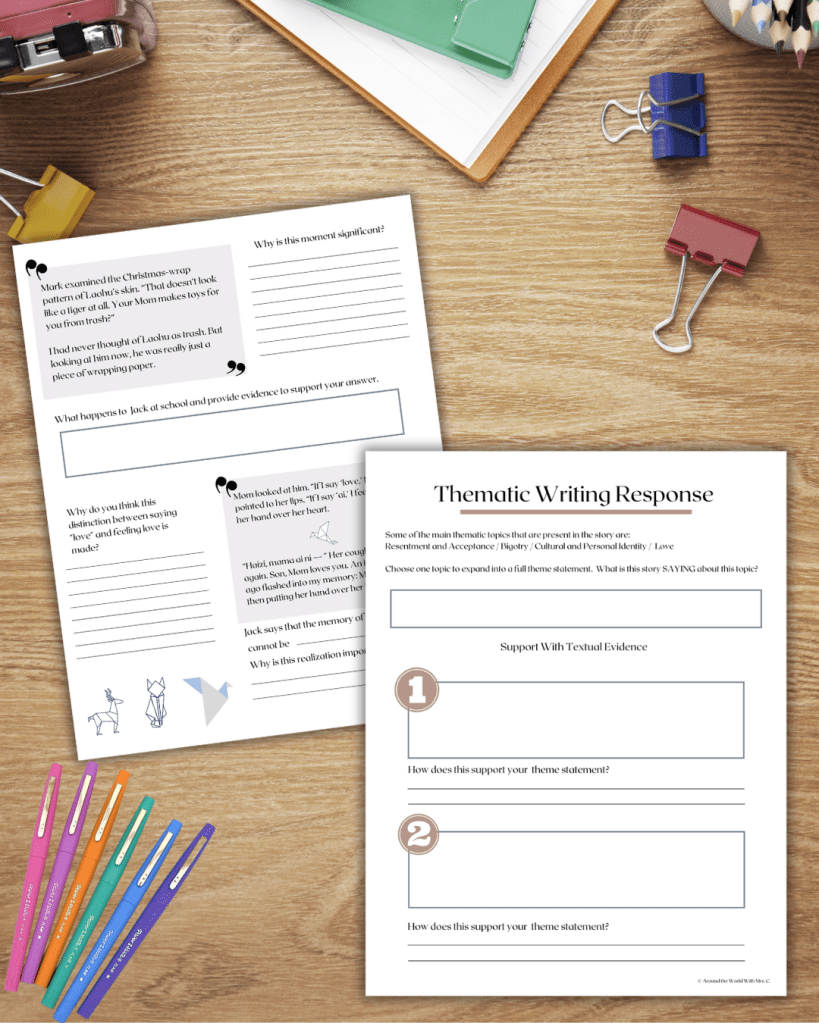
This no-prep product gives you everything you need to guide students from surface-level comprehension to a well-supported thematic statement.

Included:
- PowerPoint on Magical Realism
A genre overview with student-friendly definitions and recognizable examples. - PDF copy of the short story
Easy access for students and simple printing for you. - Three beautifully designed analysis handouts
Students explore:- quote analysis
- point of view
- author’s craft
- the role of memory
- cultural symbolism
- irony
- the significance of the paper animals
- Answer keys for all handouts
Perfect for grading support or modeling. - A thematic analysis outline
This helps students turn their notes into a meaningful theme statement with text-based evidence—ideal for a short constructed response or the blueprint for a full essay.

These handouts break the story down into manageable, thoughtful steps. Students reflect on questions such as:
- Why does the mother make the first paper animal?
- What does Jack’s shift in perspective reveal about memory and identity?
- Why does it matter that the magic returns on Qingming?
- What does the distinction between “love” and “ai” reveal about cultural expression?
By the final page, students can articulate the story’s thematic message in a way that’s personal, thoughtful, and academically sound.
Why Students Respond So Strongly to This Story
Teaching The Paper Menagerie gives students an opportunity to explore:
- immigration & cultural identity
- the parent–child relationship
- the power of memory
- the ways shame can shape how we see ourselves
- the intersection of culture, love, and language
- the quiet sacrifices parents make
The story becomes a safe, accessible way to talk about belonging, growing up, and the parts of our identity we sometimes try to hide.
And Magical Realism isn’t just “fun fantasy”, it becomes the emotional language of the story.
Perfect Pairings for a Larger Magical Realism Unit
Because the story is accessible and short, it works beautifully as:
- an intro before texts like Big Fish, A Monster Calls, or The Night Circus
- a stand-alone 1–3 day lesson
- a springboard into literary analysis writing
- a powerful addition to a Coming-of-Age unit
- a text for exploring multicultural and multilingual themes
Final Thoughts
The Paper Menagerie is one of those rare short stories that stays with students long after they leave your classroom. With the right scaffolding, it becomes a transformative reading experience—one that helps teens connect with literature, with theme, and often with themselves.
If you want to bring this story to your students without the overwhelm, you can check out my ready-to-use resource below. It gives you:
- structure
- analysis support
- genre introduction
- writing guidance
- and a fully planned lesson from start to finish
So you can focus on what matters most: the conversations this story invites.
Join my weekly newsletter!
Would you love to get weekly tips and resources for teaching secondary English delivered right to your inbox? Click here to join!
 Around the World With Mrs. C