

It’s no secret that I love great World Literature—but I also love introducing students to stories outside the traditional canon through beautifully crafted foreign films. Celtic mythology has always held a special place in my heart, so when the Irish animated film Song of the Sea released several years ago, I knew immediately that I had to watch it.
This award-winning movie drew me in from the very first scene and has never let go. Even better? My students love it year after year.
So today, I want to revisit this incredible film and show you why it deserves a spot in your classroom, especially if you’re hoping to diversify your mythology units while still hitting key ELA standards.

If you’re ready to jump in right away, I’ve created a ready-to-go mini unit that walks students through Celtic myths, the film, and all its rich literary elements.
Why Song of the Sea Belongs in Your Classroom
By the time students get to my 10th grade class, they’ve usually been immersed in Greek and Roman myths (yay!), but Celtic mythology is almost always missing from their background knowledge. Beyond leprechauns on St. Patrick’s Day, many have never encountered the richness of Irish myth and folklore.
Song of the Sea is a perfect bridge:
- It introduces students to Celtic deities, folklore, and Fae traditions
- While also reinforcing literary elements like parallel plot, symbolism, archetypes, and flashback
- All through a visually stunning, emotionally powerful story
I like to begin with the mythology that appears in the film so students have some background before watching.
Mythology in the Movie Song of the Sea
Manannán mac Lir
Manannán mac Lir (the “son of the sea”) is one of the main deities reflected in the movie. In Celtic mythology, he’s often a powerful defender who uses his magic to protect the land—especially through mist that confuses invaders.
In Song of the Sea, we see echoes of Lir’s grief and loss mirrored in the human character Connor, who loses his wife in the opening scenes. Both stories explore how overwhelming grief can consume you—and how healing, while painful, is possible.
Macha
Macha can be a challenging deity to teach because she’s part of a larger trio of powerful female figures (mother, maiden, crone). For this mini study, I focus on “The Curse of Macha.”
In the myth, Macha is pregnant with twins and forced to race despite knowing it will harm her. Afterwards, she curses the men present with labor pains so they can feel her suffering.
In the movie, Macha is also a mother desperate to take away her son Mac Lir’s pain. Her attempts to “fix” his grief by removing it entirely result in people being turned to stone—an incredible visual metaphor for how numbing emotions can freeze us instead of helping us heal.
Selkies
Selkies are one of my favorite parts to teach. These shape-shifters are seals in the water and humans on land once they shed their seal skins. In many tales, selkie women are trapped when their skins are stolen or hidden, forcing them into a human life they were never meant to lead.
In Song of the Sea, Bronagh (the mother) is a selkie. She disappears into the sea one night while pregnant, and her son Ben never sees her again. His younger sister Saoirse is born that same night.
By age seven, Saoirse is still nonverbal. One night she discovers a white coat, puts it on, and transforms into a luminous white seal. Without this coat, her life force begins to drain away. Over the course of the movie, Ben gradually discovers the truth: both his mother and sister are selkies.
Students are usually enthralled by this myth and the idea of “belonging” to two worlds—but not fully fitting into either.
Yeats, Irish Identity, and Lost Traditions
The film also opens a door to studying W.B. Yeats and Irish identity. The very first lines of the movie come from his poem “The Stolen Child”:
Come away, O human child!
To the waters and the wild
With a faery, hand in hand,
For the world’s more full of weeping than you can understand

Yeats was deeply involved in Irish cultural and nationalist movements, and he frequently drew on Celtic mythology in his work. That same impulse—to preserve and honor Ireland’s mythic past—runs through Song of the Sea.
The director, Tomm Moore, has talked about being inspired by seeing dead seals washed up on a beach and hearing a local say that in older times, when seals were revered, this never would have happened. It’s a powerful conversation starter about:
- How modern life distances us from folklore and tradition
- Why stories and myths matter to cultural identity

In the mini unit, students get to analyze “The Stolen Child” alongside the film and look at how both texts speak to themes of loss, wonder, and leaving the human world behind.
Symbolism and Celtic Traditions in the Film
The movie is packed with symbolism and Celtic imagery, and this is where the lit teacher in me really lights up.
Some of the symbolic elements we explore:
- Spirals – These appear throughout the movie. Historically, spirals in Celtic art can represent personal journey and transformation. Students trace Ben’s emotional journey and connect it to this symbol.
- Circles and fairy mounds – These structures and shapes pop up again and again, tying into ancient beliefs about the Fae and sacred spaces.
- Names as symbols – Character names are rich with meaning.
- Saoirse means “freedom,” and her role is literally to free the fairy kind trapped in the human world.
- Bronagh is connected to sadness and grief, and students feel that deeply in the final scenes when she must leave her family.
Every time I teach this, I feel like I could write ten more blog posts just unpacking the symbolism. And honestly? I’m still only scratching the surface.
Inside the Song of the Sea Mini Unit
If you want to bring all of this into your classroom without spending hours piecing it together, my Song of the Sea: Celtic Mythology Mini Unit is already done for you.
Students begin by exploring several Celtic myths and legends, such as:
- Manannán’s Horses
- The Children of Lir
- Macha’s Curse
- Tír na nÓg: The Story of Niamh and Oisín
- Cú Chulainn
- Legends of selkies
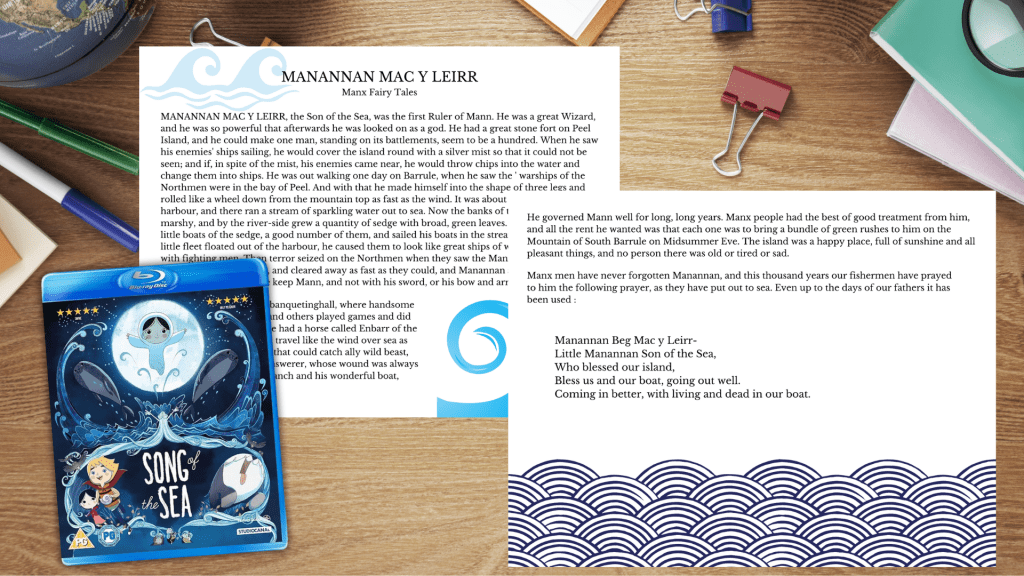
Then they watch Song of the Sea and analyze:
- Symbolism and archetypes
- Theme and parallel plots
- Flashbacks and narrative structure
- Connections to Celtic traditions and Yeats’ “The Stolen Child”

To make your life easier, the mini unit includes:
- A historical intro and Celtic mythology PowerPoints
- A Symbolic Archetypes handout
- A Parallel Structure and Flashback mini-lesson
- A Symbolism in Song of the Sea PowerPoint
- 9 myths/legends (printable or uploadable for digital reading)
- A deeper-dive PowerPoint on the mythological figures in the movie
- A Samhain presentation to connect the film’s setting with Celtic celebration traditions
- A poem analysis of Yeats’ “The Stolen Child”
- A 3-page movie analysis handout (parallel plot, flashbacks, archetypes)
- 4 possible essay prompts on the movie
- Answer keys and sample responses
- A culminating PBL project where students pitch their own myth-based movie in a similar style to Song of the Sea
- Skills-based rubrics, including a 2-point rubric for the film analysis and role-specific rubrics for the PBL project
I’ve also built in multiple formative assessment options, so you can easily adjust for different ability levels and needs in your classroom.

Why Students Love This Unit
This mini look at Celtic mythology and Song of the Sea is always a big win with my students. They:
- Get to explore a mythology they’ve never seen before
- Connect animated storytelling with serious literary analysis
- Discuss grief, family, identity, and cultural traditions in a meaningful way
- Practice close reading skills with both print texts and film
And honestly, there is nothing better than hearing,
“Wait…are we really going to analyze a cartoon like we do a story?”
and then watching the lightbulb go on when they realize how rich it really is.
If you’re ready to bring Celtic mythology and Song of the Sea into your classroom, you can grab the ready-to-go mini unit in my store and start as soon as you hit “download.”
It’s a beautiful way to broaden your mythology offerings, hit key ELA standards, and give students an unforgettable world literature experience.
 Around the World With Mrs. C