

January can feel like the longest month of the school year.
Students are coming back from break unfocused, routines need to be reestablished, and teachers are expected to jump right back into rigorous instruction—often with very little energy left in the tank.

That’s exactly why I created my Time-Saver January Winter Inquiry Bundle: a flexible, meaningful collection of lessons designed to make the transition back from winter break smoother, calmer, and more engaging for everyone in the room.
Whether you want a seamless two-week mini unit or a collection of high-quality activities you can pull from all year long, this bundle is built to support you (not overwhelm you).
Why Winter Texts Work So Well in January
Winter literature naturally mirrors how students feel in January: reflective, quiet, restless, curious, and sometimes overwhelmed.
Snow becomes more than just a setting—it becomes a symbol. Across cultures and genres, winter reveals:
- beauty and wonder
- danger and survival
- isolation and connection
- responsibility and temptation
Using winter texts allows students to ease back into analysis through imagery, mood, and theme, rather than jumping straight into dense literary theory.
The Anchor: A Powerful Essential Question
At the heart of the bundle is one guiding question that connects every text:
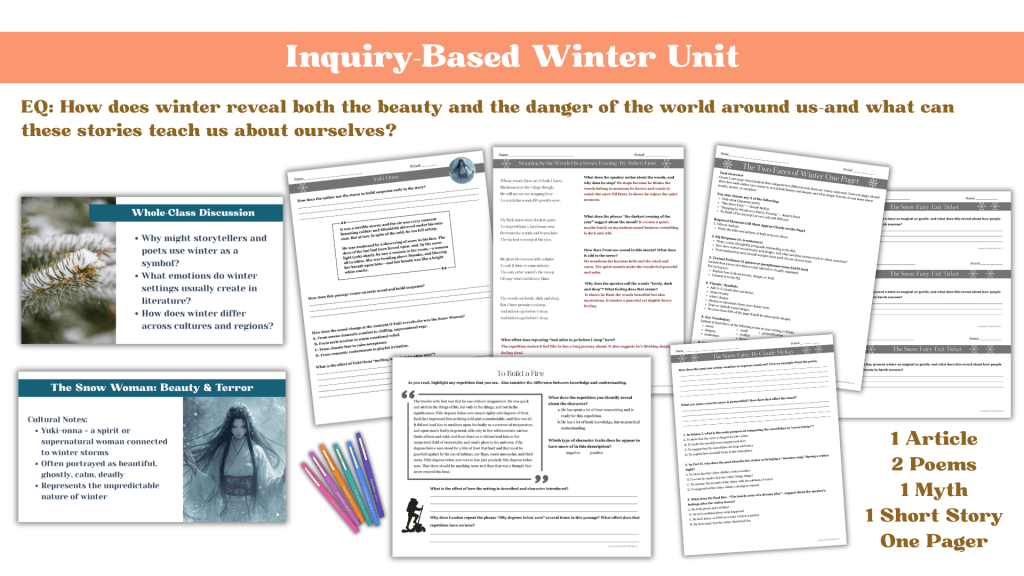
How does winter reveal both the beauty and the danger of the world around us, and what can these stories teach us about ourselves?
This EQ gives students something to return to daily. It also means teachers don’t have to reinvent the wheel—every discussion, annotation, and writing task has a clear purpose.
What’s Inside the Winter Inquiry Bundle
1. A Complete Inquiry-Based Mini Unit
The core of the bundle is a winter-themed inquiry sequence that can be taught as a 2-week mini unit or shortened depending on your schedule.
Students analyze winter through multiple lenses using:
- Why Does Snow Bring Childlike Joy?– article from Scientific America
- “The Snow Fairy” by Claude McKay
- “Stopping by Woods on a Snowy Evening” by Robert Frost
- Yuki-Onna, a Japanese myth
- To Build a Fire by Jack London

Each text includes:
- close reading and annotation questions
- discussion prompts
- guided analysis tasks
- opportunities to compare how different authors portray winter
The progression intentionally moves from whimsy and beauty to quiet reflection, then into danger, survival, and consequence, helping students see how one idea can be interpreted in radically different ways.
2. A Meaningful Culminating One-Pager
Instead of a traditional test or essay, students complete a one-pager assessment that asks them to:
- synthesize ideas from two texts
- connect evidence back to the essential question
- combine analysis with visual symbolism
This assignment works beautifully in January because it’s rigorous without being draining, and it gives students a sense of creative ownership as they return to school.
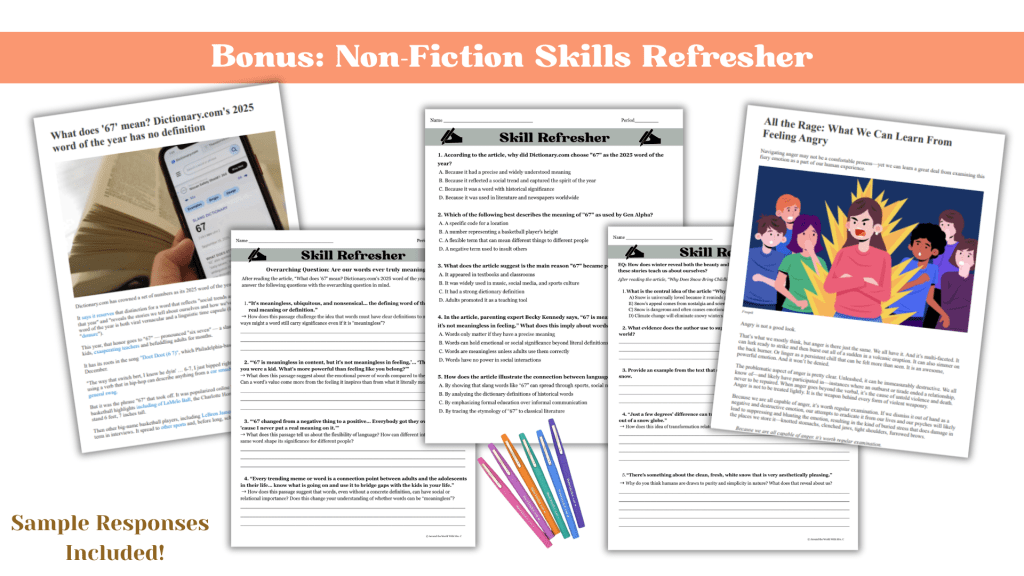
3. Nonfiction Skills Refreshers
To help students rebuild academic stamina, the bundle also includes high-interest nonfiction articles focused on winter and human behavior.
These are perfect for:
- bell ringers
- skill review days
- easing students back into annotation and short written responses
They’re structured enough to rebuild routines, but engaging enough to avoid burnout.
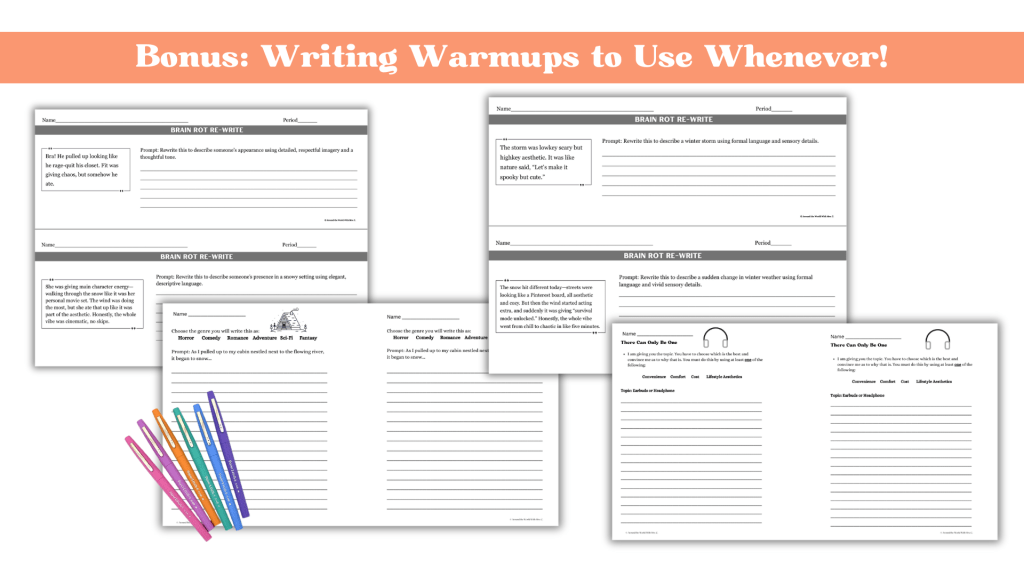
4. Bonus Writing Warmups You Can Use All Year
One of the most versatile parts of the bundle is the collection of writing warmups, including:
- Brain Rot Re-Writes (winter edition)
- Show Don’t Tell prompts
- Creative writing starters
These are ideal for:
- the first 5–10 minutes of class
- sub plans
- days when you need something meaningful but low-prep
And because they aren’t tied to a single unit, you’ll keep using them long after January ends.
How This Bundle Makes Teaching Easier
This isn’t just about content—it’s about mental load.
Teachers love this bundle because:
- everything works together, but nothing has to be used together
- lessons are ready to print or project
- texts are short, engaging, and discussion-rich
- activities are scaffolded for mixed-ability classrooms
- it saves planning time during one of the hardest months of the year
You can teach the unit straight through, pull a poem for a single class period, use the nonfiction articles as skill refreshers, or save the one-pager for a completely different unit later on.
A Calm, Purposeful Way to Begin the New Year
January doesn’t need to feel rushed or chaotic.
With the right texts and a clear inquiry focus, it can be a time for reflection, meaningful discussion, and rebuilding confidence—for both students and teachers.
This Winter Inquiry Bundle is designed to give you:
- structure without rigidity
- depth without overload
- engagement without extra prep
So you can walk back into your classroom after break feeling prepared, grounded, and ready to teach.
 Around the World With Mrs. C