

Personal narrative writing can be one of the most meaningful units we teach in ELA—but it can also be one of the most frustrating.
Students often struggle long before drafting ever begins. They don’t know what moment to choose, how to connect emotions to events, or how to move beyond vague summaries. Teachers, meanwhile, are left creating extra scaffolds, mini-lessons, and examples just to get students to a place where writing can begin.
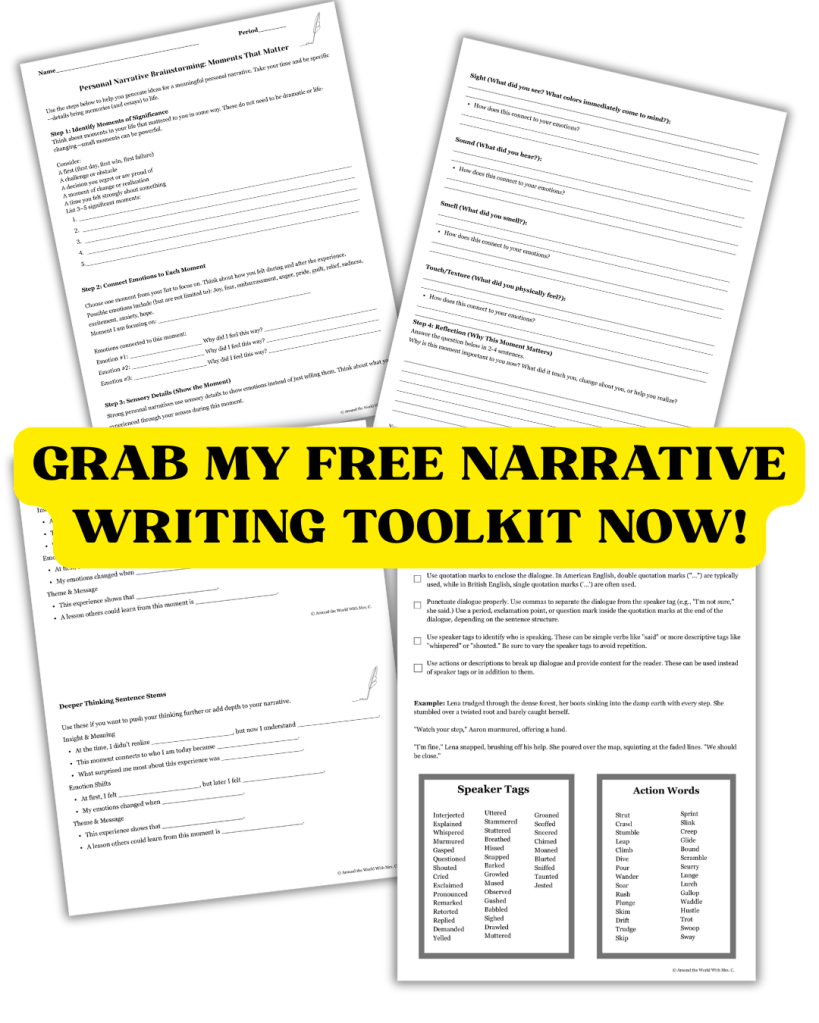
That’s exactly why I created this Personal Narrative Writing Toolkit. It’s a free, classroom-ready resource designed to support both teachers and students through the most challenging parts of narrative writing.
Why Personal Narrative Writing Is So Hard for Students
When students hear “personal narrative,” many immediately think:
- Nothing interesting has ever happened to me.
- I don’t know what to write about.
- How long does this need to be?
What they’re really missing isn’t creativity—it’s structure.
Strong personal narratives require students to:
- Select a moment of significance (not a whole life story)
- Identify emotions connected to that moment
- Use sensory details to show meaning
- Reflect on why the moment matters now
Without guidance, students often default to surface-level storytelling. This toolkit breaks that process into manageable, student-friendly steps.
What’s Included in the Free Personal Narrative Writing Toolkit
This toolkit is designed to be flexible, low prep, and easy to integrate into any middle or high school ELA classroom.
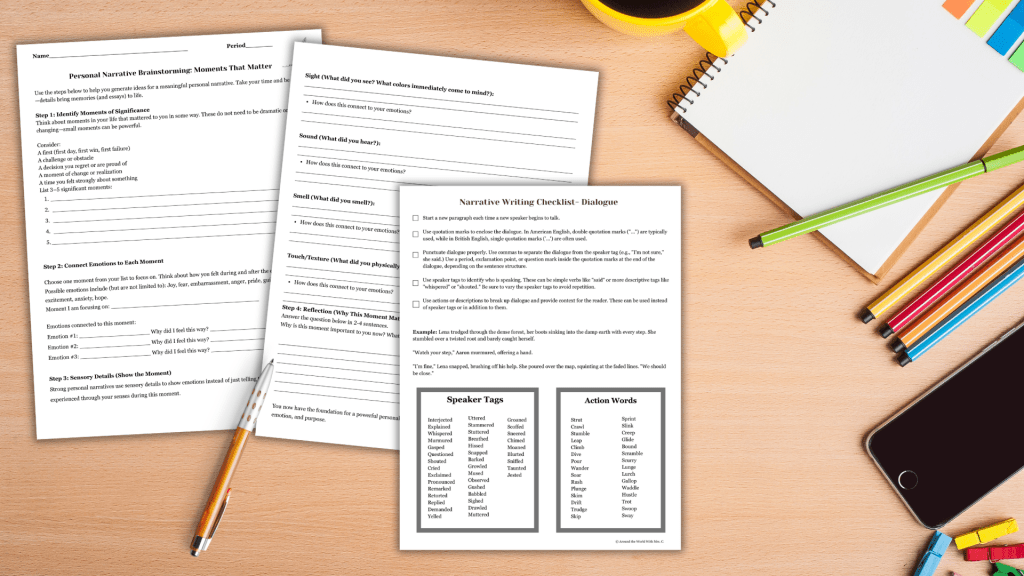
1. Guided Brainstorming for Moments of Significance
Students are prompted to identify small but meaningful moments from their lives—firsts, challenges, realizations, and moments of change. This helps them move away from summary and toward focused storytelling.
2. Emotion Mapping and Reflection
Before students ever begin drafting, they identify emotions tied to their chosen moment and reflect on why those emotions matter. This ensures that writing is purposeful, not just chronological.
3. Sensory Detail Development (Show, Don’t Tell)
Students explore sight, sound, smell, and touch—and explain how each sensory detail enhances emotion. This makes “show, don’t tell” concrete and actionable.

4. Dialogue Writing Support
The toolkit includes:
- A clear dialogue checklist (punctuation, paragraphing, speaker tags)
- Extensive verb banks for speaker tags and action beats
These tools help students write stronger dialogue without overusing “said” or overcomplicating their writing.
5. Mentor Examples for Narrative Leads and Show vs. Tell
Modeled examples (including Nancie Atwell–style narrative leads) show students what strong narrative writing looks like and give teachers ready-made mini-lesson material.
6. Sentence Stems for Support and Enrichment
Sentence stems are included for:
- Emerging writers and multilingual learners
- Students who struggle with idea development
- Deeper thinking, reflection, and thematic connections
How Teachers Use This Toolkit in the Classroom
One of the strengths of this resource is its versatility! Teachers can use it:
- As a 1–2 day prewriting lesson at the start of a narrative unit
- For writing workshop mini-lessons
- During small-group instruction or conferencing
- As a reference tool students keep nearby while drafting
You don’t need to use every page at once. You can easily pull just one section at a time, depending on student needs.
Why This Toolkit Works for Both Teachers and Students
For teachers:
- Low prep and ready to print
- Clear scaffolding without over-teaching
- Built-in differentiation
- Works across grade levels
For students:
- Reduces anxiety about getting started
- Makes abstract writing skills concrete
- Encourages meaningful reflection
- Builds confidence before drafting
When students know what to write and why it matters, the quality of their narratives improves dramatically.
A Helpful Pairing: Narrative Mentor Texts from The Moth
Pair this toolkit with short personal storytelling mentor texts, such as episodes from The Moth Podcast. These brief, powerful stories allow students to hear how real people turn everyday experiences into meaningful narratives.
If you’re interested in using podcasts as mentor texts for narrative writing, I’ve shared my favorite episodes and lesson ideas in a separate post.
Grab the Free Personal Narrative Writing Toolkit
If you’re looking for a practical, teacher-tested way to make personal narrative writing more manageable—and more meaningful—this free toolkit is a great place to start.
👉 Click here to get the Personal Narrative Writing Toolkit sent straight to your inbox.
Whether you use it immediately or save it for later in the year, I hope it helps you and your students approach narrative writing with more clarity, confidence, and purpose.
 Around the World With Mrs. C