

Teaching Dark Romanticism in High School English: A Thematic Unit That Actually Works
If you’re searching for a way to make American literature feel urgent, personal, and genuinely compelling to your students, Dark Romanticism is your answer. This subgenre is tailor-made for the high school classroom—full of psychological tension, Gothic atmosphere, and themes that teenagers instinctively connect with.
This post walks you through a thematic mini-unit built around one essential question: “How do our fears and anxieties influence the way we perceive reality?” You’ll find text pairings, discussion strategies, and practical tips to make this unit both rigorous and manageable.
What Is Dark Romanticism? (And How Is It Different from Regular Romanticism?)
Dark Romanticism is a subgenre of American Romantic literature that emerged in the 19th century. While Transcendentalists like Emerson and Thoreau celebrated nature, human goodness, and divine optimism, Dark Romantics took a harder look at the human psyche — and they didn’t always like what they saw.
Key characteristics of Dark Romanticism include:
- Psychological instability and tormented protagonists
- Gothic settings that mirror inner emotional states
- Blurred lines between reality and illusion
- Themes of guilt, fear, isolation, and the supernatural
- Moral ambiguity and the fallibility of human perception
Authors like Edgar Allan Poe, Nathaniel Hawthorne, and Washington Irving are the anchors of this movement. Their works are widely taught in American Literature courses and appear frequently on AP English reading lists. Which makes a well-designed Dark Romanticism unit a genuinely strategic investment of instructional time!
Why “How Do Our Fears and Anxieties Influence the Way We Perceive Reality?” Is the Perfect Essential Question
The best essential questions do three things: they connect to the literature, they connect to real life, and they generate genuine debate. This one does all three.
Fear and anxiety aren’t abstract concepts to high schoolers—they’re daily experiences. When students approach Dark Romantic texts through this lens, they stop asking “what happens?” and start asking “why does this character see things this way?” and “could I make the same mistake?”
This essential question also creates natural connections across texts. Whether your students are analyzing Ichabod Crane’s superstition, Roderick Usher’s paranoia, or Goodman Brown’s creeping distrust, they return to the same inquiry: How does an anxious mind distort what’s real?
That’s thematic teaching at its best (and it makes your planning significantly easier).
The Texts: How Each One Answers the Essential Question
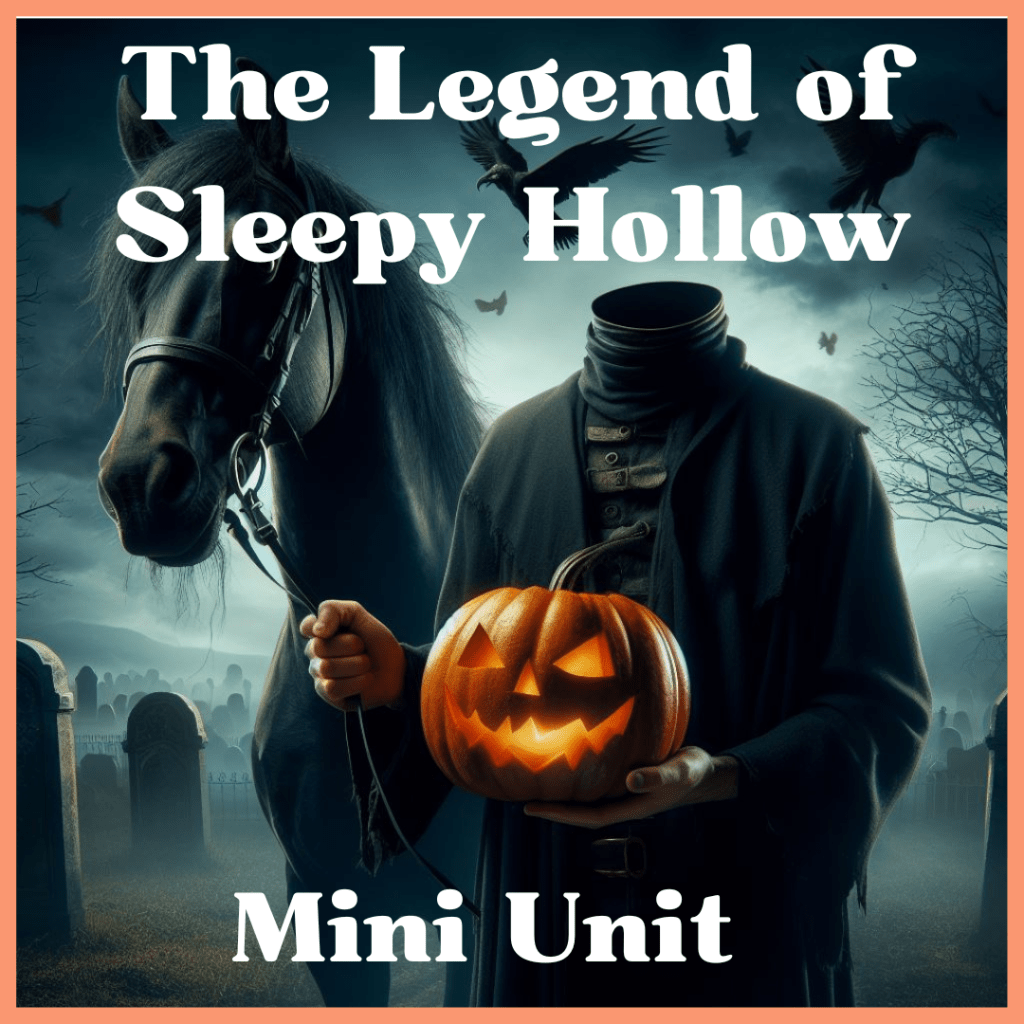
“The Legend of Sleepy Hollow” — Washington Irving
Best for: Introducing the unit, discussing superstition and cultural fear
Irving’s classic is an ideal entry point for because the fear mechanism is so visible. Ichabod Crane is a man primed by folklore and his own imagination to see danger everywhere—and that priming makes him vulnerable. The “Headless Horseman” sequence works so well in discussion because students genuinely debate whether Ichabod is chased by something real or something conjured entirely by his own fear.
Discussion anchor passage:
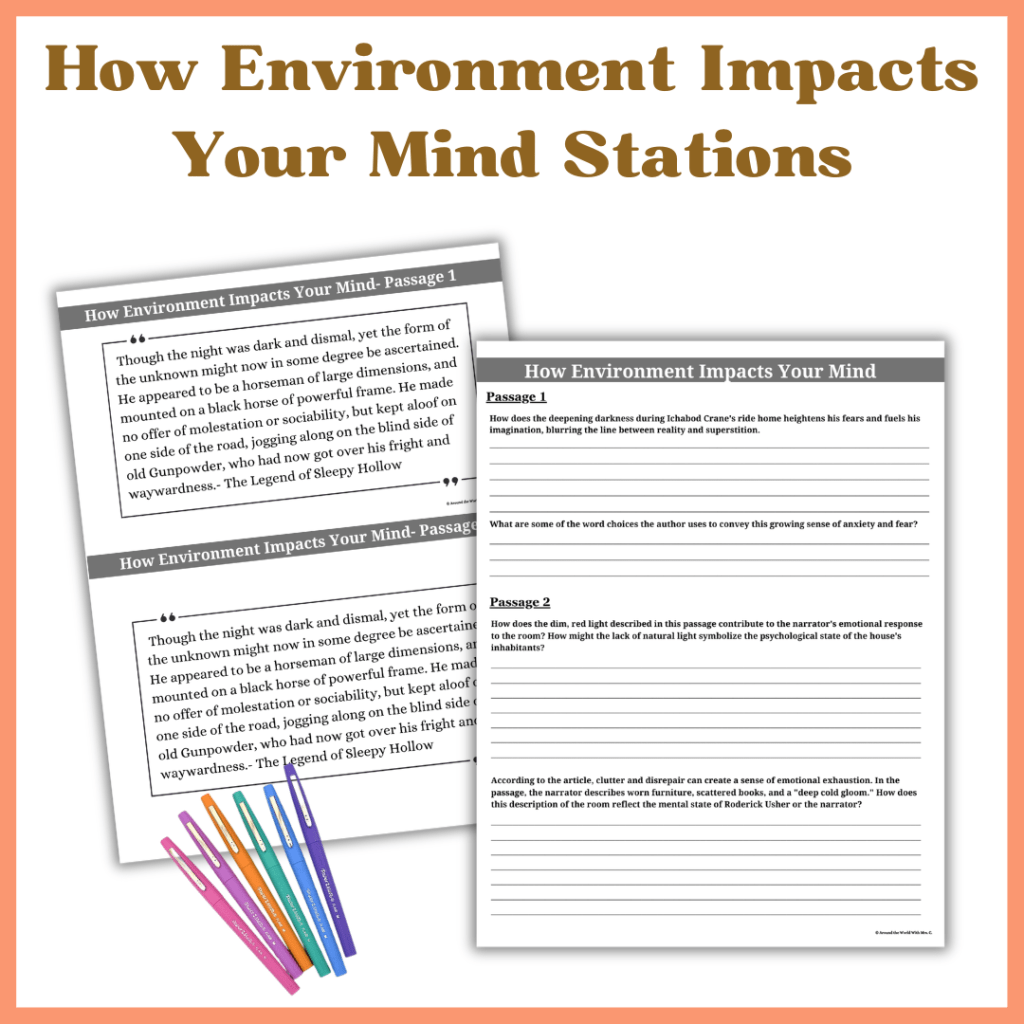
He appeared to be a horseman of large dimensions, and mounted on a black horse of powerful frame. He made no offer of molestation or sociability, but kept aloof on one side of the road…
The vagueness here is the point. The darkness, the silence, the unknown figure—Irving gives Ichabod (and the reader) just enough to let fear fill in the rest. Ask students: What details does the narrator actually confirm? What does Ichabod’s mind add?
“The Fall of the House of Usher” — Edgar Allan Poe
Best for: Exploring how environment amplifies psychological decay
Poe’s story is a masterclass in Gothic atmosphere, and it’s endlessly productive for teaching setting-as-character. The Usher mansion doesn’t just house dysfunction — it seems to cause it. As students analyze the crumbling architecture, the dim red light, the oppressive rooms, they start to see how Poe uses the physical world to externalize internal mental states.
Discussion anchor passage:
Only a little light, red in color, made its way through the glass… I felt sadness hanging over everything. No escape from this deep cold gloom seemed possible.
This passage opens up a rich conversation: Does Roderick Usher’s environment make him mentally unstable, or does his mental instability make him perceive his environment as threatening? That chicken-and-egg dynamic is exactly the kind of complex thinking you want students developing.

“Young Goodman Brown” — Nathaniel Hawthorne
Best for: Examining paranoia, religious anxiety, and the erosion of trust
Hawthorne’s forest is one of American literature’s most psychologically loaded settings. As Goodman Brown walks deeper into the woods, his fear doesn’t sharpen his perception—it destroys it! By the story’s end, he can no longer tell saint from sinner, and that inability poisons every relationship he has.
Discussion anchor passage:
“There may be a devilish Indian behind every tree,” said Goodman Brown to himself; and he glanced fearfully behind him, as he added, “What if the devil himself should be at my very elbow!”
This is a great moment to pause and ask: Is Goodman Brown uncovering truth, or constructing it? Students often disagree. And that disagreement is where the richest discussion lives.

“Annabel Lee” — Edgar Allan Poe
Best for: Introducing poetry, exploring grief as a distorting force
This poem makes a strong pairing with “The Fall of the House of Usher” because both center on an obsessive attachment that warps the narrator’s relationship with reality. The speaker of “Annabel Lee” doesn’t mourn and move on. He mythologizes, fixates, and ultimately can’t distinguish between love and possession. For students who have studied Roderick Usher, the parallel is striking and worth discussing explicitly.
“The Ocean” — Nathaniel Hawthorne
Best for: Short poetry analysis, discussing the unknown as a source of anxiety
The Ocean has its silent caves, / Deep, quiet, and alone; / Though there be fury on the waves, / Beneath them there is none.
This brief poem offers a moment to breathe and reflect. The ocean becomes a metaphor for the unknown—vast, partially visible, and open to projection. It’s a low-stakes text for practicing close reading skills before students tackle the longer pieces, and it connects nicely to the unit’s central question about perception and the unseen.
Informational Text: “How Does Your Physical Environment Affect Your Mental Health?
Best for: Bridging literary analysis and real-world application
Including a contemporary informational text in a Dark Romanticism unit accomplishes something important: it tells students that these 19th-century authors weren’t just writing spooky stories—they were documenting something psychologically real.
When students read about how light levels, confined spaces, and environmental cues affect mood and cognition, the Usher mansion and Goodman Brown’s forest suddenly feel less like Gothic flourishes and more like careful observations.
This pairing also prepares students for synthesis writing and cross-textual analysis (key skills for AP English and state assessments).
Strategies for Teaching This Unit
Socratic Seminar
The essential question is built for Socratic dialogue. Consider opening the unit with a brief seminar on a provocative prompt (“Has fear ever made you see something incorrectly? What happened?”), then returning to the seminar format after the final text to trace how students’ thinking has evolved.
Annotation With a Lens
Give students a consistent annotation focus across all texts: mark every moment where a character’s fear or anxiety seems to change what they perceive. This creates cumulative evidence they can draw on for discussion and writing.
Text-to-Text Connection Graphic Organizers
A simple chart tracking character, fear, environmental trigger, and distorted perception across all five texts helps students see the pattern Hawthorne, Poe, and Irving are all circling. It also makes essay planning much more manageable.
Final Project Options
Two approaches work especially well for this unit:
- Psychological Case Study — Students choose one character and write a clinical-style analysis of their anxiety and how it distorts their perception, citing textual evidence as “case data.”
- Original Dark Romantic Story — Students write their own short story following the conventions of the genre, including: a Gothic setting, a psychologically compromised narrator, and a moment where fear makes reality unclear.
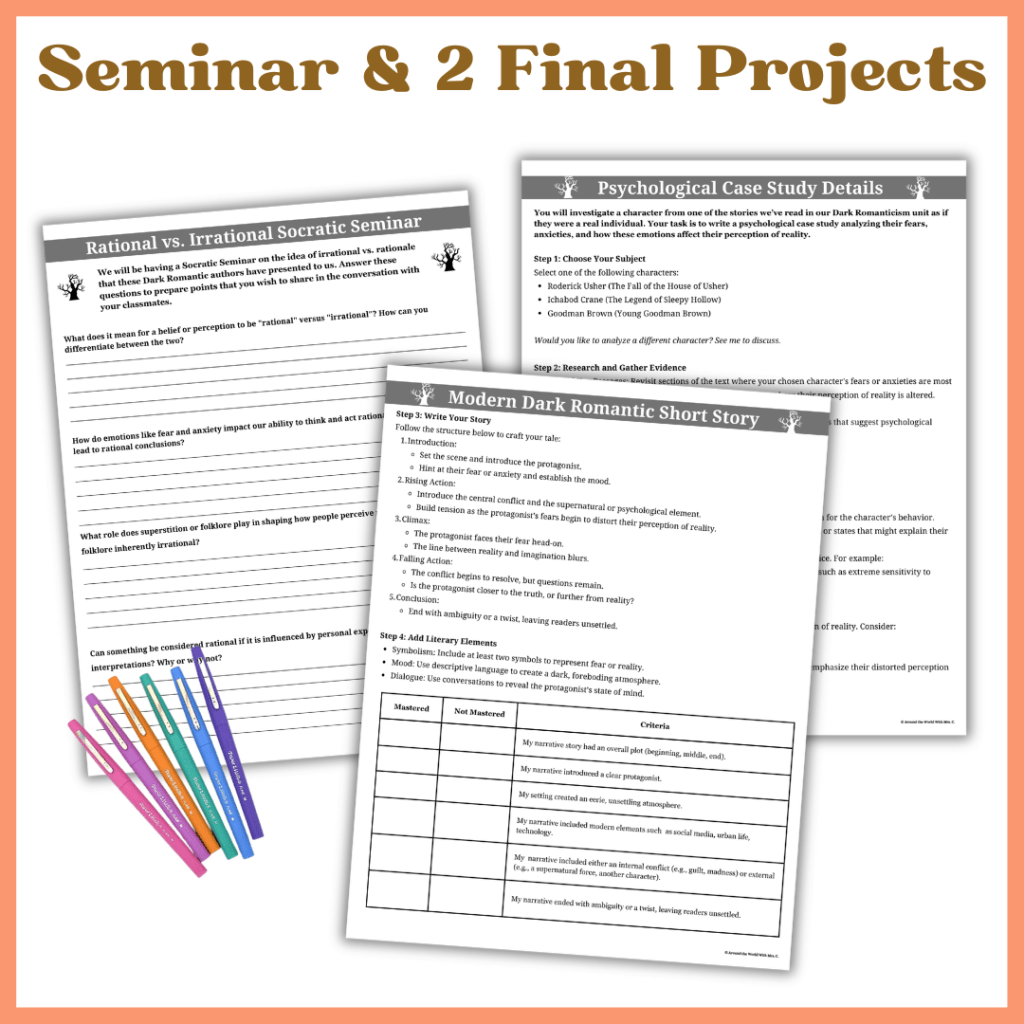
Both options reward close reading, encourage creative thinking, and give students genuine ownership of the unit’s central ideas.
Frequently Asked Questions About Teaching Dark Romanticism
What grade level is Dark Romanticism appropriate for? Most Dark Romanticism texts are taught in grades 9–12, with Poe appearing as early as middle school. The thematic complexity of this unit makes it best suited for grades 10–12, particularly in American Literature or AP English Language courses.
How long does a Dark Romanticism unit typically take? A focused thematic mini-unit using 3–5 texts typically runs 2–4 weeks, depending on the depth of writing instruction included.
Is Dark Romanticism on the AP English Literature exam? Poe and Hawthorne appear regularly as free-response options on the AP Literature exam. Teaching students to analyze psychological complexity, unreliable narration, and Gothic symbolism directly supports AP preparation.
How do I help students who find these texts too difficult? Pairing complex texts with contemporary informational articles, using scaffolded annotation guides, and building in regular discussion before written analysis all help make Dark Romantic texts accessible without simplifying them.
Why Thematic Teaching Makes Dark Romanticism Easier to Plan
Here’s the practical payoff: when every text, activity, and assessment connects back to one essential question, your planning becomes recursive rather than additive. You’re not building six separate lessons—you’re building one argument across six experiences.
Students benefit from the repetition and variation. They encounter the same idea—fear distorts perception—in a Gothic mansion, a forest, a haunted hollow, and a psychology article. Each new context deepens their understanding of the central concept and gives them more material to work with when it’s time to write.

That’s the real power of thematic teaching. And Dark Romanticism, with its psychological richness and instantly engaging atmosphere, is one of the best vehicles for it in the American Literature curriculum.
Ready to take this unit into your classroom? A complete mini-unit with lesson plans, differentiated activities, Socratic seminar guides, and answer keys is available in my Teachers Pay Teachers store.
Final Thoughts
Test prep is part of our reality as ELA teachers—but misery doesn’t have to be. With the right strategies and engaging activities, test prep can reinforce skills, boost confidence, and actually work.
Let’s make ELA test prep more effective, more engaging, and far less painful—for both teachers and students.
 Around the World With Mrs. C