

There’s a long-standing debate in ELA classrooms between content-based and skills-based instruction — but here’s the truth: it doesn’t have to be either/or. When you anchor a unit around a compelling essential question and a rich central text, you can do both simultaneously. Mary Shelley’s Frankenstein is the perfect vehicle for this kind of thematic, layered instruction.
In this post, I’m walking you through my full thematic approach to teaching Frankenstein — including the essential question, close reading strategies, literary pairings, and a real-world PBL project your students will actually care about.
(Already sold? Grab the complete, ready-to-go unit here!)
The Essential Question: Are Monsters Born or Created?
Everything in this unit flows from one central question: Are monsters born or created?
This question directly connects to the age-old Nature vs. Nurture debate — one of the most enduring philosophical and scientific discussions in human history. Are we more a product of our genetics, or of our environment and experiences?
Think of it like baking a cake: nature gives you the raw ingredients (your DNA, your predispositions), while nurture is how those ingredients are mixed and shaped (your upbringing, your community, your circumstances). Both matter. The question is: which matters more?
In the context of Frankenstein, this becomes deeply personal: Would the Creature have become a monster if Victor had loved and cared for him? Or was his “monstrous” nature inevitable?
Opening Activity Idea: Before diving into the novel, invite students to reflect on their own lives. What traits did they seem to be born with? What about them has been shaped by outside forces? Prompt them to consider factors like:
- Where they were born and raised
- Whether they grew up as an only child or with siblings
- Religious or cultural affiliations
- Exposure to travel or new experiences
- Household income and access to resources
This discussion sets the stage beautifully. Students quickly discover that identity is far more complex than they initially assumed — and they’ll carry that insight with them through every chapter of the novel.
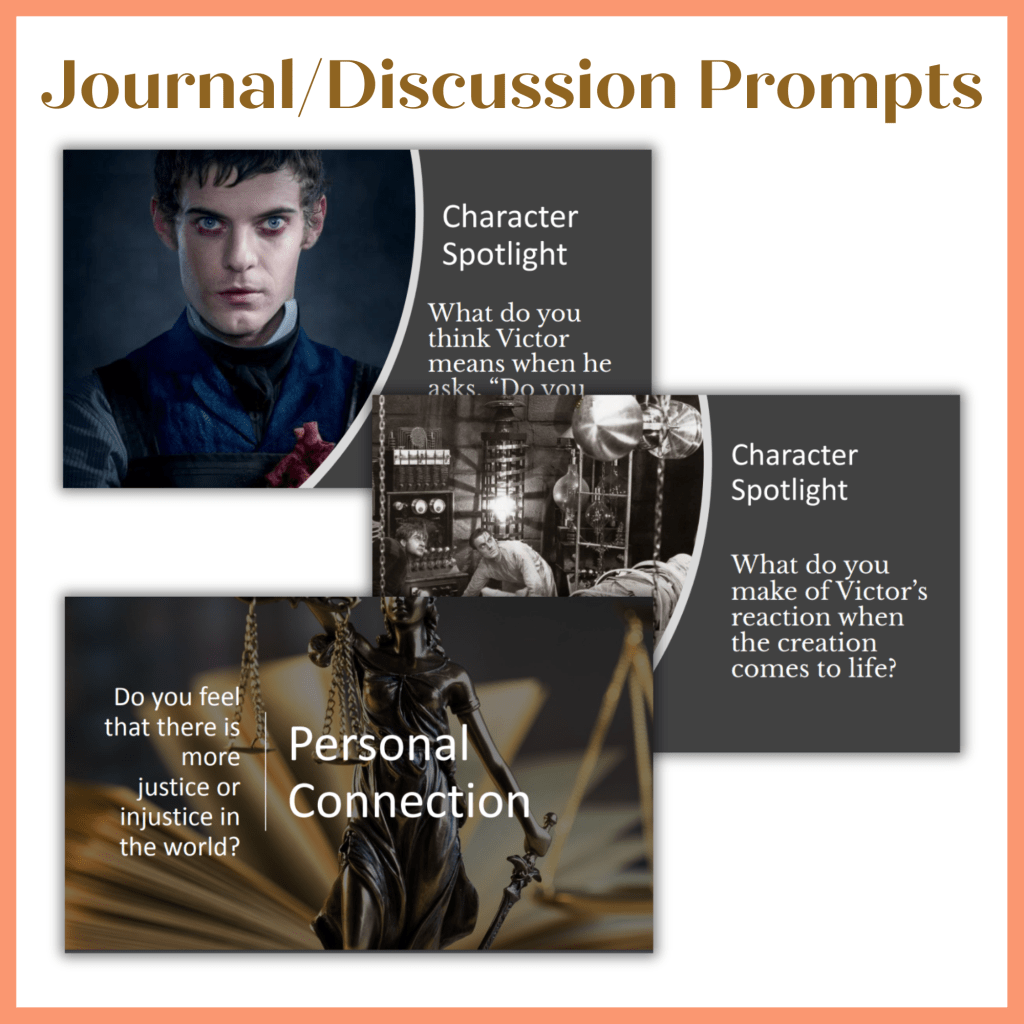
It’s also worth giving students a brief look at how the nature vs. nurture debate has evolved over time — because the history itself is a lesson. In the early 20th century, the eugenics movement took the “nature” argument to a terrifying extreme, promoting the idea that intelligence, morality, and even criminality were fixed in the blood and could be bred in or out of a population. We now know how dangerous and deeply flawed that thinking was.
Fast forward to today, and the science tells a far more nuanced story: epigenetics research shows us that our environment can actually switch genes on and off, meaning our lived experiences have the power to shape our biology in real time. Nature and nurture aren’t opposing forces; they’re in constant conversation. Keeping this in mind as you read Frankenstein adds a whole new layer to Victor’s choices and the Creature’s fate. It also sets us up perfectly for the research project we’ll tackle later in the unit.
Close Reading Strategies for Deeper Analysis
Frankenstein is a rich text, but let’s be honest — it can also be dense. Whether you’re using the traditional novel or one of the excellent graphic novel adaptations (there are some fantastic ones out there), incorporating close reading activities is one of the best ways to help students access deeper meaning.
Close reading asks students to slow down, analyze language, and think critically — building both vocabulary and analytical skills in one move.
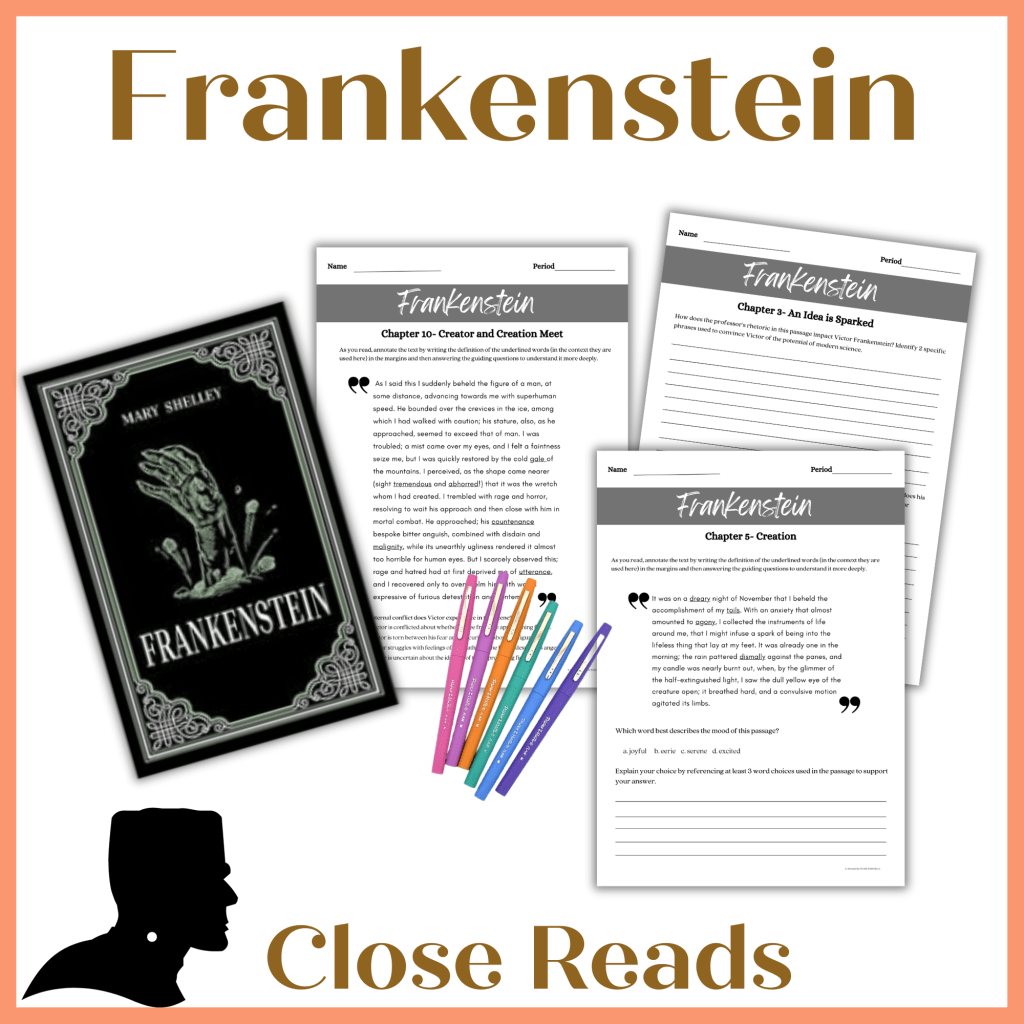
Here’s the process I use:
Before beginning any new excerpt, I set the stage with context. For Frankenstein, this might include a short presentation on Gothic Literature, a brief video on Mary Shelley’s life, and a discussion of the essential question. (Knowing that Shelley wrote this novel as a teenager, at a time when Darwin’s ideas were beginning to circulate, makes the story hit differently.)
Then, I select a focused passage — usually no more than 200–250 words — that’s particularly rich for analysis. I look for passages that contain conflict, figurative language, or challenging vocabulary.
Before students read, I bold and underline key vocabulary words and have them annotate the meanings in the margins. Then they read. Then they read again—this time responding to guiding questions I’ve written that tie back to the essential question.
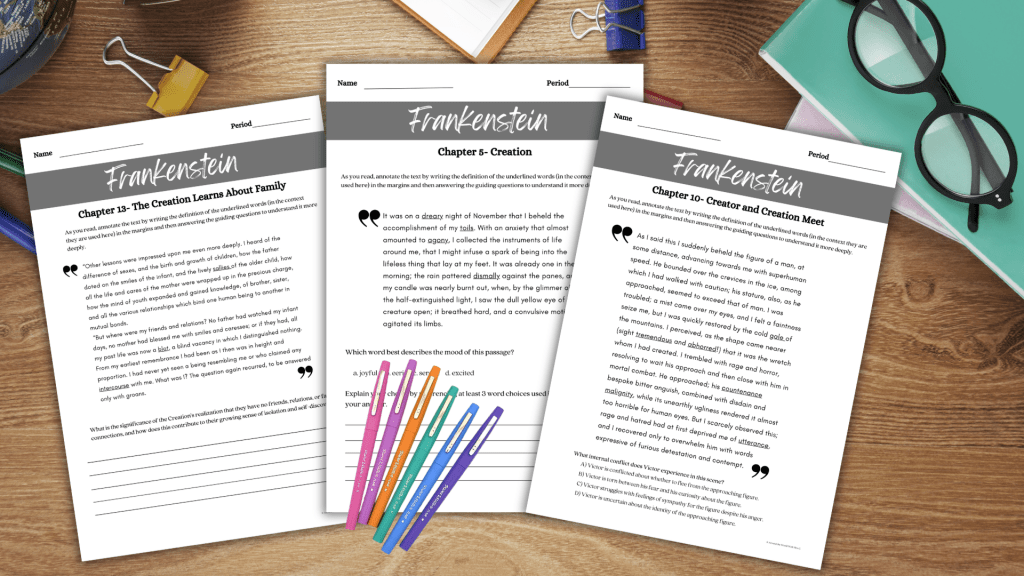
Example Passage:
One of my favorites is this moment where the Creature grapples with his utter isolation:
“But where were my friends and relations? No father had watched my infant days, no mother had blessed me with smiles and caresses… What was I? The question again recurred, to be answered only with groans.”
The grief in this passage is profound — and it opens the door to the central question: Had the Creature been loved, would his story have been different?
Close readings like this help students analyze character motivation, trace the consequences of abandonment, and engage with Frankenstein‘s broader themes of scientific ambition and ethical responsibility.
What Teachers Are Saying
Still on the fence? Here’s what one teacher had to say after using this unit with her sophomores:
“I have been teaching Frankenstein for a long time, but always to an AP Lit class of seniors. When our class structure changed and World Lit moved to Sophomore year, taking Frankenstein with it, I still wanted to teach my beloved novel but was uncertain how to adapt my teaching for my sophomores, many of whom are significantly below grade level in reading skills. Mrs. C to the rescue! I loved the close reads included in this unit and they really helped my students learn how to annotate and focus on the big ideas found in small ways. Bonus: I didn’t have to type out all those passages myself! Then, when it came time to write essays, we used the annotated close reads as sources for quotations and analysis. It saved them time and effort and evaded some of the AI use, as we had a common source of quotations.”
— Amy P., 10th Grade ELA Teacher | New Hampshire ⭐⭐⭐⭐⭐ | Met expectations • Great value • Standards-aligned Student populations: Learning difficulties
Literary Pairing: Paradise Lost and Frankenstein
One of the most powerful things you can do in a thematic unit is expand the conversation beyond a single text. Paradise Lost by John Milton is a natural pairing for Frankenstein and deepens students’ understanding of the creator/creation dynamic.
Milton’s epic poem wrestles with questions of power, free will, and moral responsibility — themes that resonate directly with Mary Shelley’s novel.
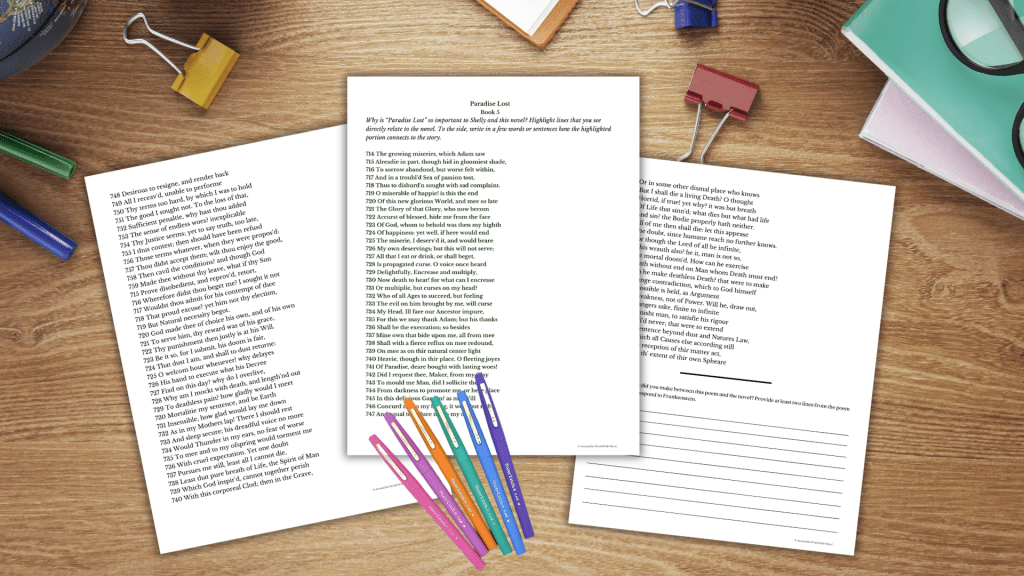
Here’s what makes the pairing so effective:
Satan as a complex figure: Milton portrays Satan as a character who is simultaneously villainous and pitiable — someone whose desire for power led to his downfall and eternal exile. Sound familiar? Students quickly draw the parallel to the Creature, who is both feared and sympathetic, both destructive and deeply human in his longing for connection.
Adam and Eve and the question of choice: Milton’s Adam and Eve remind us that even those given every advantage make mistakes — and face consequences. This nuances the nature vs. nurture conversation: even environment isn’t a guarantee.
The theme of creation and consequence: Both Victor Frankenstein and Milton’s God create beings capable of independent will — and both struggle with the implications. What are a creator’s responsibilities? What happens when creation is abandoned?
If Paradise Lost feels like a heavy lift for your students, consider using targeted excerpts from Satan’s famous soliloquy in Book 1 alongside the Creature’s early chapters. The structural parallel — both characters reflecting on their abandonment and choosing resentment over submission — is stunning when placed side by side.
Real-World PBL: Nature vs. Nurture and Serial Killers
Here’s where things get really interesting for students.
The question of whether people are “born bad” or “made bad” isn’t just philosophical. It’s been the subject of real scientific study, courtroom debate, and cultural reckoning. For much of history, the concept of “bad blood” dominated: if someone committed terrible acts, it was believed to be in their genes, full stop.
But Darwin’s circulating theories during Shelley’s time cracked that certainty open. If environment shapes who we are, then what role does society play in creating the people it later condemns?
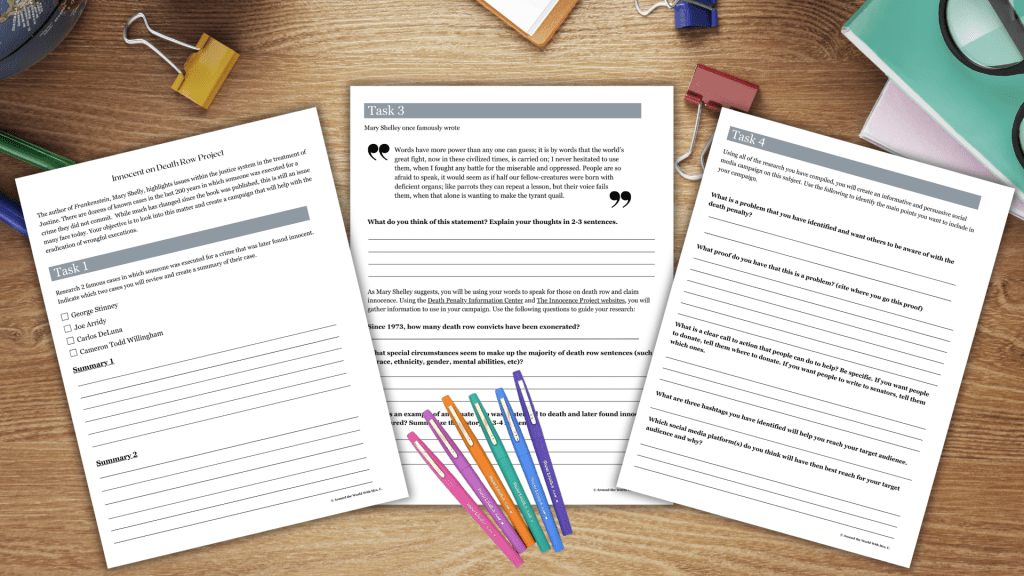
Since then, researchers have studied this question extensively in the context of violent crime and serial killers. The findings are genuinely surprising, and the ethical questions they raise are complex. In fact, around 2010, a “murder gene” defense was used in a trial that resulted in a reduced sentence for a convicted killer.
A short PBL research project on this topic leads to incredible classroom conversation. Students can:
- Research studies on the genetics and neuroscience of violent behavior
- Examine famous case studies (Ted Bundy, Jeffrey Dahmer, and their vastly different upbringings, for example)
- Consider ethical questions: If someone’s biology predisposes them to violence, how should society respond?
- Write a position paper or create a presentation defending their stance on the essential question
This project brings the essential question to life in the real world — and students see Frankenstein not as a dusty old novel, but as a text that was asking urgent questions long before the science caught up.
You might also incorporate brief readings on epigenetics (the study of how environment affects gene expression) as a bridge between the two extremes. Modern science increasingly suggests it’s not nature or nurture — it’s both, in conversation. This gives students a more nuanced framework and models strong academic thinking.
Bringing It All Together
Anchoring your Frankenstein unit around the essential question “Are monsters born or created?” creates a through-line that connects every text, every close read, every discussion, and every project. Students aren’t just reading a Gothic novel. They’re investigating one of humanity’s most persistent questions about identity, responsibility, and what it means to be human.
The skills and content don’t compete here. They build on each other.
If you want everything described in this post — the close reads, the Paradise Lost pairing, the PBL project, discussion prompts, and more — all organized and ready to use, check out my full Frankenstein unit!
And if you want weekly ELA tips and resources delivered straight to your inbox, join my newsletter here.
 Around the World With Mrs. C