

Secondary ELA · Literary Analysis · Resource Reviews · High School ELA Unit
A complete 6–8 week literary analysis unit that uses Disney movies and classic fairy tales to make feminist, Marxist, and cultural criticism genuinely engaging for secondary students.
Updated March 2026 · 13 min read · Grades 9–12
Why Fairy Tales Are the Perfect Entry Point for Critical Thinking
By the time students reach high school, they’ve seen a dozen versions of Cinderella and can hum half the lyrics from Frozen. But ask them why these stories persist—and how they shape our ideas about gender, power, and culture—and you’ll likely get silence.
That’s not a student problem. It’s a framing problem. Most fairy tale units ask students to retell a story rather than interrogate it. With the right critical lenses, though, these familiar narratives become some of the richest literary texts in your classroom—because students already care about them.
This post walks through a full 6–8 week ELA unit that pairs classic written fairy tales with their Disney adaptations and teaches five critical lenses: archetypal, feminist, Marxist, gender/symbolic, and cultural criticism.
“It’s so much fun to watch my students learn about literary lenses. Thank you.” — Susan K.
What Is Critical Lens Theory in Literary Analysis?
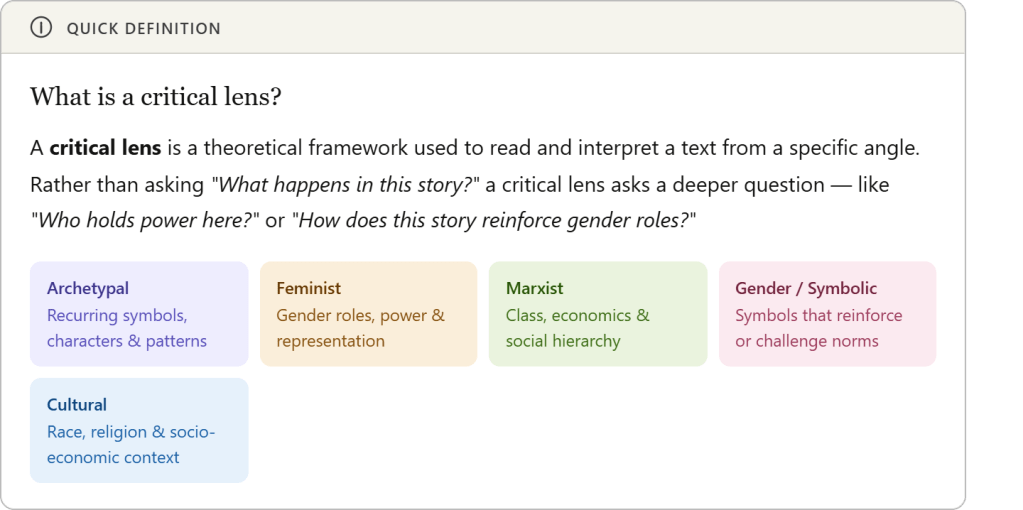
A critical lens is a theoretical framework used to analyze a text from a specific angle. Rather than asking “What happens in this story?” students ask “What does this story assume about gender?” or “Who has power here, and who doesn’t?”
The five lenses covered in this unit are:
- Archetypal criticism — recurring characters, symbols, and patterns
- Feminist criticism — gender roles, power, and representation
- Marxist criticism — class, economic power, and social hierarchy
- Gender/Symbolic analysis — how symbols reinforce or challenge gender norms
- Cultural criticism — how race, religion, and socio-economic context shape storytelling
Each lens is self-contained and can be taught independently, but together they give students a full toolkit for literary analysis they’ll use for the rest of their academic lives.
Who is this unit for?
This unit works well whether you are teaching a dedicated fairy tales elective, a mythology and folklore course, or simply looking for a fresh way to teach literary theory in a standard 9th or 10th grade ELA class.
It also works as a second-semester unit when students already have some familiarity with literary terms and are ready to go deeper. Teachers with mixed-ability classrooms will find the built-in differentiation especially useful — every lens study includes separate tasks for lower-level and ESOL students, on-level students, and gifted or advanced learners, so you are not creating three versions of every lesson yourself.
And because each week is self-contained, you can also use just one or two lenses as a standalone introduction to critical theory without committing to the full unit.
The 5-Week Breakdown: Fairy Tales + Disney Films
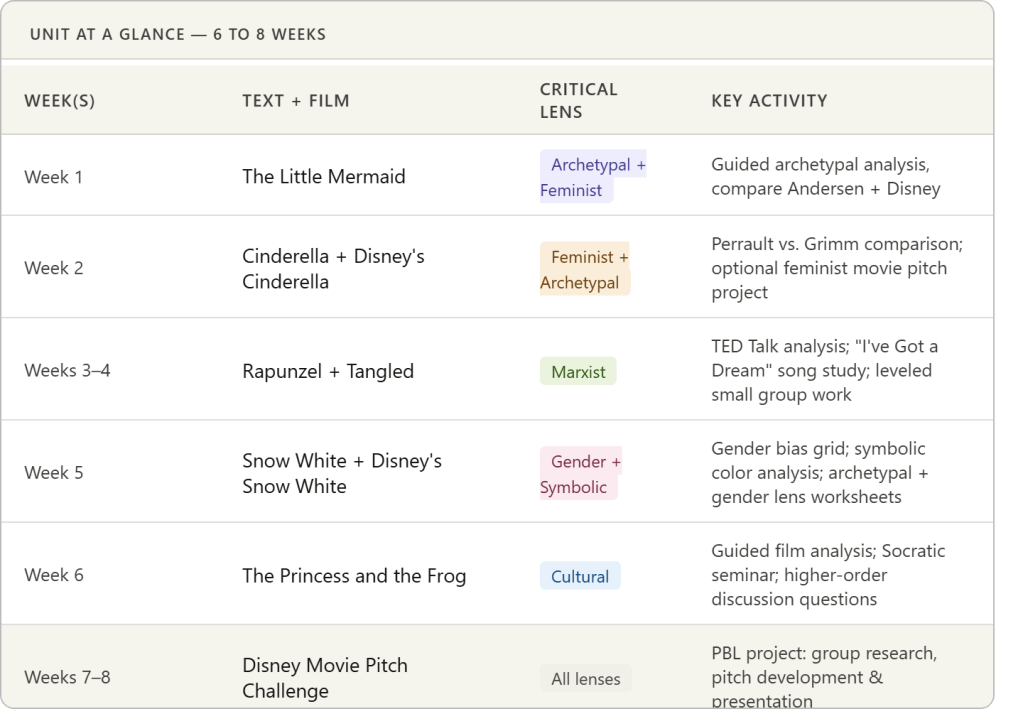
01 Week
Archetypal & Feminist
Archetypes and Gender in The Little Mermaid
Students compare Hans Christian Andersen’s original story with Disney’s adaptation, analyzing character archetypes (hero, mentor, shapeshifter) and symbolic archetypes (water, transformation, sacrifice).
The feminist reading emerges organically. Andersen wrote the story after being heartbroken by a man who was marrying a woman, and his little mermaid mirrors anyone silenced by the expectations of their society. One of the most powerful class discussions: “In many ways, the little mermaid is society’s ideal woman—silent, beautiful, obedient, and devoted.”
One of the most thought-provoking threads running through this week is the detail students almost always overlook: in Andersen’s original story, the little mermaid has no name. She is never called anything. Disney named her Ariel — a word meaning ‘to gather’ — which itself becomes a discussion point about what it means to give a voiceless character an identity. From there, students move into close reading of the text through both the archetypal and gender lenses simultaneously.
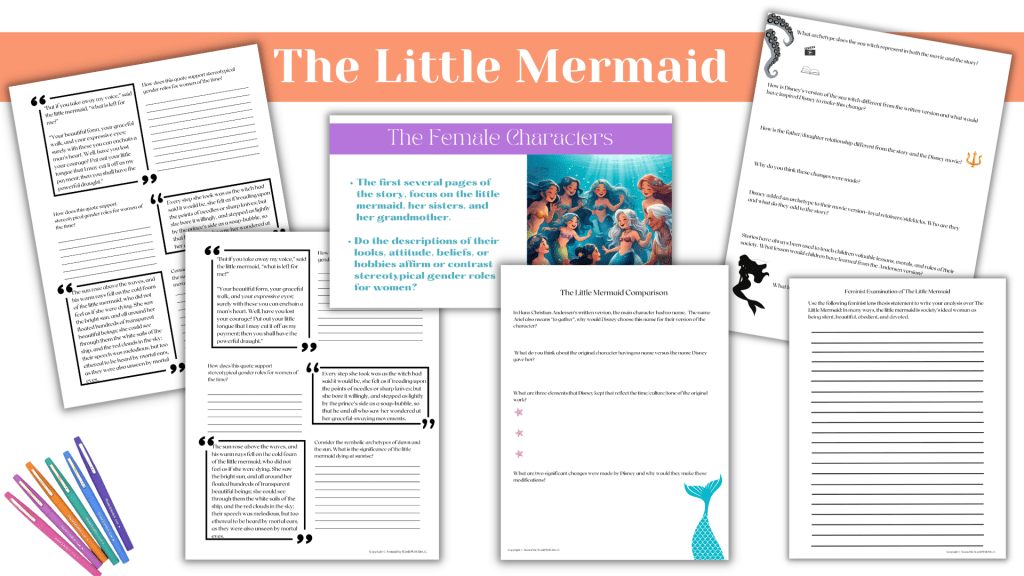
The archetypal analysis asks students to identify what the little mermaid’s quest actually is and what it reveals about Andersen’s values. Notably that she goes on this quest entirely alone, with no guide and no loyal retainer, which is a deliberate and significant departure from the traditional hero’s journey. The gender analysis pushes deeper: students examine what it means that the only female character with real power in the story — the Sea Witch — is depicted as a disgusting hag, and what it means that the price of transformation is literally the little mermaid’s voice. The Sea Witch’s answer to:
‘But if you take away my voice, what is left for me?’ — ‘Your beautiful form, your graceful walk, and your expressive eyes’ — tends to land hard with students.
That single exchange does more to open up a conversation about how women are valued than almost any other moment in the unit.
02 Week
Feminist & Archetypal
Step into the Stepmother’s Shoes: Cinderella
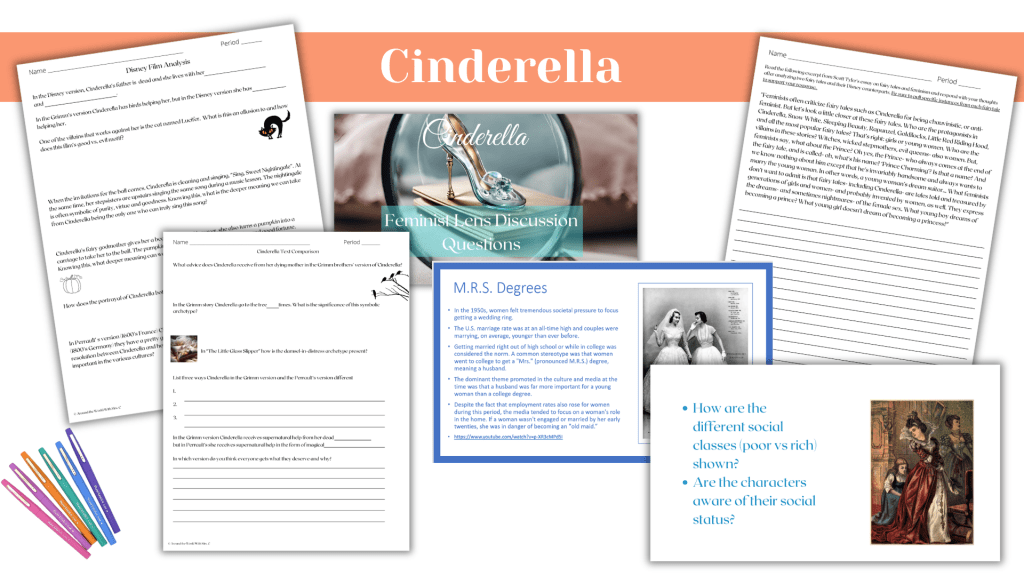
With over 100 cultural versions worldwide, Cinderella is the ideal text for cross-cultural comparison. This week focuses on Perrault’s “The Little Glass Slipper” and the Grimm version, contrasting their morals, their portrayals of female archetypes (angel, damsel-in-distress, wicked), and how each story defines virtue for young women.
Perrault’s Cinderella forgives everything; the Grimm version hands down brutal consequences. Students dig into what each version is actually teaching—and who it’s teaching it to.
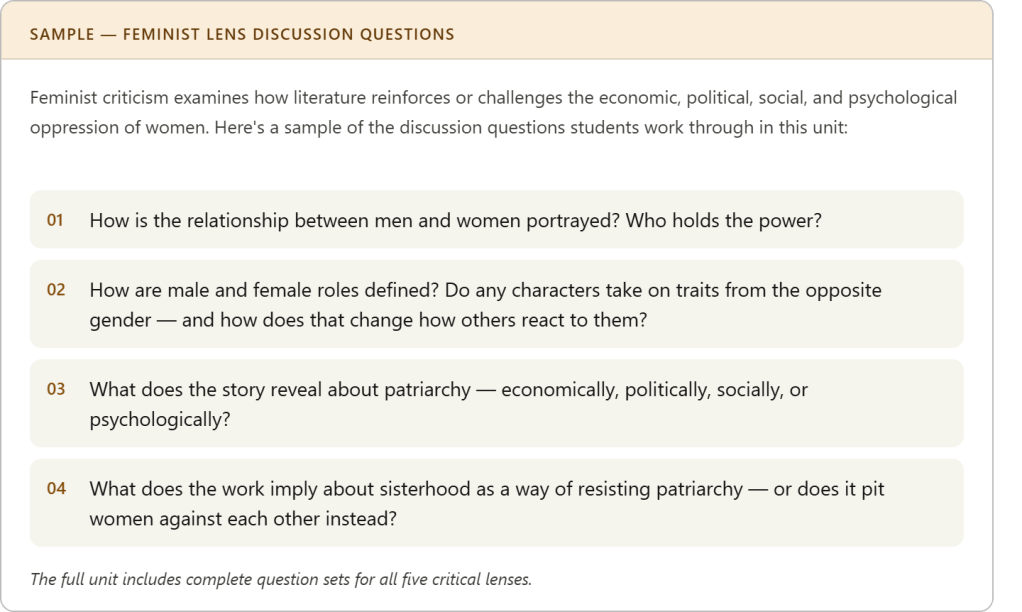
What makes the Cinderella week particularly rich is how differently the two versions define what a ‘good woman’ looks like. Perrault gives readers explicit morals at the end: graciousness matters more than beauty, and even the most gifted woman needs a godparent’s blessing to succeed.
The Grimm version offers no such lesson, but delivers a far darker consequence for wickedness. Putting these side by side, students start to see that fairy tales aren’t neutral entertainment . They’re instruction manuals for behavior, written by a specific culture at a specific moment in time. The optional Socratic seminar at the end of this week pushes students to apply all three lenses at once — feminist, Marxist, and archetypal — to the same film, which produces some of the most surprising and lively discussions of the entire unit.
03 Week
Marxist Criticism
Class, Power, and Tangled Dreams: Rapunzel + Tangled
This week introduces the Marxist lens. Not as a political ideology, but as a tool for examining how social class shapes lives and stories. Students read Rapunzel, watch Tangled, and analyze characters like the “ruffians” through the lens of economic power and class mobility. Key questions: Who has power, and how do they use it? What’s standing between the powerless and a better life? A built-in TED Talk analysis and song study extend the discussion beyond the text.
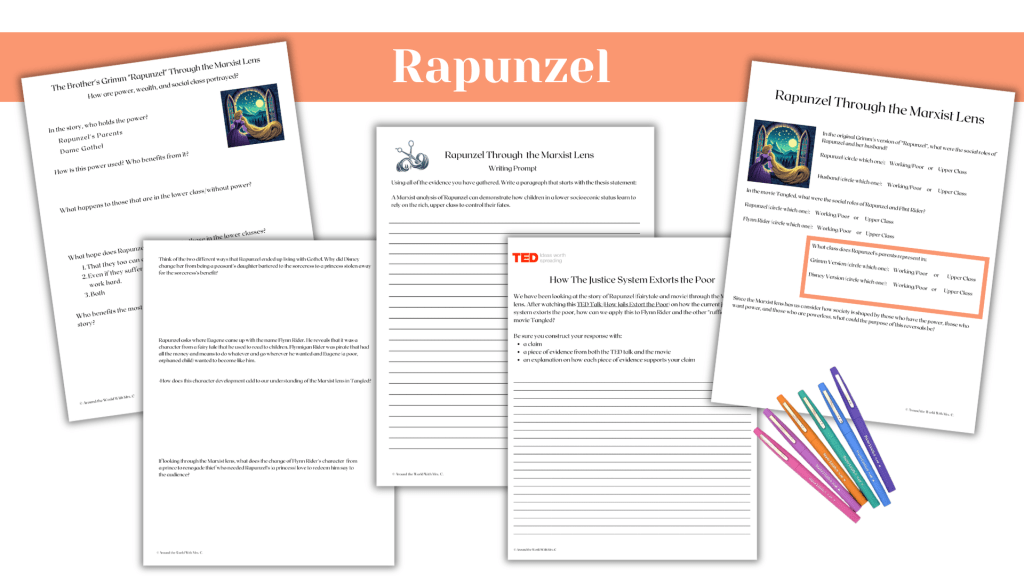
One of the most effective moments in this week comes from a character detail students often overlook: Eugene Fitzherbert’s backstory. As a poor orphaned child, he latched onto a fictional pirate named Flynnigan Rider — a man with all the money and means to do whatever he wanted, and decided to become him. That single piece of character development crystallizes the Marxist lens better than any definition could.
Students see that the desire for wealth isn’t just greed. It’s a survival response to a world that told Eugene his real identity wasn’t enough. Paired with the TED Talk on how the poor are economically exploited, and the song study of ‘I’ve Got a Dream,’ this week gives students multiple entry points into the same idea, which makes it especially strong for mixed-ability classrooms.
04 Week
Gender & Symbolic
Gender, Symbolism, and Power in Snow White
Students analyze symbolic colors, mother figures, and ideals of beauty and obedience. A gender bias grid asks students to sort characters by behavior rather than gender—and the results are always revealing. Students frequently identify that the Evil Queen is coded as villainous precisely because she is powerful and autonomous, traits often read as masculine. The takeaway: Snow White’s passivity is rewarded; the Queen’s ambition is punished. What does that tell young audiences about power?
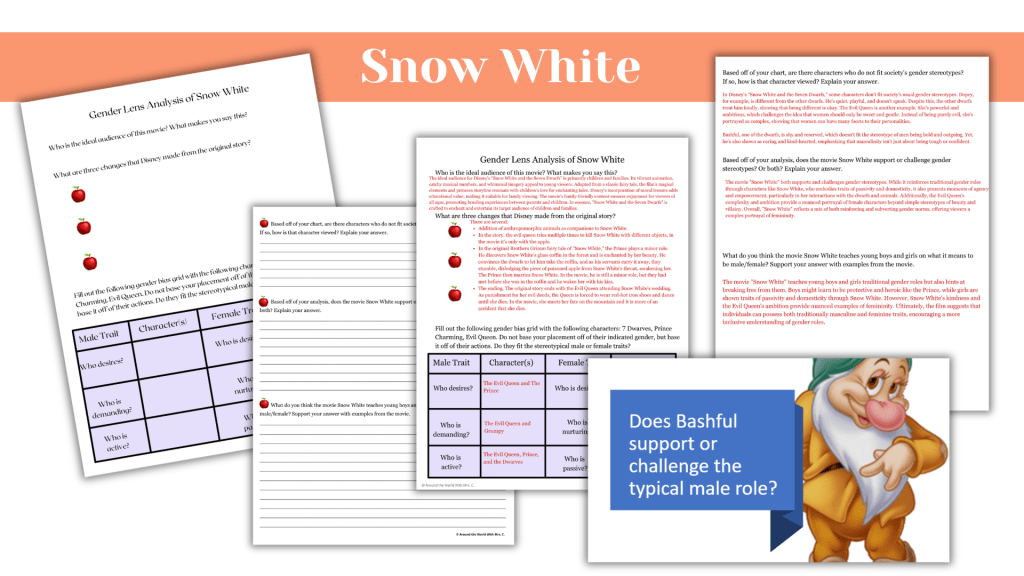
The analysis worksheets for this week ask students to sit with some genuinely uncomfortable questions. What does Snow White’s physical description — skin as white as snow, lips as red as blood, hair as black as ebony — actually symbolize in archetypal terms? What does it mean that the Evil Queen’s entire sense of worth is tied to a mirror that ranks women by beauty? And what does Snow White’s immediate, unquestioning acceptance of a marriage proposal from a man she has never met reveal about the romantic expectations this story is quietly teaching?
Students who dig into these questions often arrive at the same realization: the story doesn’t just reflect old-fashioned values. It actively rewards one kind of woman and punishes another, and that pattern shows up in stories students encounter every single day.
05 Week
Cultural Criticism
Race, Representation, and The Princess and the Frog
Students examine how race, religion, and socio-economic context shape the storytelling in Disney’s first film with a Black princess. Did the film achieve the representation it set out to create?
Key moments to analyze: the visual shift from lavish mansions to rundown homes on the train ride home, Tiana’s belief that food brings all walks of life together, and the real estate rejection scene—where “a little woman of your background” opens a rich discussion of intersectionality that resonates far beyond the 1920s setting.
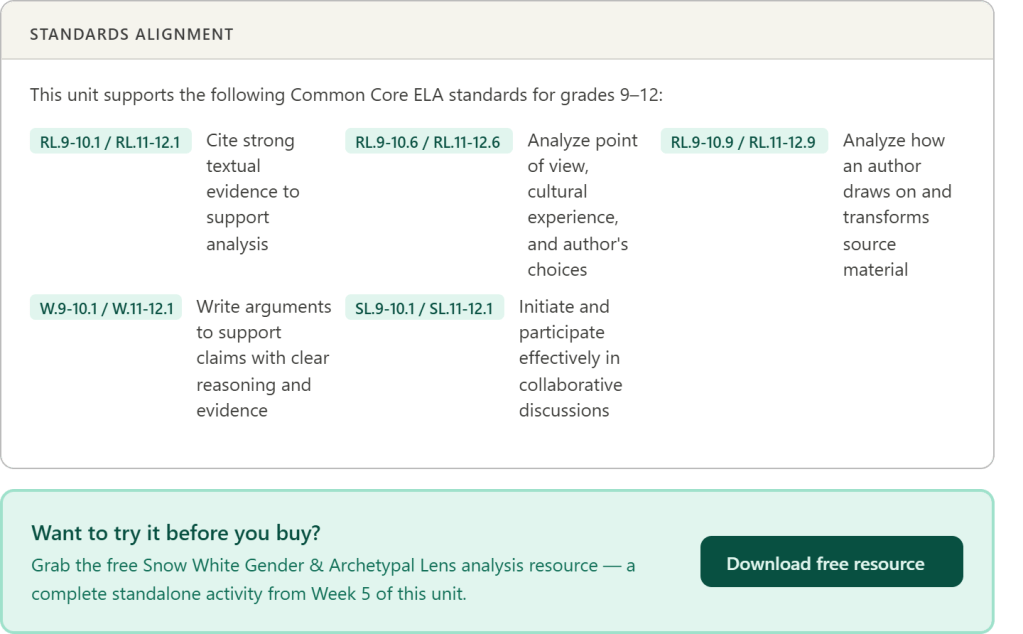
The Socratic seminar questions for this week are some of the most thought-provoking in the unit. Why does Tiana’s father tell her that wishing on a star will only take her so far, while Lottie’s father tells her she can have anything her heart desires? Why is Naveen the only character who experiences meaningful growth. Is that because he is a man, an immigrant, or simply because the story needs someone to learn a lesson?
And when the Fenner brothers tell Tiana the property is probably for the best she didn’t get — citing ‘a woman of your background’ — are they talking about her race, her class, or her gender? The power of this week is that students rarely agree on the answers. That productive disagreement is exactly what Socratic seminar is designed for, and it tends to be the discussion students remember long after the unit ends.
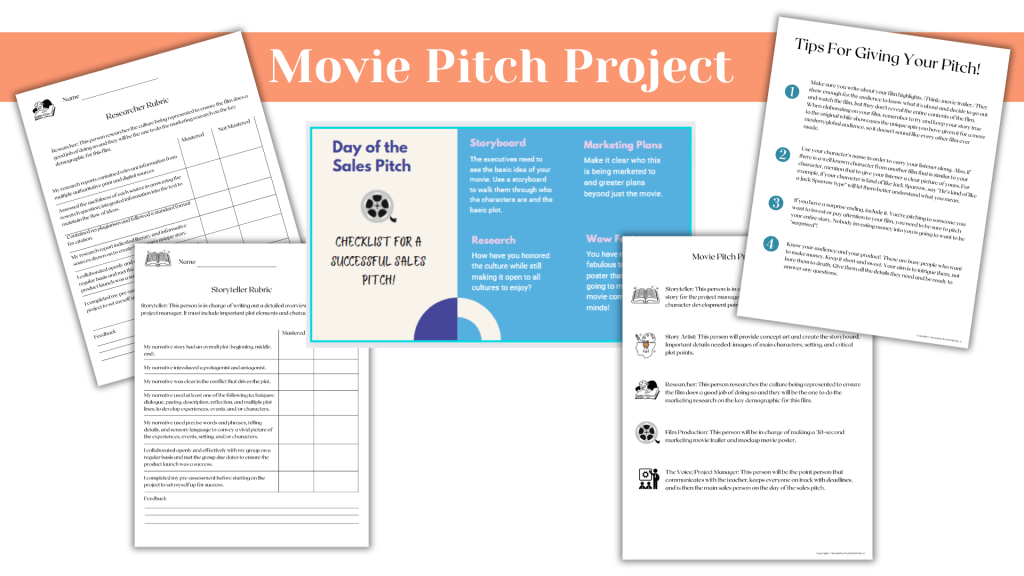
The Disney Movie Pitch Challenge: Student-Led Project-Based Learning
At the end of the unit, student groups research, reimagine, and formally pitch a brand-new Disney movie—one that reflects more authentic values, diverse characters, and modern storytelling. Backed by everything they’ve learned from the five critical lens studies, students present their pitches with real analytical rigor behind the creative concept.
It’s collaborative, creative, and genuinely fun—and it gives students a way to synthesize literary analysis into something they care about making.
“Absolutely amazing and fun end of the year unit. Students loved creating their own movie sales pitch!” — Verified ELA teacher review, Teachers Pay Teachers
What’s Included in the Full Unit
- 5 complete fairy tale + film studies (each self-contained and mix-and-match ready)
- Critical lens PowerPoints with student-friendly explanations of each theory
- Worksheets, handouts, Socratic seminar discussion prompts, and writing tasks
- Flexible PBL project (Disney Movie Pitch) with checkpoints and presentation guidance
- Essay prompts with scaffolded supports for differentiation
- TED Talk analysis and song study (Week 3)
- Gender bias grid activity (Week 4)
- Free Snow White analysis resource available as a standalone download
What Teachers Are Saying
★★★★★
“Love this resource! My students were so engaged and enjoyed learning.”
Jennifer C. August 30, 2024
★★★★★
“I rarely will shell out the money for an entire unit on TPT, but I was desperate. I really love this unit! I find myself making a few tweaks to make it ESL friendly, but it’s pretty much plug and play if you want it to be!”

Begging Borrowing Stealing March 14, 2023
★★★★★
“It’s so much fun to watch my students learn about literary lenses. Thank you.”
Susan K. April 13, 2022
Frequently Asked Questions
What grade level is this unit designed for?
This unit is designed for grades 9–12 (high school ELA), though many teachers adapt it for advanced 7th and 8th grade students. The critical theory concepts are scaffolded for accessibility, making them approachable for students encountering these lenses for the first time. What is a critical lens in literary analysis?
A critical lens is a theoretical framework used to analyze a text from a specific perspective—such as feminist theory, Marxist theory, archetypal analysis, or cultural criticism. Each lens asks different questions about the text, helping students uncover deeper meanings about power, gender, class, and culture. Do I have to teach all five weeks?
No. Every lens study is self-contained, so you can pick and choose based on your time, standards, or class needs. Many teachers run the full 6–8 week unit; others use one or two weeks as a standalone critical theory introduction. What Disney movies are used in this unit?
The unit uses The Little Mermaid, Cinderella, Tangled, Snow White and the Seven Dwarfs, and The Princess and the Frog—each paired with the original written fairy tale it was adapted from. Is this unit appropriate for ESL or ELL students?
Yes—teachers report making minor tweaks for ESL/ELL students, but the unit is highly visual, discussion-based, and built around stories students often already know, which supports language learners. The scaffolded essay prompts and handouts also help differentiate for diverse learners. What is the Marxist lens and how is it used in this unit?
The Marxist lens examines how social class and economic power shape characters, narratives, and reader expectations. In this unit it’s applied to Rapunzel and Tangled, with guiding questions like: Who has power? How do they use it? What barriers exist for those seeking a better life? Teachers note that framing it as a tool for literary analysis—rather than a political ideology—helps students engage with it more openly.
Ready to Bring Critical Theory into Your Classroom?
Get the full 6–8 week unit—or start with the free Week 4 Snow White resource to try it with your students first.Get the Full UnitFree Week 4 Preview
Final Thoughts
This unit isn’t about convincing students that fairy tales are secretly dark or that Disney is problematic. It’s about teaching them to ask questions of any text they encounter. To look at who has power, whose voice is centered, and what a story is quietly teaching alongside its plot.
Students leave with a critical toolkit they’ll use in every English class that follows. And they leave having genuinely enjoyed the process—because the texts are ones they already know and love.
That’s what good literary analysis instruction looks like.
Join my weekly newsletter!
Would you love to get weekly tips and resources for teaching secondary English delivered right to your inbox? Click here to join! Would you like to connect on social to see more of my ideas in bite-sized form? You can find me on YouTube and Instagram.
© 2024 Your ELA Resource Site · All rights reserved
 Around the World With Mrs. C