

I know that I and every other high school English teacher I know has been lamenting the past couple of years on the major crisis that is VOCABULARY! We also know from a whole body of research that vocabulary and background knowledge are the two biggest components to text comprehension.
In a previous post, I discussed 3 of my favorite (and FREE) ways to work on building vocabulary with my high school students. You can also check out those ideas here!
In this post, I am sharing the best tips myself and two other English teachers are utilizing to help bridged the vocabulary gap in our high school students. We’re sharing our best strategies for building vocabulary in secondary ELA via in-context instruction, Greek and Latin root words, and the power of The Science of Reading in Secondary ELA.

Using Close Reads to Teach Vocabulary in Context
Research highlights the significance of teaching vocabulary in context through close readings in secondary education. Close readings prompt students to analyze, evaluate, and reflect on language, enhancing their understanding of vocabulary.
I highly suggest checking out some of these studies. Such as, “Examining Reading Comprehension: Implementing the Close Reading Strategy with General Education and Special Education Students” published in 2021 by Winton, Kaitlyn
With the use of close reading strategies, Winton saw significant gains in all her students despite different academic needs. These gains were not only in vocabulary, but also in text comprehension and reading stamina!
While I did not solely rely on close readings, this strategy has always worked well for my students. Here are some of my top tips for close reading activities:
- Before beginning pretty much any new text, I provide a quick overview of anything that may be of important for context. For example, before diving into Jack London’s “To Build a Fire”, I would give a short presentation of where the Yukon is located as well as main points of Naturalism.
- Pick a particularly juicy portion of the text you want students to zero in on. This could be for a variety of reasons: conflict, vocabulary, figurative language, etc.
- To be highly effective, I keep this portion short- usually no more than 200-250 words.
- I identify any words that I think will be challenging, archaic, have double meanings, or are particularly important to the context of the the piece. I underline and bold those words.
- Before students even read the passage, they are to first annotate to the side what those words mean.
- Then I have students read the passage.
- Then students read the passage again with guiding questions that often incorporate those words as well as other details.
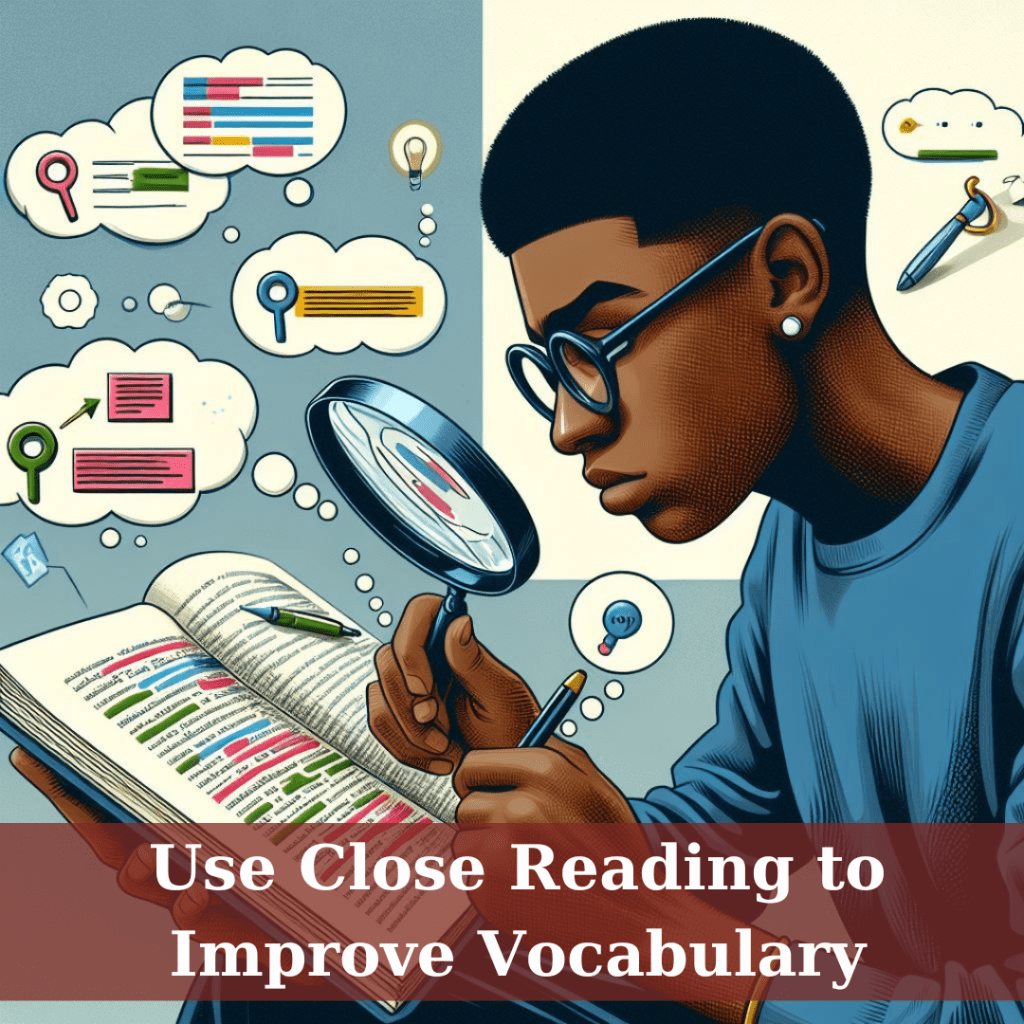
By identifying the words first, my students realize that I am admitting there is challenging vocabulary and I want them to slow down and truly understand what they are reading. This also provides scaffolding to my students but also putting some of the responsibility on them.
I also found that having students complete these individually (or with a partner) before a small-group or whole-class conversation, they were able to actively engage in a deeper way.
Research has also shown that content and language integrated learning (CLIL) has shown efficacy in improving various language skills, including vocabulary, in secondary students(P. Sysoyev & Artur S. Belousov, 2023). In my experience, this is has an even greater effect with my ELL and SPED students when they make these connections.
For example, after completing a close read of this section of The Fall of the House of Usher, students then create an illustration of what they have read and use the text to support the details they include.

Incorporating visual or multimedia elements, such as illustrations, videos, or audio recordings related to the text, can enhance students’ comprehension and engagement. These multimodal resources can provide additional context and support for vocabulary acquisition, particularly for diverse learners or those with varying learning preferences.
Close reads are a fantastic strategy to add to the plethora of ways to build your students’ vocabulary. I have several that are READY TO GO right here!
Using Latin and Greek Root Words to Build Vocabulary Skills
It is estimated that roughly 70% of the English language has its roots in Latin or Greek. Learning even basic Latin and Greek facilitates grasping English vocabulary and deciphering unfamiliar words.
Jeanmarie from McLaughlin Teaches English likes to teach students that Greek and Latin roots are a tool for understanding words with which they are unfamiliar. Over the years, she has employed two different strategies for teaching roots to students.
The first is a very traditional method where students are presented with a list of roots on Monday as the warm up activity. Throughout the week, they do some activities with them and then on Friday, they are quizzed.

She has also used a method where she teaches roots in the context of the texts the class is reading. She finds a short passage that has a number of words with roots. Then gives the students the list of roots in a graphic organizer. Students then find the roots in the words in the passage, try to think of additional words with the root and then use context (if they can) to determine the meaning of the root. (If they don’t get the meaning of the root, she gives it to them.)
If you would like to see what each of these look like, you can grab a free Bell Ringer Sampler set that includes 10 different styles of warm ups (including the two mentioned above).
The Science of Reading in Secondary Grades
Google “the science of reading” (or SOR) and you’ll find a huge body of research that indicates a structured approach to literacy instruction is imperative to building reading proficiency. Allison @mrsmcmanusela has been trying to figure out how to bring this research to secondary schools to help students reach proficiency with the increasingly more complex texts read at this level. One way that she believes students can get there is with a systematic approach to vocabulary instruction.

Each week, students receive five new vocabulary words. They figure out the meaning of the words using context and then take them home to work with on their own. Finally, at the end of the week, they use the meaning of the word, the word’s clues and a bit of skilled reading to fill the words into blanks in a reading passage. This system allows students to study and get to know as many as 150 new words in a school year. Try out SIX WEEKS FOR FREE and see the improvement!
When her students don’t know how to use the word’s clues, Mrs. McManus tells them to SWIPE – check out this tool for finding word meaning that uses even more SOR systems.
And finally, for those kiddos that are missing basic decoding skills but still need to see new, challenging words, Mrs. McManus uses a Word of the Day program that hits on syllable types & patterns, spelling rules AND grade level vocabulary.
Final Thoughts on Building Vocabulary in Secondary Education
As you can see, there are several ways we can be working to close the vocabulary gap with our secondary students. The key truly is, as with everything else, to be consistent. Adding in short, daily practices along with close reads will be a sure-fire way to make sure that your students are getting the must needed exposure to conquer the vocabulary struggles we have seen of late.
Don’t forget that you can also check out 3 more FREE and FUN vocabulary building strategies in a previous blog post here!
 Around the World With Mrs. C
2 thoughts on “3 High School Teachers Tips on Building Vocabulary in Secondary Education”