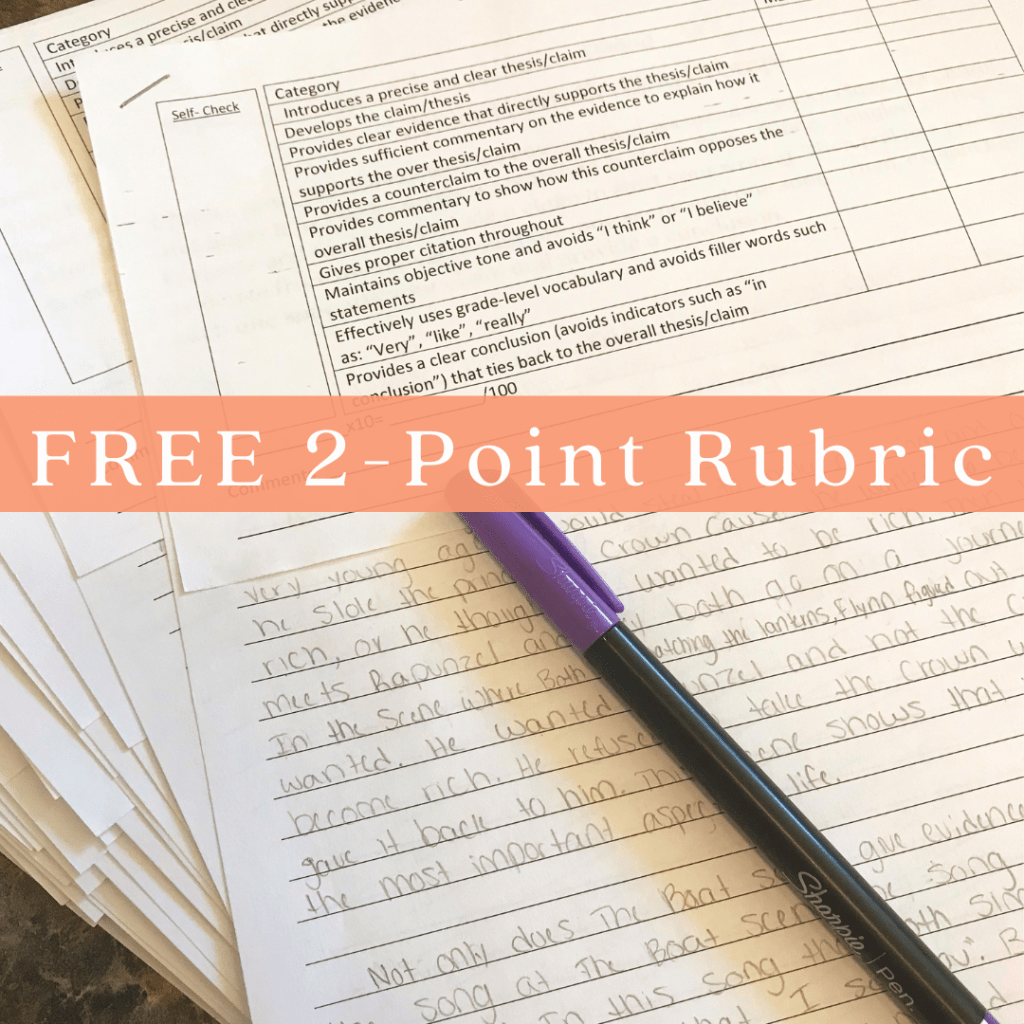
Ah, the timeless challenge of grading – a hurdle every English teacher faces. Even the most experienced educators can find themselves mired in the daunting task of grading AND providing meaningful feedback. Having explored various grading methods, some effective and others not so much, I stumbled upon a game-changer: 2-point rubrics. And let me tell you, it revolutionized everything for both me and my students!
In this post, I am going to share the reasons why 2-point rubrics are the greatest grading hack you wish you knew about years ago as well as a FREE rubric you can download now to check out.

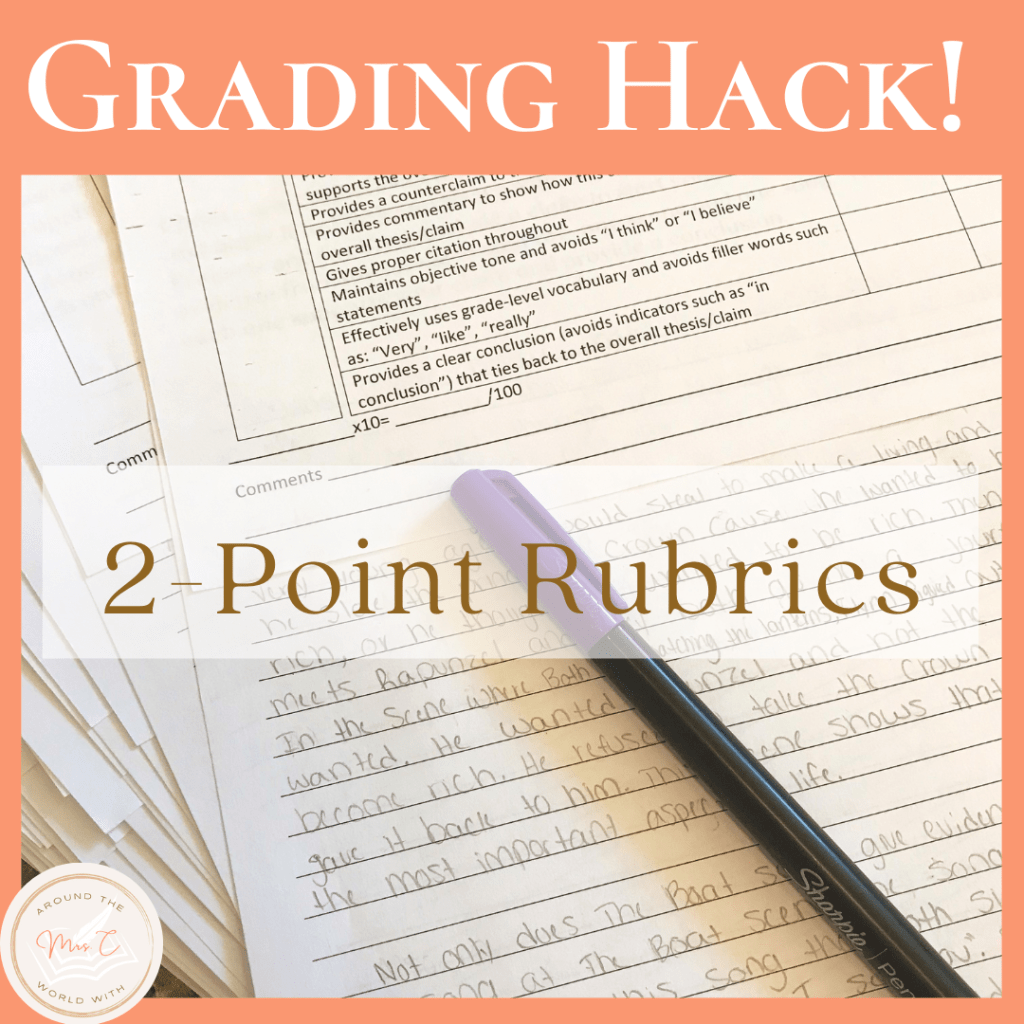
2-Point Rubrics from the Teacher POV
Using 2-point rubrics streamlined my grading. No more hemming and hawing on “Well, they KIND of did it…”.
No! You either did or you didn’t master it.
This shift made Reponses, benchmarks, and even essays easy peezy! I even found that I could easily be grading 10 or more essays with feedback in an hour!
To make this work, I took the standards I was working with and broke them down into the smallest possible pieces (think of them as micro learning targets).
For example, here is one standard in my state:
ELAGSE9-10RL2: Determine a theme and/or central idea of text and closely analyze its development over the course of the text, including how it emerges and is shaped and refined by specific details; provide an objective summary of the text.
That is a LOT of things being asked in ONE standard!
1) Theme statement
2) Analyzation of how it was developed
3) An objective summary.
However, I could go even deeper with the objective summary and how I know it should be structured as far as length, tone, and number of details required. I could honestly make at least 5 or 6 checkpoints for just this ONE standard.

So, for this ONE standard, I could make several learning targets. Such as:
- theme statement
- specific evidence from the text
- explanation of how the evidence ties to the theme statement.
- summarizing a text
- maintaining objective tone
From this point, I could start with mini lessons to scaffold these learning targets with informal assessments and then culminate in a written piece to conduct a summative assessment using the 2-point rubric. Students can then quickly see which learning target they need to master.
Using 2-Point Rubrics for Differentiation
2-point rubrics offer a personalized approach to instruction and feedback, catering to the unique needs of each student. You can also use this to quickly identify interventions your students may need and group them accordingly.
The language of 2-point rubrics also makes things simpler for your students. It can be hard to explain to a child with different learning needs how they “kind of” met a skill or standard. Several of our gifted and special needs students do not do well with ambiguity.
These students especially need clear-cut meanings of when they are completing a task or when they are not. This also frees up their bandwidth to know exactly what they need to work on. Having a clear plan of action, also leads to greater confidence in continuing the work on their own.
In case you haven’t thought about this yet, this can also streamline IEP data as well and make gathering these points and feedback for parents a much easier task!
The Power of 2-Point Rubrics from the Student POV
It helps students to hone in on what they did well and specifically what they still need to work on. No more ambiguity of “Well, you KIND of got there, but….”. Kids need specifics. “Yes, you nailed the theme statement, but you lacked sufficient evidence. So, go back and find specific evidence.” Nothing ambiguous about that!
This way students also spend more time working on areas that they need to instead of constantly feeling like they’re doing busy work with skills they already understand and have mastered.
Using these 2-point rubrics in short conferences helped to empower my students. Instead of seeing red all over their essay, they got to see clear and actionable steps to improving their writing. This lead to most of my students ACTUALLY DOING their revisions!
And we English teachers know how powerful it is when students learn from their mistakes and revise their work.
By having students staple their original rubric to their revisions, I also was able to quickly pin-point what areas were updated and this made grading revisions a manner of minutes!

A Win-Win
Once I moved to this style of grading, my students’ writing vastly improved. Because I was grading so quickly, it left more time to verbally conference about their skills. These conferences went far better than just giving back a paper with lots of written notes that most won’t pay attention to and learn from.
One fantastic way you can also approach this is with small group conferences. You can quickly see a specific learning target that several students still need help with and group them. This way, you can rotate through the groups with targeted mini lessons and practices. They can also work together and learn from each other while mastering the target.
Grab a FREE 2-Point Rubric to Get Started!
If this sounds like something you’d like to experience, I’d love for you to give it a try! Want a sample 2-point argumentative writing rubric for FREE? Click here! With this free download, you will receive a 2-point rubric that is perfect for your next argumentative writing prompt!