

There seems to be a divide in some circles of ELA teachers between content-based and skills-based instruction. However, there really doesn’t have to be. By providing our students with a rich thematic approach to a central text and a compelling essential question to anchor it in, we can do both!
In today’s post, I am sharing my thematic approach to Mary Shelly’s Frankenstein. If you are ready for a full unit that is READY TO GO, check this out!
The Essential Question: Are monster born or created?
First, we anchor our ideas around this question. This connects to the long-debated Nature vs. Nurture philosophies.
Nature vs Nurture is like asking whether someone’s traits come from their genes (nature) or from their environment and experiences (nurture). Imagine it like baking a cake: nature gives you the ingredients (like your genes), while nurture is how you mix and bake them (your environment and experiences), shaping who you become!
So, the question becomes are we more-so a product of our genes or of our environment. Would Frankenstein’s creation have had an entirely different path had his creator loved and cared for him? Or would he have ended up the same due to his “nature” of looking like a monster?
I suggest opening the unit with a discussion or journaling prompts on how students see this in their own lives. There are things about themselves that they were born with that make them who they are, but what are outside influences that have shaped them as well? Such as:
- where they were born
- where they were raised
- only child vs. siblings
- religious affiliations
- travel opportunities
- household income
Soon, they will start to see that what shapes us as a person is a far more complicated thing than they thought. Our genetics have a lot that plays into it, but so do the surrounding circumstances.
Close Reads in Frankenstein for Deeper Analysis
I love the original Frankenstein novel. However, I know it can be a bit dense. So, whether you are reading the traditional novel or the new graphic novel versions (I personally love this one), adding in close reads will help your students with a deeper analysis.
Close readings prompt students to analyze, evaluate, and reflect on the language used. This can help build vocabulary in addition to having students critically think on the essential question that has been posed.
Here are some of my top tips for close reading activities:
- Before beginning pretty much any new text, I provide a quick overview of anything that may be of important for context. For example, before diving into Frankenstein, I could share this presentation on Gothic Literature and this short video on the author, Mary Shelly, as well as a discussion on our essential question.
- Pick a particularly juicy portion of the text you want students to zero in on. This could be for a variety of reasons: conflict, vocabulary, figurative language, etc.
- To be highly effective, I keep this portion short- usually no more than 200-250 words.
- I identify any words that I think will be challenging, archaic, have double meanings, or are particularly important to the context of the the piece. I underline and bold those words.
- Before students even read the passage, they are to first annotate to the side what those words mean.
- Then I have students read the passage.
- Then students read the passage again with guiding questions that often incorporate those words as well as other details.
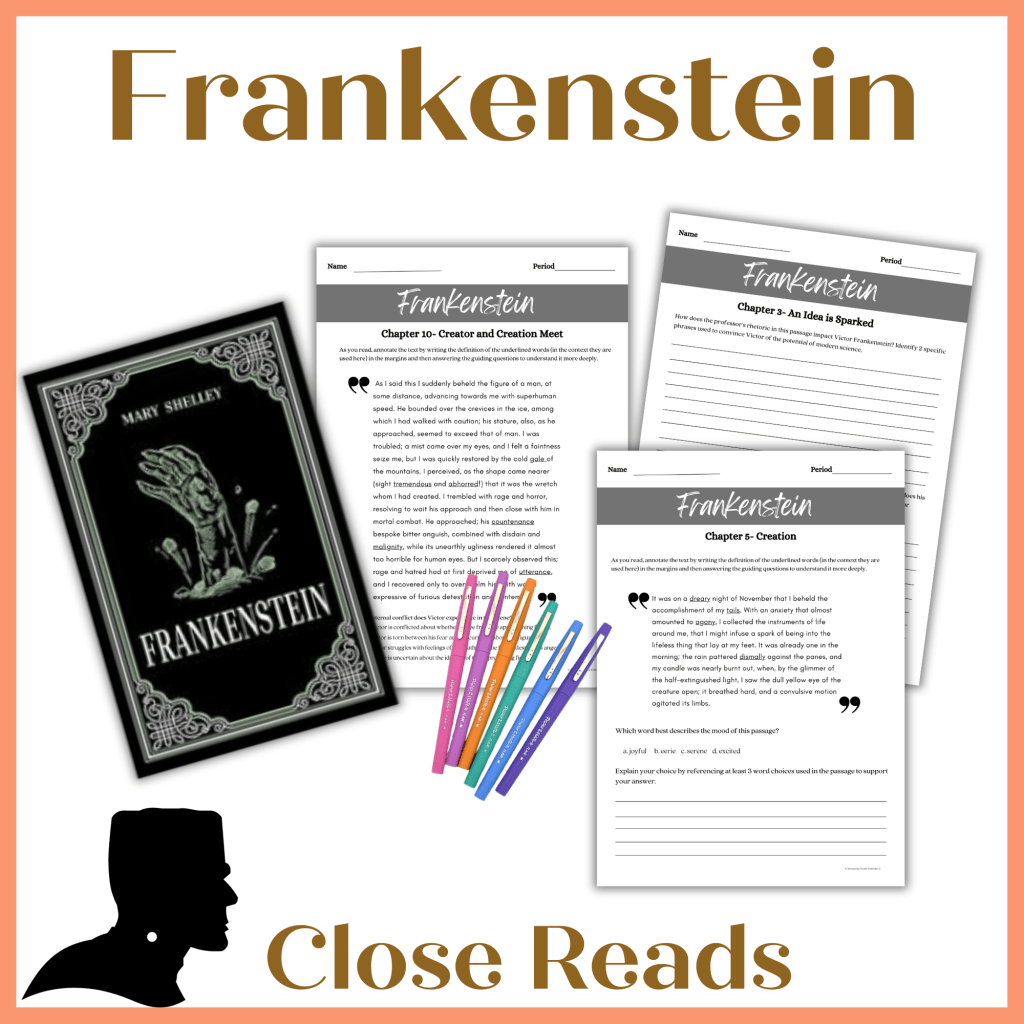
Having these guiding questions and thinking critically on the passage can then lead to discussions and tie-ins to the essential question.
Such as this passage of the Creation learning about humanity and the natural order of families that he never had.
“But where were my friends and relations? No father had watched my infant days, no mother had blessed me with smiles and caresses; or if they had, all my past life was now a blot, a blind vacancy in which I distinguished nothing. From my earliest remembrance I had been as I then was in height and proportion. I had never yet seen a being resembling me or who claimed any intercourse with me. What was I? The question again recurred, to be answered only with groans.”
With passages such as this, we can easily tie this back to whether or not the Creation would have turned into a monster if he had been cared for in such a manner.

With these close reads, you can encourage students to analyze character motivations and the consequences of their actions. They also help to facilitate discussions on the parallels between Victor Frankenstein’s creation and the broader implications of scientific ambition and ethical responsibility.
Incorporating Passages from Paradise Lost and Frankenstein
Exploring excerpts from John Milton’s “Paradise Lost” can deepen students’ understanding of the complex relationship between creator and creation as much of this poem relates to the timeless struggle between power, free will, and moral agency.
Milton tells a story about God, Satan, and people, making us think about who’s in charge and what it means to be free.
One big thing to look at is Satan. Milton paints him as a character who’s both bad and kind of sad (much like Frankenstein’s Creation). He wanted power so much he rebelled against God and got kicked out of heaven. This shows us how wanting too much can lead to trouble.

Then there’s Adam and Eve. They represent all of us, really. We see them making choices and dealing with the consequences. They mess up, but they also show that we have a say in what happens to us.
Milton also talks a lot about how amazing the world is, from the heavens to Eden to hell. It makes us think about where we fit into everything.
Mary Shelley’s “Frankenstein” connects to these ideas too. Just like in “Paradise Lost,” we see a creator making something and then dealing with the consequences. Victor Frankenstein creates his monster but then struggles with the responsibility of what he’s done. This connects to Milton’s themes of creation and the choices we make.
Real-World Connections: PBL Research Project on Nature vs. Nurture and Serial Killers

Circling around this question of monsters being made or born can lead to a fantastic real-world PBL project!
This question of nature or nurture has also been posed with serial killers over the last century. For so long the idea of “bad blood” was long believed. If you were bad, you were born that way. Somewhere in your genes there was bad blood.
However, in Mary Shelly’s time, Darwin’s theories were circulating and for the first time, people were really starting to question if it was really your genes that made you who you are OR was it something else?
Since then, so many studies have been conducted and they are interesting! In fact, back in 2010, the idea of the “murder gene” was used in a trial and resulted in a lesser sentence for a man who committed murder.
Having students dive into a quick PBL project on this topic leads to even deeper conversations and connections with Frankenstein and his monster.
Final Thoughts on Teaching Frankenstein Thematically

Anchoring your discussion in the essential question, “Are monsters born or created?”, close reads, textual pairings with scientific articles and literary pieces such as “Paradise Lost”, and intriguing research on serial killers are just a few of the ways that you can be approaching Frankenstein thematically!
You can find all of this and even more in my full Frankenstein unit.
Join my weekly newsletter!
Would you love to get weekly tips and resources for teaching secondary English delivered right to your inbox? Click here to join!
 Around the World With Mrs. C